Archive for diamond
You are browsing the archives of diamond.
What an active field!
Oxygen tolerance of an in silico-designed bioinspired hydrogen-evolving catalyst in water
(PNAS) Certain bacterial enzymes, the diiron hydrogenases, have turnover numbers for hydrogen production from water as large as 104/s. Their much smaller common active site, composed of earth-abundant materials, has a structure that is an attractive starting point for the design of a practical catalyst for electrocatalytic or solar photocatalytic hydrogen production from water. In earlier work, our group has reported the computational design of [FeFe]P/FeS2, a hydrogenase-inspired catalyst/electrode complex, which is efficient and stable throughout the production cycle. However, the diiron hydrogenases are highly sensitive to ambient oxygen by a mechanism not yet understood in detail. An issue critical for practical use of [FeFe]P/FeS2 is whether this catalyst/electrode complex is tolerant to the ambient oxygen. We report demonstration by ab initio simulations that the complex is indeed tolerant to dissolved oxygen over timescales long enough for practical application, reducing it efficiently. This promising hydrogen-producing catalyst, composed of earth-abundant materials and with a diffusion-limited rate in acidified water, is efficient as well as oxygen tolerant.
America’s Growing Minerals Deficit
(ProEdgeWire/WSJ) After every election, there’s a mad scramble in Washington over the must-make-it-happen agenda for the newly inaugurated president and Congress. There are welcome signs from the White House’s own Material Genome Initiative that securing America’s access to critical metals and minerals will be high on the list. A good thing, too. Jobs and capital increasingly flow to countries that command the resources to power modern manufacturing, and American manufacturing is more dependent on metals and minerals access than ever before. Yet there is no country on the planet where it takes longer to get a permit for domestic mining. Among other consequences of this red tape, there are now 19 strategic metals and minerals for which the U.S. is currently 100 percent import-dependent-and for 11 of them a single country, China, is among the top three providers.
Researchers developing nanosensor to detect CO2
Researchers at the Universities of Toronto and St. Francis Xavier, Canada, are developing an affordable, energy efficient and ultrasensitive nanosensor that has the potential to detect even one molecule of carbon dioxide. Current sensors used to detect CO2 at surface sites are either very expensive or they use a lot of energy. And they’re not as accurate as they could be. Improving the accuracy of measuring and monitoring stored CO2 is seen as key to winning public acceptance of carbon capture and storage as a greenhouse gas mitigation method. With funding from Carbon Management Canada, Harry Ruda of the Centre for Nanotechnology at UT and David Risk of StFX are working on single-nanowire transistors that should have unprecedented sensitivity for detecting CO2 emissions. CMC, a national network that supports game-changing research to reduce CO2 emissions in the fossil energy industry as well as from other large stationary emitters, is providing Ruda and his team $350,000 over three years. The grant is part of CMC’s third round of funding which saw the network award $3.75 million to Canadian researchers working on eight different projects. Risk is also using a CMC grant to work on marrying specialized sensor-housings, called forced diffusion chambers, with fiber-optic CO2 sensors.
Flat boron by the numbers: Rice researchers calculate what it would take to make new 2D material
It would be a terrible thing if laboratories striving to grow graphene from carbon atoms kept winding up with big pesky diamonds. “That would be trouble, cleaning out the diamonds so you could do some real work,” says Rice University theoretical physicist Boris Yakobson, chuckling at the absurd image. Yet something like that keeps happening to experimentalists working to grow two-dimensional boron. Boron atoms have a strong preference to clump into 3D shapes rather than assemble into pristine single-atom sheets, like carbon does when it becomes graphene. And boron clumps aren’t nearly as sparkly. Yakobson and his Rice colleagues have made progress toward 2D boron through theoretical work that suggests the most practical ways to make the material and put it to work. Earlier calculations by the group indicated 2D born would conduct electricity better than graphene. Through first-principle calculations of the interaction of boron atoms with various substrates, the team came up with several possible paths experimentalists may take toward 2D boron. Yakobson feels the work may point the way toward other useful 2D materials.
Diamond defects shrink MRI to the nanoscale
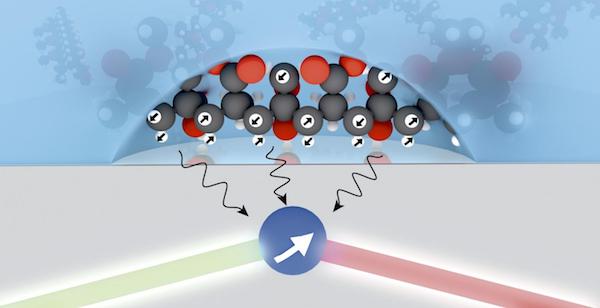
(Nature) Diamond-based quantum devices can now make nuclear magnetic resonance measurements on the molecular scale. Work by two independent groups will make it easier to find out the structure of single biological molecules such as proteins without destroying or freezing them. Nuclear magnetic resonance (NMR) and its close cousin magnetic resonance imaging (MRI) give information about a sample’s structure by detecting the weak magnetic forces in certain atomic nuclei, such as hydrogen. They work by detecting how molecules collectively resonate—like guitar strings that vibrate together—with electromagnetic waves of specific wavelengths. The techniques provide information about the structure of samples without damaging them, which is particularly important if the sample is a human body. But to some researchers, whole bodies are less interesting than the molecules that they are made up of. “I want to push NMR and MRI to the molecular level,” says Friedemann Reinhard, a physicist at the University of Stuttgart in Germany. His team is one of two that have used NMR to detect hydrogen atoms in samples measuring just a few nanometres across. The second team was led by Daniel Rugar, manager of nanoscale studies at IBM’s Almaden Research Center in San Jose, Calif. Both studies are published in Science.
A safer next-gen battery is used with solar panels for the first time
(GigaOm) But the next generation of lithium ion batteries are promising to be safer, and a few of them are already starting to be used in real-world situations in the power grid, electric vehicles and gadgets… So what makes Seeo’s batteries safer? It largely involves improvements to the electrolyte, or the medium that shuttles lithium ions back and forth between the cathode and the anode to charge and discharge the battery. Traditional lithium-ion battery electrolytes are mostly made of liquids, while Seeo is using a solid dry polymer based electrolyte, which feels like plastic to the touch. The polymer is non-flammable and when combined with using lithium foil as the anode, the battery can be ultra light weight and also have a high energy density, or amount of energy that can be stored per a given weight. If traditional lithium ion batteries are overcharged they can have a margin of error in the danger zone of about 20 percent above the max voltage of the battery, explained Zarem. In contrast, Seeo batteries have a margin of error of 100 percent over the voltage. The batteries also won’t burst into flames if something penetrates it (for example, during a car crash).
Check ‘em out:
Five years after I-35 collapse, big leap in bridge sensors
(Futurity) Five years after the deadly I-35W bridge collapse in Minneapolis, advances in sensors are making warning systems more affordable and practical. A new generation of these devices is needed to adequately monitor the nearly 150,000 US highway bridges, about one-in-four listed by the federal government as either “structurally deficient” or “obsolete,” say researchers at the University of Maryland. “We no longer need to roll the dice when it comes to the structural integrity of the nation’s highway bridges,” says engineer Mehdi Kalantari. “Technical advances in wireless sensors make real-time monitoring both affordable and practical.” Kalantari leads one of two engineering teams developing a system of tiny, long-lasting, energy-efficient, low-maintenance wireless sensors, along with software that analyzes real-time data collected. Another University of Maryland engineering team is working on a total “smart bridge” package with multiple technology innovations. While the system is not yet available commercially, key elements are being tested by Maryland State Highway officials, the Maryland Transportation Authority, and the North Carolina Department of Transportation.
Chimera Energy develops fracking technique that uses no water
(GizMag) Chimera Energy Corporation of Houston, Texas, has announced that they are licensing a new method for extracting oil and gas from shale fields that doesn’t contaminate ground water resources because it uses exothermic reactions instead of water to fracture shale. Some fracking engineers prefer non-hydraulic methods. One of these, used recently in New York State, swaps the water for gelled propane. The idea being that the propane reverts to a gas at the end of the process and can be pumped out, leaving any additives behind in the well, much like boiling seawater and leaving behind the salt. Chimera Energy uses what is called “dry fracturing” or “exothermic extraction.” First developed in China, this involves using hot gases rather than liquid to fracture the shale. In dry fracturing, metal oxides, ultraexpansive evaporants and pumice are pumped into the well. The metal oxides react with one another to form an exothermic reaction. Extremely hot gases are generated that expand and crack the shale. Meanwhile, the pumice shoots in and reinforces the fractures, keeping them from closing and allowing the gas or oil to flow. Chimera Energy claims that not only is the technique environmentally safe, but that it is compatible with any existing well in the world.
Transparent solar cells for windows that generate electricity
Scientists are reporting development of a new transparent solar cell, an advance toward giving windows in homes and other buildings the ability to generate electricity while still allowing people to see outside. Their report appears in the journal ACS Nano. Yang Yang, Rui Zhu, Paul S. Weiss and colleagues explain that there has been intense world-wide interest in so-called polymer solar cells, which are made from plastic-like materials. They describe a new kind of PSC that produces energy by absorbing mainly infrared light, not visible light, making the cells 66 percent transparent to the human eye. They made the device from a photoactive plastic that converts infrared light into an electrical current. Another breakthrough is the transparent conductor made of a mixture of silver nanowire and titanium dioxide nanoparticles, which was able to replace the opaque metal electrode used in the past. This composite electrode also allowed the solar cell to be fabricated economically by solution processing. The authors suggest the panels could be used in smart windows or portable electronics.
Nikkei reports Japan-China JVs for rare-earth magnets foundering on Japanese regulations
(Green Car Congress) The Nikkei reports that joint ventures being planned by Japan-based TDK Corp. and Hitachi Metals Ltd. to make powerful magnets in China have foundered due to Japanese regulations that will complicate the necessary exports and technology transfers. In essence, the projects have been caught in the trade diplomacy crossfire over Chinese restrictions on exports of rare-earth metals, which are vital for making powerful magnets. The longer the dispute rages, the greater the chance of trouble for production of hybrid cars and other items containing these magnets.
Diamond in the rough: Half-century puzzle solved; M-carbon damages diamond
A Yale-led team of mineral physicists has for the first time confirmed through high-pressure experiments the structure of cold-compressed graphite, a form of carbon that is comparable in hardness to its cousin, diamond, but only requires pressure to synthesize. The researchers believe their findings could open the way for a super hard material that can withstand great force and can be used - as diamond-based materials are now - for many electronic and industrial applications. Under normal conditions, pure carbon exhibits vastly different physical properties depending on its structure. For example, graphite is soft, but diamond is one of the hardest materials known. Graphite conducts electricity, but diamond is an insulator. In the middle is the form of carbon confirmed by the Yale-led team, dubbed M-carbon and predicted by theoretical methods initially in 2006. M-carbon is made when graphite is compressed to pressures approximately 200,000 times room pressure, at room temperature. Researchers say this intermediate structure has much lower symmetry than diamond, but is as hard. In fact, “Our study shows that M-carbon is extremely incompressible and hard, rivaling the extreme properties of diamond so much that it damages diamond,” says principal investigator Kanani K.M. Lee, assistant professor of geology and geophysics at Yale.
Something should be of interest here:
Quantum computer built inside a diamond
(USC News) Diamonds are forever - or, at least, the effects of this diamond on quantum computing may be. A team that includes scientists from USC has built a quantum computer in a diamond, the first of its kind to include protection against “decoherence” - noise that prevents the computer from functioning properly. Like all diamonds, the diamond used by the researchers has impurities - things other than carbon. The more impurities in a diamond, the less attractive it is as a piece of jewelry because it makes the crystal appear cloudy. The team, however, utilized the impurities themselves. A rogue nitrogen nucleus became the first qubit. In a second flaw sat an electron, which became the second qubit. (Though put more accurately, the “spin” of each of these subatomic particles was used as the qubit.)
US has become dangerously dependent on imports of raw materials that are needed to keep economy moving.
(Detroit News) US manufacturers are now more than 40 percent dependent on imports of many commodity and rare earth metals.For example, import reliance on gallium is at 94 percent, cobalt and titanium 81 percent, chromium 56 percent, silicon 44 percent and nickel 43 percent. These minerals are critical for defense and energy technologies and many high-tech consumer products. Consider nickel, which is needed in the manufacture of stainless steel and electricity storage batteries, among other things. Oregon has the only US mine producing nickel. Almost all of the domestic nickel comes from recycling alloys containing nickel. Now, thanks to a $100-million-plus investment by Rio Tinto, the Eagle nickel mine in Michigan’s Upper Peninsula is expected to open in 2014, producing 16,000 tons of nickel and 10,000 tons of copper.
Atom-by-atom nucleation and growth of graphene nanopores
(PNAS) Here we demonstrate a scalable method for creating extremely small structures in graphene with atomic precision. It consists of inducing defect nucleation centers with energetic ions, followed by edge-selective electron recoil sputtering. As a first application, we create graphene nanopores with radii as small as 3 Å, which corresponds to 10 atoms removed. We observe carbon atom removal from the nanopore edge in situ using an aberration-corrected electron microscope, measure the cross-section for the process, and obtain a mean edge atom displacement energy of 14.1 ± 0.1 eV. This approach does not require focused beams and allows scalable production of single nanopores and arrays of monodisperse nanopores for atomic-scale selectively permeable membranes.
A final answer on how high-temperature superconductors don’t work?
(Science) Some physicists argue that phonons must still play a key indirect role in high-temperature superconductors. And experiments have shown that the phonons and electrons do interact in the compounds. Now, Claudio Giannetti of the Catholic University of the Sacred Heart in Brescia, Italy, and a dozen colleagues report data that, they say, show that electrons alone tell the whole story. They shined pulses of laser light onto a high-temperature superconductor called bismuth strontium calcium yttrium copper oxide (BSCCO) to study how the material reflects light at various wavelengths,
Superconductive sodalite-like clathrate calcium hydride at high pressures
(PNAS) We show that in the stoichiometry CaH6 a body-centered cubic structure with hydrogen that forms unusual “sodalite” cages containing enclathrated Ca stabilizes above pressure 150 GPa. The stability of this structure is derived from the acceptance by two H2 of electrons donated by Ca forming an “H4” unit as the building block in the construction of the three-dimensional sodalite cage. This unique structure has a partial occupation of the degenerated orbitals at the zone center. The resultant dynamic Jahn-Teller effect helps to enhance electron-phonon coupling and leads to superconductivity of CaH6. A superconducting critical temperature (Tc) of 220-235 K at 150 GPa obtained from the solution of the Eliashberg equations is the highest among all hydrides studied thus far.
Hydrogen storage could be key to Germany’s energy plans
(MIT Technology Review) If Germany is to meet its ambitious goals of getting a third of its electricity from renewable energy by 2020 and 80 percent by 2050, it must find a way to store huge quantities of electricity in order to make up for the intermittency of renewable energy. Siemens says it has just the technology: electrolyzer plants, each the size of a large warehouse, that split water to make hydrogen gas. The hydrogen could be used when the wind isn’t blowing to generate electricity in gas-fired power plants, or it could be used to fuel cars. Unlike conventional industrial electrolyzers, which need a fairly steady supply of power to efficiently split water, Siemens’s new design is flexible enough to run on intermittent power from wind turbines.
Left, prototype of SOFC stack. Right, samples of interconnects being developed in a public–private partnership with Alfred University, Solid Cell, RocCera and the the New York State Energy Research and Development Authority. Credit: Solid Cell.
Alfred University recently announced two interesting projects where their ceramics and glass experts are working with private-sector partners that could have significant impact the energy and sensor fields.
The first project involves a AU collaborating with a company called Solid Cell in a New York state-funded project to improve solid oxide fuel cells. The university’s Olivia Graeve will be, in particular, working with Solid Cell to lead research to develop improved SOFC interconnects.
These interconnects serve to physically separate but electrically connect the electrodes in SOFCs. The challenge to make durable interconnects has been a major hurdle in developing and commercializing SOFCs, which operate at very high temperatures (typically 800°C or higher) in an environment filled with caustic chemicals that can attack and weaken all but the toughest materials.
Metals alloys, until recently, have been the go-to material for interconnects, but so far they frequently fail at the high temperature regimes. Efforts are being made to reduce SOFC operating temperatures to 600°C or lower, but in the meantime many SOFC developers, such as Solid Cell, are interested in alternatives to metal alloy interconnects.
Graeve also teaches materials science and engineering at the Inamori School, and her group’s work will be to find a ceramic alternative. ”This project with Solid Cell is very synergistic and takes advantage of our expertise areas in a very meaningful way,” she says in an email.
The idea is that ceramic materials are highly durable at high temperatures and can be formulated to be both conductive and resistant to chemical attack. This is apparently part of a ongoing joint effort. According to a 2011 Solid Cell release, the goal at that time was to “demonstrate the feasibility of replacing traditional ceramic powder synthesis with a low-cost process. The proprietary technology will reduce the time, energy and handling requirements of synthesis, while producing a nanopowder with improved physical properties.” A Solid Cell representative, Arkady Malakhov, explains that this new project is an extention of prior work, moving from feasibility to actual production of the interconnets.
The work is being funded by the New York State Energy Research and Development Authority, and also includes the involvement RocCera, which is assisting with fabrication technology
For more information on the interconnects topic, Solid Cell has available online the presentation it made a few months ago at ACerS’s ICACC’12 conference in Daytona Beach.
Sacrificial substrate for diamond nanocoating
In the second example, S.K. Sundaram and Scott Misture, professors at the school, are working with Group4 Labs Inc. to create a system to provide a sacrificial substrate that will be just one part of a novel technology that adds a thin diamond coating to semiconductors to hasten heat extraction. Group4 Labs wants to be able to use this new system on solid-state lighting, sensing and communication applications.
The task undertaken by Sundaram and Misture, both Inamori Professors of materials science in AU’s Kazuo Inamori School of Engineering, is to devise a substrate that — once removed — will allow a micrometer-sized layer of diamond coating to attach to the semiconductor surface. The diamond coating, in turn, then will act as a substrate additional coatings.
The trick is to find a way to get the diamond to stick to the substrate, and, here, the key is to find an inexpensive substrate with a thermal expansion coefficient that matches the diamond. In other words, the diamond and the substrate must be able to undergo the same thermal expansion and contraction or else one of the materials will separate and crack. Once the diamond-substrate is sandwiched with the semiconductor material, the substrate is carefully removed, leaving the diamond coating behind.
According to an AU news release, Misture and Sundaram think that cordierite glass-ceramics will likely be the candidate for the substrate because it and the diamond have compatible thermal expansions. In addition, both have chemical and thermal stability during processing. The release notes, “Misture and Sundaram hope to accomplish that by manipulating the glass chemistry and controlling a specific crystal phase’s crystallizing out.”
Group4 Labs, based in Fremont, Calif., is something of startup company that is attempting to leverage gallium-nitride-on-diamond technology to (according to the company’s website) and says its GaN-on-diamond can reduce transistor temperatures by over 500°C and thereby improve power output and efficiency. The company has been working on a joint LED project in New York State, but also recently announced that it will be partnering in four DARPA contracts related to “Near Junction Thermal Transport” with the goal of “address thermal hurdles and energy efficiency in the 21st century where energy consumption is costly and unsustainable.”