
Posts by Lisa McDonald
Reducing aggregate toxicity: Graphene oxide may aid in treatment of Alzheimer’s disease

In vitro studies have demonstrated the potential of graphene oxide to help treat Alzheimer’s disease by preventing the buildup of harmful amyloid-β aggregates. Researchers in Sweden and Denmark used yeast as a model system to explore graphene oxide’s potential in vivo.
Read MoreCeramic and glass business news of the week for October 30, 2023

Malaysia witnesses the launch of its first university–industry research consortium, GPI makes glass quality case for bottle bills, and more ceramic and glass business news of the week for October 30, 2023.
Read MoreA new way to self-heal: Electron beam radiolysis drives crack repair in titanium dioxide

Ceramic materials that can self-heal cracks would help reduce maintenance and inspection costs while enhancing component reliability and lifespan. Researchers at the University of Minnesota Twin Cities made a counterintuitive discovery of a new way to self-heal cracks in ceramics—through electron beam radiolysis.
Read MoreVideo: Chocolate pots—serving luxury in the 17th and 18th centuries

As chocolate became a fashionable beverage throughout Europe in the 17th century, it became big business to design and sell cookware specifically designed for preparing chocolate. Learn about the European chocolatière, or chocolate pot, in today’s CTT.
Read MoreOther materials stories that may be of interest for October 25, 2023

Harnessing piezoelectrics to regrow neurons, diamonds for UV photodetection, and other materials stories that may be of interest for October 25, 2023.
Read MoreMitigating crack formation—electron-rich metals increase the fracture resistance of ceramics
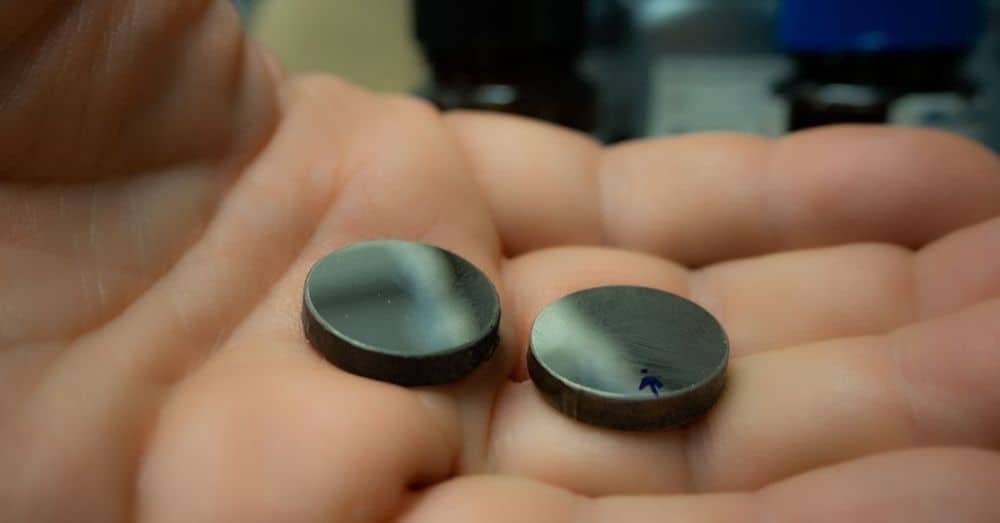
The arrangement and movement of electrons within a ceramic material has the potential to greatly influence its resistance to brittle fracture. Researchers at the University of California, San Diego and Linköping University published an open-access paper demonstrating the effect that electronic structure has on plastic deformation in high-entropy carbides.
Read MoreCeramic and glass business news of the week for October 23, 2023
Apply Carbon establishes mass recycled carbon fiber production facility, Lynas to upgrade Malaysian rare earth refinery amid dispute over operating license, and more ceramic and glass business news of the week for October 23, 2023.
Read MoreNanoscale goldbeating: Ancient Egyptian technique adapted for fabricating 2D thin films

Two-dimensional thin films are often fabricated using bottom-up solution-based techniques, such as electrochemical deposition and atomic layer deposition. Now researchers have reported a top-down, solid-state method based on the age-old Egyptian craft of goldbeating that they say is generalizable to various metallic, polymeric, or ceramic nanoparticles.
Read MoreVideo: California bans the use of fiberglass as a flame retardant in mattresses and upholstered furniture

As the health effects of chemical flame retardants became more well known, the use of fiberglass as a flame-retardant material grew in popularity. However, fiberglass comes with its own share of adverse health effects, and the U.S. state of California has now enacted a ban on its use as a flame retardant in mattresses and upholstered furniture.
Read MoreOther materials stories that may be of interest for October 18, 2023
MOF coatings prevent implant infection, extract uranium from seawater, and other materials stories that may be of interest for October 18, 2023.
Read More