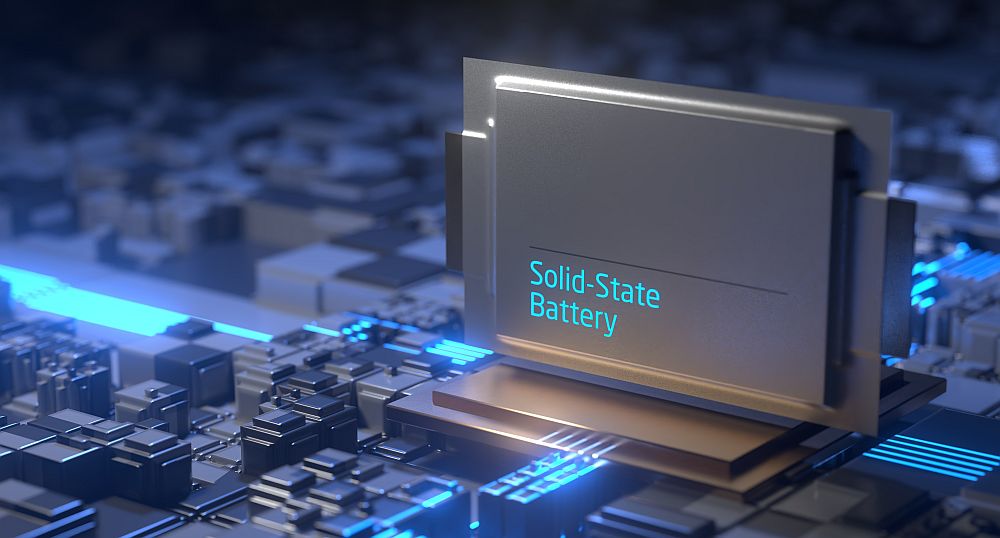
[Image above] Illustration representing the future of solid-state batteries. Credit: JLStock / Shutterstock
The groundwork for solid-state batteries has been laid for decades, but the incentive to act on that potential really only picked up in the past 15 years. Now, this much-anticipated technology is on the cusp of its market revolution, as demonstrated during this year’s CES.
CES is one of the largest consumer technology trade shows, held each January in Las Vegas. This year, CES took place January 6–9 and welcomed more than 148,000 attendees and more than 4,100 exhibitors.
During the four-day event, several companies presented solid-state battery technologies for various applications. View the highlights below.
Ultraslim mobile charging through SolidSafe Air
Solid-state batteries have the potential to be smaller than traditional lithium-ion batteries because their solid electrolyte doubles as the separator, which helps eliminate bulky components. At CES 2026, Better Mobile Xperience (BMX) demonstrated this potential with its new SolidSafe Air power banks.
BMX is a mobile accessory brand launched by the original founders of Hyper, the popular accessories brand for Apple devices. Its SolidSafe power banks make use of a semi-solid-state electrolyte to charge mobile phones. Compared to other power banks in the SolidSafe series, the new Air model is the slimmest, with the 5,000 mAh version measuring a mere 6.8 mm thick. (Learn about other unique features of the Air model in this video.)
The SolidSafe Air power banks are expected to be available for shipping from the BMX website by the second quarter of 2026.
Superfluidized solid-state battery breakthrough marks ProLogium’s 20th anniversary
ProLogium Technology is a Taiwan-based energy innovation company focused on lithium ceramic battery research, development, and manufacturing. Ahead of CES 2026, the company announced it would unveil its new “Superfluidized All-Inorganic Solid-State Lithium Ceramic Battery” technology at the show as part of its 20th anniversary celebrations.
The company also said it would be working with Germany’s FEV Group and Taiwan’s Darfon Energy Tech to use the new battery in electric bicycles and light vehicles, projects which “reflect our collaboration with leading customers to bring safer, higher-energy, and more environmentally adaptive technologies into mass production and real-world deployment,” says Vincent Yang, founder and CEO of ProLogium, in the announcement.
Fast-charging electric motorcycle sparks excitement—but also skepticism
Electric vehicles are one of the most highly anticipated uses of solid-state batteries to enhance safety and range compared to current EVs. Estonian startup Donut Lab presented a solid-state-battery-powered electric motorcycle from its partner firm Verge at CES 2026, but the supposedly revolutionary product soon met with skepticism online.
Donut Lab’s website claims that the solid-state battery can charge in five minutes, reach densities close to 400 Wh/kg, and successfully undergo 100,000 charge cycles. But these characteristics go “directly against many of the known trade-offs between stability, degradation, and safety,” notes a Medium article. Furthermore, the company offers “little information about manufacturing processes, no independent validations, and marketing-oriented communication,” the Medium article states.
Ultimately, “the Donut Lab case is an excellent reminder that deep innovation always lives in an awkward zone between disbelief and hope,” the Medium article concludes. “Today we are not facing conclusive proof that solid batteries have arrived, but neither is this necessarily smoke and mirrors. This is an extraordinary statement that requires extraordinary evidence. And that evidence, if it exists, will soon be available.”
Even though the electric motorcycle application is under scrutiny, some companies at CES 2026 announced plans to use Donut Lab’s solid-state battery technology for other purposes. For example, ESOX Group confirmed it is working under a defense-specific licensing framework to deploy the technology across military and security applications, such as drones and unmanned ground vehicles.