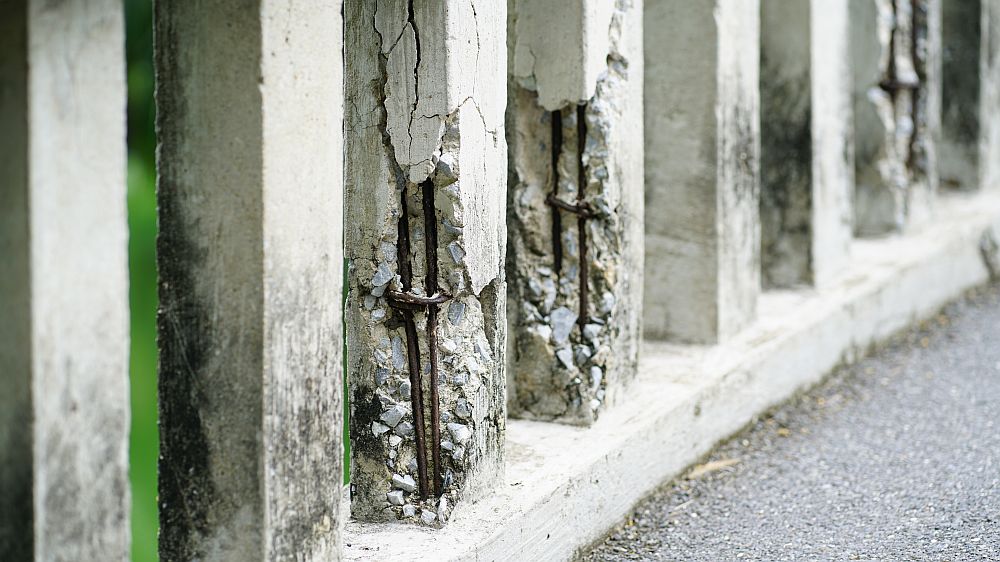
[Image above] Example of damaged old concrete pillars. Although current standards for concrete cracking are based on external loads, most cracks are caused by restraining the concrete’s environmentally induced volume changes. Credit: Tharnapoom Voranavin / Shutterstock
When planning against possible threats, many organizations often focus on those from external sources. But even though external threats are typically easier to visualize and defend against, internal threats can sometimes be more common and damaging, and so require their own set of specially designed solutions.
This mentality toward external versus internal threats can also be seen in how safety standards for different materials are designed. For example, consider reinforced concrete structures. Concrete is the most widely used human-made material on Earth, serving as the foundation of transportation networks, housing, industry operations, and energy generation, among many other uses. If concrete structures fail, it can put many lives and operations at risk.
Cracking is the most common form of damage in concrete structures, and it serves as a gateway for water infiltration, corrosion of steel reinforcement, and premature collapse. So, methods to effectively monitor and control crack width in concrete structures are vital to safely enable long-term service of concrete structures.
Current standards for monitoring crack width make heavy use of formulations originally developed for load-induced cracking. In other words, the standards predict crack initiation and growth based on external forces. However, cracks in concrete structures are mainly a result of volume changes in the concrete itself.
Moisture loss, hydration, and temperature fluctuations can cause concrete to shrink or contract. But external structures or internal reinforcement can restrict the concrete’s movement, generating tensile stresses that exceed the concrete’s tensile strength, resulting in cracks.
Because current standards do not capture the mechanics of this restraint-induced cracking, researchers such as ACerS member Agnieszka Jędrzejewska have spent years working to develop better models. Jędrzejewska is associate professor and deputy head of the Department of Structural Engineering at Silesian University of Technology in Poland. She has contributed significantly to the literature on restraint-induced cracking in reinforced concrete structures, notably through work with RILEM Technical Committees 254-CMS and 287-CCS.
In February 2025, Jędrzejewska gave a lecture as part of the ACerS Cements Division Rising Star Webinar Series on hydration-induced cracking of reinforced concrete structures. During the event, she met Kamran Aghaee, assistant professor of mathematics, engineering, and computer science at West Virginia State University. Aghaee specializes in using machine learning methods to study cementitious materials, and “We quickly realized that his perspective could open new ways of looking at familiar problems,” Jędrzejewska says in a LinkedIn post.
Jędrzejewska then invited Mariusz Zych, associate professor of civil engineering at Cracow University of Technology in Poland, to work with her and Aghaee. She has collaborated with Zych on numerous projects over the past decade involving in-situ measurements of restraint-induced cracking, and so she knew he could provide valuable support to this new collaboration.
The three researchers scoured the literature and compiled a dataset containing nearly 200 studies on restraint-induced cracking in externally restrained reinforced concrete structures. They then employed several machine learning algorithms, including linear regression, decision trees, random forest, and XGBoost, to see which could most accurately forecast the restraint-induced crack width.
Among the algorithms, random forest and XGBoost exhibited the most robust performance—their predictive capacity on the test set reached an R2 up to 0.74. Inherent database inhomogeneity arising from the scarcity, variability, and complexity of in-situ measurements constrained the prediction accuracy, but “Despite these challenges, the ML [machine learning]-based predictions outperform standardized models of Eurocode 2, CIRIA C766, and ACI 207 and ACI 224,” the researchers write.
While the paper itself is a meaningful outcome of the collaboration, also notable is the database of the nearly 200 laboratory and field cases, which the researchers uploaded to the open repository Zenodo so it can be accessed by anyone in the cements and concrete community.
In her LinkedIn post, Jędrzejewska says that while working with machine learning was never her original plan, this collaboration “gave me a very concrete understanding of its strengths and limitations and made me even more convinced that we need structured knowledge and semantic technologies for meaningful reasoning in structural engineering.”
The paper, published in Journal of Building Engineering, is “Machine learning-based prediction of restraint-induced crack width in reinforced concrete structures” (DOI: 10.1016/j.jobe.2025.115137).