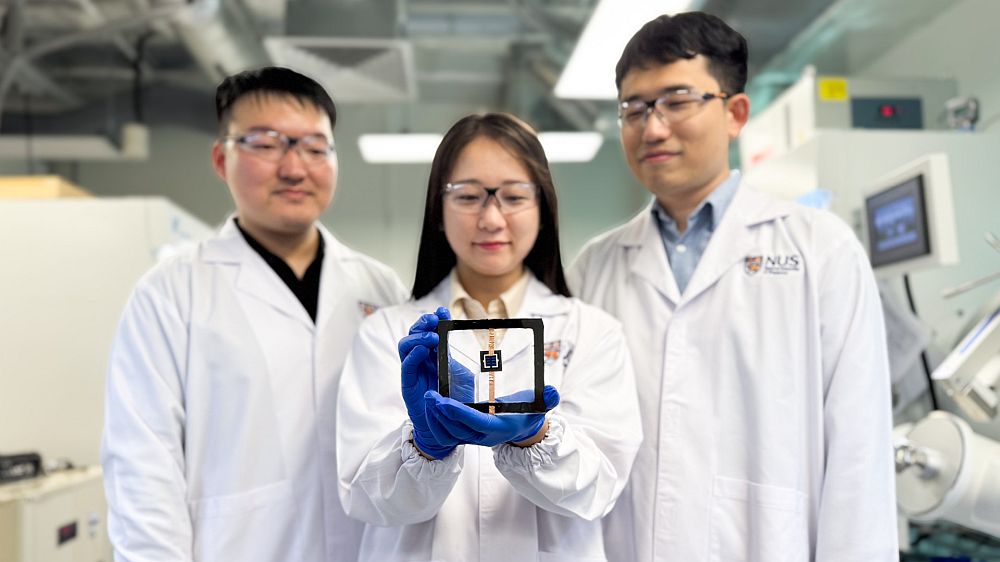
[Image above] National University of Singapore researchers Zhang Boxue (left), Park Somin (middle) and Wei Mingyang (right) cross-linked the hole-selective molecular contact layer in perovskite–silicon tandem solar cells to enhance the cells’ stability. Credit: National University of Singapore
The race continues to increase efficiencies of solar cells, and records continue to be claimed for those based solely on silicon, such as here and here. But standard silicon cells can only take us so far, so researchers are also looking at a myriad of other materials to boost efficiency.
One class of materials, perovskites, shows promise. When these materials are combined with silicon to make tandem cells, efficiencies of nearly 35% have been achieved.
However, the long-term stability of these tandem cells remains a challenge due largely to perovskites’ weakness to ultraviolet light and moisture. Long-term stability is critical for commercialization, as most silicon solar panels on the market have warranties of 20 to 25 years.
A lot of work has gone into stabilizing the perovskite layer in tandem solar cells, such as by adding buffer layers, performing passivation treatments, or encapsulating the module. But this layer is not the only culprit for a tandem cell’s low stability—the ultrathin contact layer linking the perovskite to the silicon is also a pain point.
In tandem solar cells, the perovskite layer is placed on top of the crystalline silicon layer. The perovskite layer absorbs higher-energy light, while the silicon layer below captures lower-energy light, thus increasing efficiency.
Between these two cells is an ultrathin layer composed of organic molecules called the hole-selective molecular contact. This layer helps move electrical charge between the perovskite and silicon layers by extracting positive charge carriers (holes) while blocking negative charge carriers (electrons).
Around 2018, self-assembled monolayers (SAMs) increasingly started being used as the hole-selective contact. Specifically, SAMs based on phosphonic acid helped achieve record-setting performance in tandem devices. However, these SAMs can have stability issues from chemical decomposition, desorption, and weak interfacial adhesion, so there is reason to explore alternative materials for the contact layer.
A recent study by researchers from the National University of Singapore(NUS) aimed to understand better how the hole-selective contact layer affects the stability of perovskite–silicon tandem solar cells. They started this analysis by using accelerated aging tests at 65°C to identify the cells’ degradation mechanisms.
After measuring charge transport through the cell, the researchers determined that phosphonic acid-based SAM contact layers degraded under heat through a mechanism called dominant transport degradation, losing their orderly structure (confirmed through X-ray diffraction) and disrupting the flow of current. They observed a spatially uniform decline in conductivity upon heat exposure, which correlated with contact failure and thus performance losses over time.
The researchers attributed the reduced monolayer conductivity to partial molecular desorption and aggregation, which led to a disordered conjugated network. Notably, no morphological degradation was seen in the perovskite layer after similar aging conditions, which is counter to previous studies that mostly attributed performance loss to the perovskite material itself.
To stabilize the interfacial structure and reduce thermal degradation, the researchers introduced an improved version of the SAM based on cross-linked molecular contacts. They cross-linked the primary amines in the SAM with aldehyde-functionalized bipyridine molecules, which resulted in a tightly bound layer that resists heat and maintains its structure during operation.
The researchers fabricated one-square-centimeter tandem solar cells incorporating the cross-linked contact layer. The contact layer was anchored to the cell using an indium zinc oxide layer, which ensured homogeneous coverage.
The cross-linked tandem cells achieved power conversion efficiencies exceeding 34% (33.61% certified) and retained more than 96% of their initial performance after 1,200 hours of continuous illumination at 65°C. A NUS press release notes that this level of durability is unusual in perovskite-based solar cells and demonstrates the cross-linking strategy’s ability to not only stabilize the contact layer but also improve interfacial passivation and perovskite film quality.
Another major advantage of this approach is its simplicity, which improves cell reliability without adding more steps to the manufacturing process. The researchers consider it a breakthrough for achieving long-term stability.
“Our work helps bridge the gap between laboratory performance and real-world reliability,” says coauthor Mingyang Wei, assistant professor in the Department of Materials Science and Engineering at NUS, in the press release.
Wei says their next goal is to test these prototypes under actual tropical conditions and then scale them up to module sizes suitable for deployment. Notably, “Testing in Singapore’s hot and humid climate will be particularly helpful, as such conditions accelerate material degradation and provide a rigorous test of durability,” he says.
The paper, published in Science, is “A cross-linked molecular contact for stable operation of perovskite/silicon tandem solar cells” (DOI: 10.1126/science.ady6874).