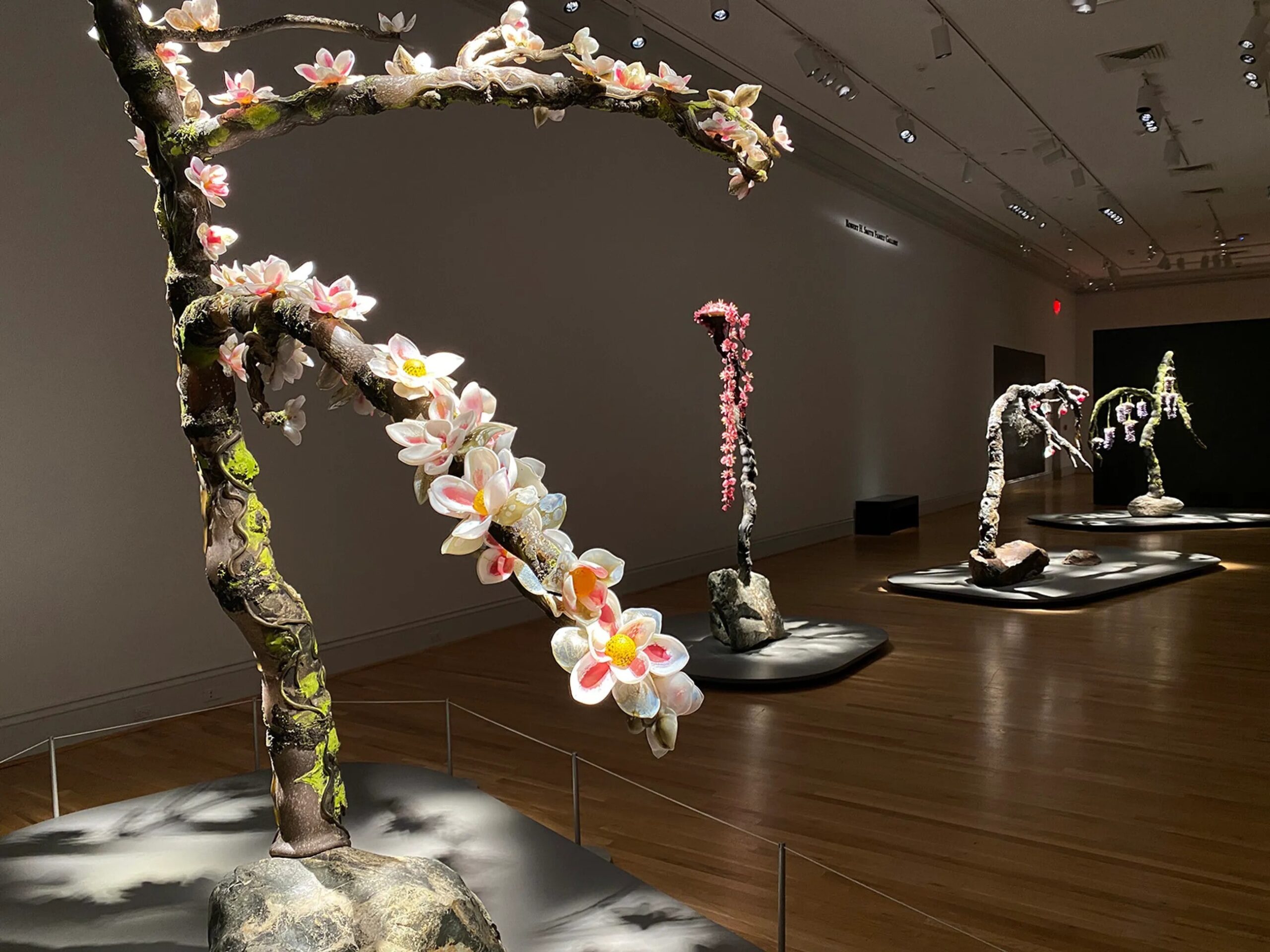
[Image above] An installation photograph of Debora Moore’s glass trees from Forces of Nature: Renwick Invitational 2020. Credit: Ashley Reese, Smithsonian American Art Museum
These past two weeks have covered much of the United States in deep piles of snow and ice, causing many of us to yearn for the sun-filled days of spring. Unfortunately, we are still a few weeks away from the first spring buds gracing us with their presence (maybe longer if the groundhog is to be believed).
Public conservatories offer one way to escape the frigid climate and embrace dreams of a tropical getaway with their collections of exotic plants. Though this option is typically limited to larger cities, there is another way for people to experience the beauty of spring in a climate-controlled environment—art museums.
Flowers are an enduring theme in art history, inspiring artists from Vincent van Gogh to Alma Thomas. Though the depiction of flowers in art has evolved dramatically across cultures and centuries, floral motifs continue to carry profound meaning while showcasing artistic innovation and technique.
The Glass Flowers collection by Bohemian father-and-son glass artists Leopold Blaschka and Rudolf Blaschka is a prime example of the skillful ways in which artists can capture the ephemeral nature of flowers. Over 50 years, from 1886 through 1936, the Blaschkas produced 4,300 glass models that represent 780 plant species. Many of these models now live permanently in the Harvard Museum of Natural History, where they continue to inspire scientists and artists alike.
Contemporary glass artist Debora Moore first saw the Blaschka glass models during a visit to Harvard in the 1990s. Though she began making her own glass flowers in 1987, the 19th-century botanical studies by the Blaschkas inspired her work, and Moore is now known globally for continuing the botanical glasswork tradition.
Debora Moore: Using glass to bring the outdoors inside
Debora Moore was born in St. Louis, Mo., in 1960 as the third of six children in a military family. She spent many childhood summers with her grandparents, and she has said in interviews that her career as an artist was influenced by her grandparents’ garden and public art classes she took while visiting them.
Moore worked several jobs, including waiting tables and modeling, before she started working in glass at Pratt Fine Arts Center in the late 1980s. In 1990, she won a scholarship to blow glass at Pilchuck Glass School, where she worked as a member of Dale Chihuly’s glassblowing team.
Moore’s explorations into botanical glasswork started with orchids because “The astounding variety within the orchid family provides endless opportunities for artistic expression with their vibrancy of color and elegance of form,” she says on her website.
Her projects have expanded to include other plant families as well, and while the models are all rooted in nature, she will take liberties with the design to “translate the breath-taking grandeur and delicate fragility of the natural world into a unique sculptural interpretation,” she says in a Dornob article.
Moore’s artistic deviations come from a deep understanding of flora—she has traveled the world from Thailand to Türkiye to Antarctica because “[capturing] the essence of the plant or flower … can only be done by sitting with the plant or flower in its natural habitat,” explains a Smithsonian American Art Museum article about Moore’s models. Learn more about Moore’s views on nature in the video below.

Credit: VISITSEATTLE.tv, YouTube
In addition to expanding into new plant families, Moore also expanded the size of her models by working with a structural engineer to upscale the smaller pieces into full-size trees. In January 2019, Moore’s Arboria, which featured four life-size flowering trees in glass that explored the four seasons, served as the inaugural exhibition in the Project Space at the Tacoma Art Museum. The installation then moved to the Smithsonian American Art Museum in 2020 as part of the Forces of Nature: Renwick Invitational exhibition.
Moore’s work is held in the permanent collections of several prestigious institutions around the U.S., including the Corning Museum of Glass (Corning, N.Y.), Chrysler Museum of Art (Norfolk, Va.), Smithsonian American Art Museum (Washington, D.C.), Tacoma Art Museum (Tacoma, Wash.), and Crocker Art Museum (Sacramento, Calif.), among others. For those lucky enough to live near one of these institutions, they can escape the bluster of winter and enjoy an early spring through Moore’s exceptional talent.