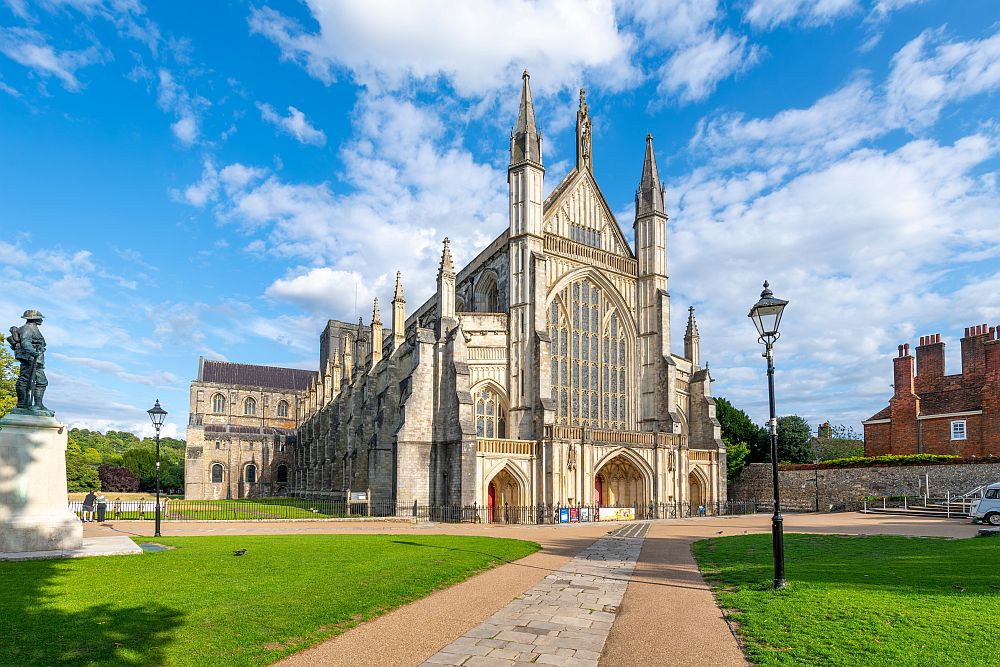
[Image above] Picture of the Winchester Cathedral, which still stands today thanks to a rescue operation in the early 20th century. Credit: Kirk Fisher / Shutterstock
Winchester Cathedral—the longest Gothic cathedral in Europe—had its cornerstone laid in 1079. Construction continued for the next four centuries, yet even after all that effort to reach the final form in 1532, the cathedral was literally sinking into the Hampshire peat by 1904. Massive cracks appeared in the walls, and many feared an imminent collapse.
The cathedral’s potential demise was a consequence of its site. Winchester was founded on the west side of the River Itchen, not far from the south coast of England. The area has been inhabited for thousands of years, and by the mid-11th century, the city was large enough to warrant a cathedral.
Although Winchester is not located entirely on boggy ground, it was decided that the cathedral would be built near the river for two reasons:
- It allowed for easy transport of building materials.
- It gained prestige being located near the existing Royal Palace.
Knowing what we know now about civil engineering and the importance of the foundation to such a massive building, its location may seem inadvisable. The decision to build near the river was made regardless, and when the cathedral’s east end (closest to the river) was expanded in the 13th century, the builders used rafts of logs as a foundation to keep the structure dry.
The crypt beneath the nave (central part of the cathedral) is built partly below the water table. The space flooded regularly in the winter and during heavy rains, and the centuries of fluctuating water levels caused the wood foundation to rot and the peat beneath the structure to compress.
Local engineers felt that the structure’s foundation needed reinforcement to prevent further settling. However, every time they dug into the compressed peat, pressure would release, the peat fell apart, and water filled the trenches. Well-known engineer Francis Fox was consulted, and his radical proposal was to stage an underwater rescue mission that involved digging trenches around the structure and filling them with cement. To pull off this elaborate plan, though, they needed a diver.
Geology break
How could I write about a cathedral’s foundation in a floodplain without a geology lesson? (Maybe I could, but I won’t.) The Late Cretaceous bedrock under Winchester is chalk, overlain by less consolidated clays, sands, gravels, and silts topped with peat. At the cathedral site, test excavations for the reinforcement determined that the ground consisted of 3 meters of fill, underlain by 2 meters of chalky marl, then a layer of peat of varying thickness (roughly 2.5 meters), which overlies 3 meters of dense gravel and weathered chalk. The water table is approximately 2 meters above the peat layer. The original foundations extended only to the water.
Diver wanted: Must love working in the dark
Why did Fox think that the solution was a diver? Standard pumping was not an option because removing the groundwater caused the silt to shift, further endangering the structure. They needed someone who could work with the water, not against it.
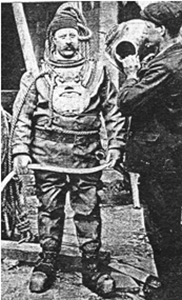
Picture of William Walker, the diver who saved Winchester Cathedral by shoring up its foundations. Credit: The Historical Diving Society, Wikimedia (Public domain)
Surface-supplied diving had become a valuable skill by the early 1900s, building on the 1830s advances in diving technology by Augustus Siebe and his son-in-law, William Gorman. It is a mode of underwater diving that uses a hose to supply breathing gas from the surface rather than through tanks carried by the diver. In addition to the technical considerations of maintaining an air supply at depths up to 190 feet, these divers often had additional skills such as carpentry or pipe fitting. The high-risk work also came with high salaries.
A call went out for divers in 1905, and William Walker answered it. He and his family were based in Portsmouth, where Walker had a good job at the docks. In Winchester, Walker worked 20 feet below the surface in total darkness, hand-placing materials in narrow, 6-foot-deep trenches to shore up the foundation.
Portsmouth is 29 miles from Winchester, and every weekend throughout his six-year commitment to the cathedral (1906–1911), Walker would make the 70-mile round trip on his bicycle to see his family.
The engineering strategy for stabilizing a massive foundation
To understand the massive volume of materials Walker needed to move with his own two hands, it will help to envision the scale of the cathedral itself. The cathedral stretches for 558 feet (approximately 170 meters) and is 82 feet (approximately 25 meters) wide. To make the repairs, 235 pits were dug around the perimeter of the structure, each approximately 20 feet (6 meters) deep.
Walker’s background as a shipyard diver had prepared him well for working in a confined space with limited visibility. (Yes, there are two Portsmouths in the world with naval shipyards; Walker worked at the other one.) The reinforcement process began with Walker’s descent into a pit to clear the rotten logs and peat down to the gravel layer, 16 feet below the existing foundation. The work was done mostly by touch because the water was murky and the pits dark.
Once the old foundation was cleared, the pit floor was packed with jute bags full of hydraulic cement. After the cement floor had hydrated and hardened, the water could be safely pumped out, allowing traditional masons to enter and build the concrete block piers that now support the cathedral. The masons also worked in the dark.
By the time the job ended in 1911, Walker had placed 25,800 bags of cement to seal the water out of the trenches. The masons then deployed 114,900 concrete blocks to build up the new foundation from the gravel bed. When that work was completed, the inside of the cathedral was patched up with 900,000 bricks.
Following the successful rescue mission, Walker was appointed a Member of the Royal Victorian Order by King George V for his efforts in saving the historic cathedral.
Lessons for modern preservation
Modern measurements of settling rates have indicated that Winchester Cathedral’s foundations are still moving today, raising questions about whether the work was worth the risks. Do the downsides to historic preservation sometimes outweigh the benefits of keeping history alive?
Ethical questions aside, Winchester cathedral stands today thanks to early 20th century materials science and engineering innovations and to one diver who worked tirelessly to save it. Even though Walker’s greatest achievement—the cathedral foundation—is entirely hidden from the thousands of tourists who visit the cathedral, they can visit the statuette of William Walker along with his diving helmet or the nearby pub that bears his name.