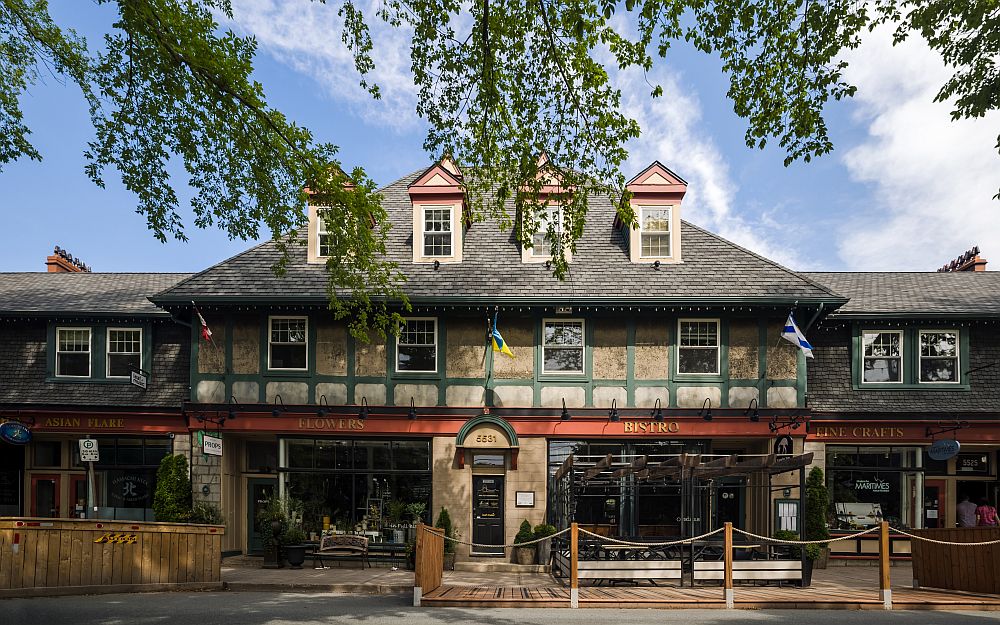
[Image above] Example of a Victorian-styled shop built with Hydro-Stone blocks in the Hydrostone District of Halifax. Credit: Prashanth Bala / Shutterstock
I never would have imagined that a mature tree could be ripped from the ground, roots and all, until my friends back in Iowa posted aftermath pictures of the August 2020 derecho. That infamous storm reached extreme, sustained wind speeds of up to 140 mph as it traveled across the Midwestern United States, with Iowa suffering the highest damages.
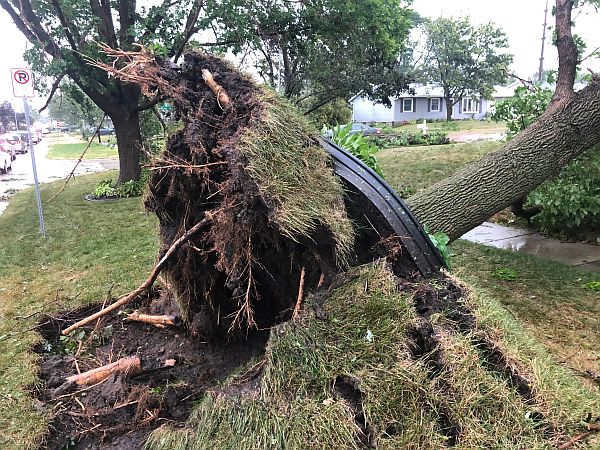
Example of a tree that was completely uprooted during the August 2020 derecho, located in the city of Marion (two miles east of Cedar Rapids, Iowa). Credit: JWGuenther / Shutterstock
The impact of this storm on the city of Cedar Rapids specifically was so intense that it surpassed the devastation from the flood of 2008, another pivotal event in the state’s history of natural disasters. Cedar Rapids is home to my alma mater, Coe College, and I remember my heart breaking when I saw pictures of the tree-covered campus stripped of its once vibrant foliage.
Yet despite the far-reaching impacts of the derecho on my home state, almost none of my friends in Ohio knew about this catastrophic event until I told them. The experience made me realize just how few tragedies make it into the public consciousness, even when those disasters have far-reaching impacts beyond the local community.
I was reminded of this fact this past September during my road trip around the Canadian province of Nova Scotia with a friend. While in the capital city of Halifax, we visited the Maritime Museum of the Atlantic, where I learned for the first time about the Halifax Explosion.
Halifax Explosion: Largest artificial explosion before the atomic bomb
On the morning of Dec. 6, 1917, the steamship Mont-Blanc was entering the Halifax Harbor, inbound from the Atlantic with war material for France. At the same time, the Norwegian vessel Imo was outbound for New York to load supplies for occupied Belgium.
The two ships collided in the Narrows, the harbor’s tightest navigation section. The collision left a gash in Mont-Blanc’s hull, which generated sparks that ignited volatile grains of dry picric acid stored below its decks.
The Mont-Blanc burned for nearly 20 minutes as it drifted toward Pier 6, a busy area filled with residential homes, businesses, moored ships, the Royal Naval College of Canada, and a large sugar refinery. Many people, not realizing the steamship’s cargo, rushed to help put out the flames. But Vincent Coleman, a railway dispatcher, telegraphed a warning to stations up the line to stop any trains from entering Halifax.
Just past 9 a.m., the fire reached Mont-Blanc’s main cargo area, which contained nearly 3,000 metric tons of explosives. The explosion—which had about one-fifth the power of the 1945 Hiroshima atomic bomb—sent out a shock wave in all directions, followed by a tsunami that washed violently over the city’s shores. More than 1 square mile (2.5 square kilometers) of the Richmond community was totally leveled either by the blast, the tsunami, or the fires caused when buildings collapsed inward on lanterns, stoves, and furnaces.
The Halifax Explosion resulted in nearly 1,800 confirmed deaths, with some estimates suggesting a higher death toll of around 2,000. The explosion also injured about 9,000 people and left an estimated 25,000 homeless.
The aftermath: Recovering lost memories from the dead and survivors
Following the explosion, city officials used a method developed during a previous tragedy—the Titanic—to identify and catalogue the deceased and their belongings. (Halifax is where bodies recovered from the sunken ship were brought in 1912.) Many of these mementos were never claimed, however, and ended up in city storage for decades—until historian Janet Kitz came along.
Kitz immigrated from Scotland to Halifax in 1971 after marrying Leonard Kitz, who in the 1950s served as Halifax’s first Jewish mayor. While studying at Saint Mary’s University in 1980, her professor suggested she write a paper on the Halifax Explosion. The tragedy had by then largely faded from public consciousness because “So many people in Halifax figured that you just put it behind you and never discuss it again,” says Dan Conlin, curator at the Canadian Museum of Immigration at Pier 21, in a CBC article about Kitz’s legacy.
From her work tracking down the origins of the mortuary bags, Kitz curated “A Moment in Time” at the Maritime Museum of the Atlantic, the first museum exhibit on the explosion. The museum’s current permanent exhibit grew from this first exhibit.
Kitz continued to track down memories from the Halifax Explosion, interviewing and organizing stories from survivors who previously only shared their experiences in hushed tones with heavy hearts. As explained in a Global News article, while the explosion initially made global headlines, the tragedy occurred during World War I, and survivors fatigued by the devastation locally and internationally wanted to put the disaster behind them.
But as Kitz’s work helped raise awareness of the Halifax Explosion once more, it reminded people of a very visible testament to the tragedy hiding in plain sight—the city’s Hydrostone District.
Noncombustible concrete blocks serve as ‘a vision of regeneration’
As stated earlier, almost all of the Richmond community was completely leveled during the Halifax Explosion. The city enlisted famed town planner Thomas Adams and architect George Ross to assist in reconstruction planning for the devastated area.
After surveying the area—and keeping in mind what caused the devastation—Adams and Ross proposed the use of noncombustible concrete blocks called Hydro-Stone for the exterior of the houses. Hydro-Stone consisted of gravel or crushed stone (typically granite), sand, and Portland cement amalgamated through a hydraulic pressing process.
NOTE: Hydro-Stone is the official brand name of the product, as seen in a 1919 ad for the blocks. However, Hydrostone has become a popular alternative spelling, as seen with the Halifax Hydrostone District.
Manufacture of the blocks was done in a plant located in Eastern Passage, and after completion, the blocks were shipped across the harbor and carried up a steep rise to the construction site. Two diagonal streets—Devonshire and Dartmouth Avenues—were added to the reconstruction plans to make hauling the blocks up the rise easier.
More than 300 homes were built using the Hydro-Stone blocks to replace the mostly wooden buildings destroyed during the explosion. An illustrated poster from 1919 hailed the restoration as “a vision of regeneration … that fringes the miraculous.” Richmond residents also reported feeling much safer in the new homes, as demonstrated by several letters from children the Evening Echo newspaper ran in February 1921.
While the Hydro-Stone blocks used for the reconstruction are no longer produced (the modern Hydro-Stone product is instead a type of gypsum cement plaster), many of the original buildings in the reconstructed Hydrostone District remain standing and in use today. However, rather than working class laborers, the area is now a sought-after neighborhood for young professionals and families due to gentrification. The story of how the rebuilt area ironically displaced the very people it was supposed to house is detailed in the video below.

Credit: PLANifax, YouTube
As I learned about this history of the Halifax Explosion and Hydrostone District while walking through the Maritime Museum, I could not help but reflect on how ceramic materials and composites have helped serve humans in times of need throughout history. As we come up on the 108th anniversary of the Halifax Explosion this weekend, we can all benefit from remembering those lost but also acknowledging the great impact this disaster had on urban planning principles and infrastructure.