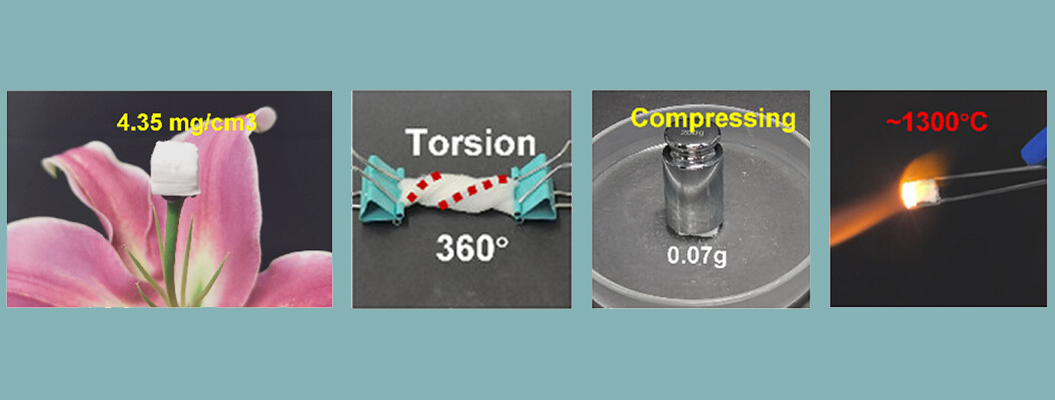
[Image above] A new ceramic aerogel demonstrates several superior properties, such as extremely low density, superelastic deformability, exceptional crystallographic stability, and ultralow thermal conductivity. Credit: Jiang et al., Advanced Science (CC BY 4.0)
The comic book character Superman is an iconic figure in both print and on the screen. When he first appeared in Action Comics #1 in June 1938, this superhero could already leap tall buildings and resist bullets. As Superman evolved over time (in both comics and the 12 movies produced between 1978 and 2025), he became even more powerful: He could survive extreme temperatures, lift thousands of tons, and even turn himself into a living bomb using the overpowered “solar flare” ability (which first appeared in the comics in 2015).
Likewise, many material systems have gained additional functionalities since their first appearance by turning creative desires into real-life properties through skillful engineering. Ceramic aerogels, for example, are ultralightweight, highly porous materials used for thermal insulation. They were first synthesized in 1931, but interest in these materials only gained traction after NASA used them for astronaut spacesuit insulation in the 1960s.
Although ceramic aerogels are known for their use in thermal insulation, conventional aerogels made from single oxides or nonoxides are limited to lower thermal environments because they experience severe grain growth, densification, and pore collapse at higher temperatures, leading to microstructural failure. Enter a new class of “super” aerogels based on high-entropy ceramics.
The term “high entropy” describes materials composed of five or more elements in roughly equimolar proportions. The specific arrangement of each atom within the single-phase solution is very disordered, and this atomic disorder can significantly reduce thermal conductivity at high temperatures, thereby suppressing the diffusion that normally causes grain growth. (Some groups argue that at least seven elements are needed to achieve true disorder.)
High-entropy ceramic aerogels based on zirconia and silica have been produced using the sol–gel method combined with supercritical drying. However, despite their low thermal conductivity, these oxide aerogels are still highly brittle and have poor compressive resilience because of their pearl-necklace-like microstructure.
Researchers at Lanzhou Institute of Chemical Physics in China recently overcome these limitations by developing a “super” high-entropy oxide aerogel composed of five metal elements with Planet Krypton-like names: gadolinium, lutetium, titanium, zirconium, and hafnium. When combined with oxygen, they form the composition (Gd1/2Lu1/2)2(Ti1/3Zr1/3Hf1/3)2O7 or GLTZH.
Because of their moderate range of ionic radii, from about 0.745 Å for titanium to 1.053 Å for gadolinium, local lattice distortion occurs that is necessary for enhanced phonon scattering (greater thermal stability) while still permitting the formation of a single stable phase.
“Molecular dynamics simulations confirmed that this particular combination exhibited the lowest potential energy and greatest thermodynamic stability among the alternative compositions tested,” the researchers write.
Synthesizing GLTZH aerogels
To form a precursor sol, five polyacetylacetonato metal complexes based on the five elements were mixed in a stoichiometric ratio and dissolved in methanol at a ratio of 0.65:1 (metal source to methanol). Adding 0.3 wt.% polyethylene oxide to this precursor sol produced a solution suitable for electrospinning, a process that uses electric fields to draw polymeric solutions into extremely thin fibers.
After GLTZH nanofibers were produced through electrospinning, they were heated to 1,000°C. With an average diameter of 250 nm, the nanofibers formed a hierarchical network with an interlayer spacing of about 5 µm.
Energy-dispersive X-ray spectroscopy confirmed the nanofibers’ uniform distribution of all five metal elements without any elemental segregation. The high-density lattice distortion improves mechanical properties, impedes grain growth, and slows atom diffusion.
Upon heating, a perfectly mixed atomic arrangement where all five metal types occupied lattice positions randomly is formed. Such a structure eliminates the grain boundary impurities and compositional segregation typically found with ball-milled powders, according to the researchers.
Atomic-resolution electron microscopy confirmed the transition from noncrystalline ~400°C) and hypocrystalline (~600°C) to a single-phase defective fluorite structure (~800°C). Selected-area electron and X-ray diffraction confirmed this fluorite structure remained after annealing at 1,100°C.
Super properties
Analysis showed that the GLTZH aerogels demonstrated several superior properties that might make Superman jealous if he was an aerogel:
- Density of just 4.35 mg/cm3, making it light enough to rest on flower petals without damaging them.
- Superelastic deformability with a recoverable compressive engineering strain up to 98%. Aerogels sprang back to their original shape across a temperature range spanning from -196°C to 1,500°C without structural fracture. They also withstood 1,000 compression cycles at 50% strain without structural failure, as well as tolerated 360-degree torsion and 180-degree bending. The researchers attributed these behaviors to the highly flexible and resilient nanofibers and strong interfaces.
- Exceptional crystallographic stability without severe grain growth. The aerogel retained ultrafine grains under both heat treatment at 1,000°C and exposure at 1,400°C.
- Ultralow thermal conductivity of just 24.14 mW·m⁻¹·K⁻¹ at room temperature and 81.21 mWm⁻¹·K⁻¹ at 1,000°C. These values outperform most existing ceramic insulation materials at high temperatures.
The researchers conclude that their work “establishes a new pathway … to resolve the long-term trade-off between thermal stability and mechanical compliance in ceramics.” Potential applications for GLTZH aerogels include applications that must withstand a combination of high temperature (1,500°C), mechanical, and oxidative stresses, such as thermal protection systems for hypersonic vehicles and next-generation insulation.
If these “super” aerogels are commercialized, they could enable a new era of thermal protection systems—working just like Superman toward a safer and better tomorrow..
The open-access paper, published in Advanced Science, is “Superelastic high‐entropy oxide ceramic aerogels for thermal superinsulation and sealing at extreme conditions” (DOI: 10.1002/advs.202516840).