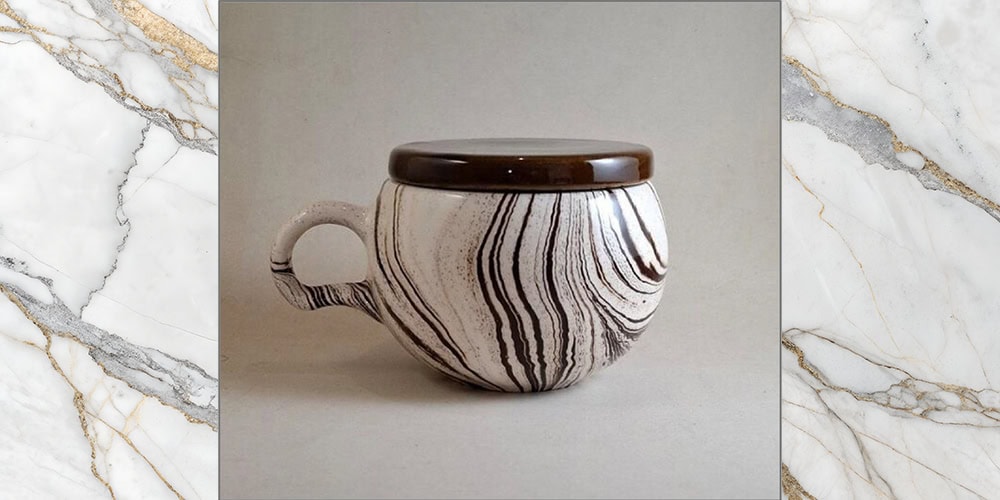
[Image above] This handcrafted ceramic vessel showcases the water-based underglaze marbling technique, characterized by a symmetrical form with an 8-cm mouth diameter and 8-cm height. Credit: (Photo) Zeinab Abedian Jelodar, IJCES (CC BY 4.0); (Background) Level2Photographer / Shutterstock
Messy art activities are a staple of childhood learning for their ability to foster creativity and sensory development without the pressure for perfection. Even without a defined end goal, they can also be an effective way to communicate basic science concepts, as is the case with marbling.
Marbling is the process of floating inks or paints on a viscous liquid to create swirling, stone-like patterns, which are then transferred to another surface, typically paper or fabric. Children can easily use this process to create unique pieces of marbled artwork while also learning about the chemistry behind surface tension, density, and surfactants.
The artistic technique of marbling has a long history, with paper marbling originating in ancient China, Japan, and the Middle East. Marbling techniques have also evolved to achieve similar aesthetic results on ceramic materials, though the method is slightly different. Instead of dipping the ceramic into floating pigments on aqueous or oil-based media, the patterns are achieved by layering colored slips (clay slurries) or manipulating glazes on the surface.
Early applications of marbling in ceramic decoration took place throughout the Ottoman period (14th to 20th centuries) and in Italy (16th and 17th centuries). Ottoman artisans would either throw colored slips onto a spinning piece of work to create concentric patterns or drip the slip down a comb to create waves. In contrast, the Italian styles involved applying different colored glazes in a marble-like way.
Although marbling was adapted for ceramics, the traditional liquid-based transfer technique used on paper and fabric remains relatively underexplored in decorative ceramic applications. A recent open-access study by researchers at the Iran University of Art aimed to evaluate the use of liquid-base marbling to decorate ceramic surfaces.
One of the challenges of adapting the liquid-based marbling technique to ceramic decoration is the fact that unlike paper, ceramics traditionally are processed using thermal treatments. As a result, “ceramic marbling demands pigments and binders that can withstand vitrification, maintain discrete pattern boundaries, and resist unwanted diffusion during firing,” the researchers write. The pigments must also be more concentrated and not soluble in water to ensure suitable coverage.
In traditional marbling, the viscous solution can also include a binding agent such as gum tragacanth, fenugreek seed, salep, linseed, or carrageenan to ensure that the colorants float on the surface. Ox-gall, a naturally sourced wetting agent, is often added to paints to keep them afloat.
For the study, the researchers utilized underglaze, overglaze, and colored-glaze methods with pigments to apply the ceramic marbling technique, and each method required its own firing process. The study tested the methods in both water and oil with different additives as binders. All ceramic bisque tile samples followed the same ceramic body composition, thickness, and firing temperature prior to the glaze applications.
The underglaze method, which is when the marbling technique was applied prior to the transparent finishing glaze, showed optimistic results. This method used three different additives, including tragacanth, eremurus, and gum Arabic, and allowed for precision and balanced line patterns. The study also notes that the bisqueware used in this method underwent three different firing stages.
The overglaze method, which is when the marbling technique was applied after an initial glazing, allowed for successful designs, but significant glaze shrinkage occurred during firing, thus diminishing the quality of the glaze. The researchers conclude that the glaze thickness required for the overglaze method was “suboptimal.”
Finally, the colored-glaze method, which used a higher proportion of glaze material within the pigment mixture than the other methods, was deemed unsuccessful. The colored-glaze solution tended to disintegrate after being poured onto the surface, which the researchers attributed to its increased heterogeneity because of the higher glaze content.
“The findings demonstrate that, through adjustments in material formulation and the incorporation of natural compounds such as gum tragacanth, gum Arabic, and eremurus, it is possible to successfully transfer and stabilize intricate, diverse marbling patterns onto ceramic surfaces,” the researchers write.
They conclude that the results of this study demonstrate the potential to combine historical techniques with emerging innovations to produce ceramic works that cross the line between artistic and functional design.
The open-access paper, published in International Journal of Ceramic Engineering & Science, is “Innovative Application of Traditional Paper Marbling Technique in the Fabrication of Ceramic Glazes” (DOI: https://doi.org/10.1002/ces2.70027).