[Image above] Credit: ceeceelee / Shutterstock
Across the United States, farmland is disappearing as the demand for both renewable energy and artificial intelligence increases.
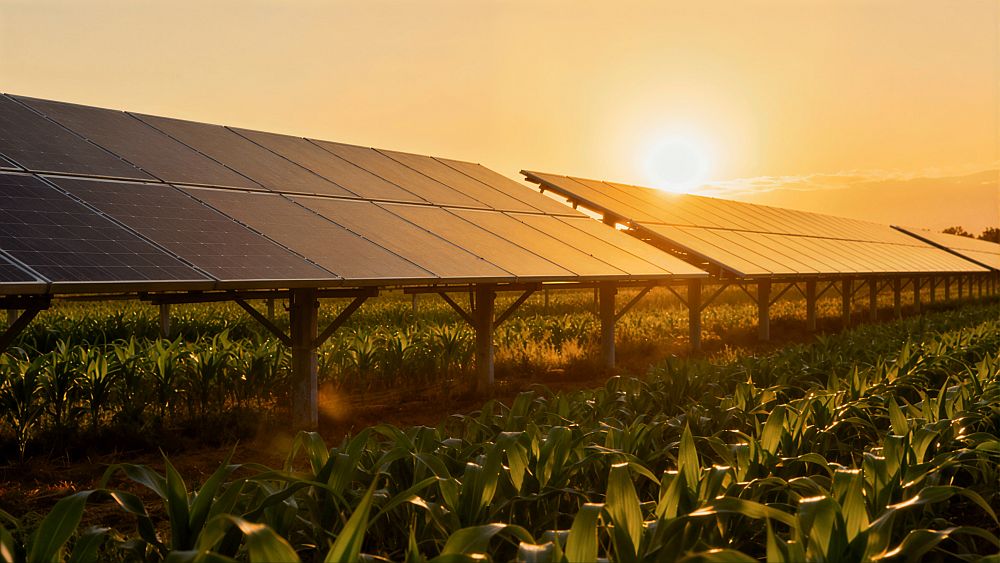
The U.S. Department of Agriculture recently reported that between 2009 and 2020, 43% of solar installations were on land previously used for crop production and 21% on land used as pasture or rangeland. While wind installations were also frequently constructed on similar sites, “Agricultural land surrounding wind turbines typically maintained agricultural land cover after development, while approximately 15 percent of land surrounding solar farms shifted out of agriculture,” the report states.
With more solar installations being proposed on farmland—modeling by the American Farmland Trust found that 83% of projected solar development to 2040 will be on agricultural land—these projects are becoming controversial. Although there can be benefits of co-locating solar arrays and crops, there is still much to learn about the budding practice of agrivoltaics.
Data centers, especially those required for AI, are also encountering pushbacks from both rural and urban communities. In addition to large amounts of electricity, these data centers require huge amounts of land, typically 200 acres or more per site, with some future-proofing efforts targeting 500 to 1,000 acre sites.
Because land in rural communities is easier to develop, data center sites have spread into rural areas, with the average site covering more than 0.35 square miles (224 acres)—roughly the size of 450 football fields. Environmental impacts and rising consumer electricity costs are just two of the major issues resulting in states and local communities putting a moratorium on data centers.
But although passions are running high on the topics of solar and data center development, there is a lack of information on the economic, environmental, health, and cultural consequences of these projects on rural communities. To fill this gap, the University of Missouri announced the Center for Rural Energy Security (CRES) in January 2025.
CRES is a partnership between the university’s College of Agriculture, Food and Natural Resources, and the College of Arts and Sciences. Formally launched in Q3 of 2025, CRES conducts independent, nonpartisan research and analysis to help inform decision makers and policy experts on rural energy security matters.
“There’s a large amount of infrastructure that has to be built and most of that ends up crossing rural communities, which impacts farmers, impacts residents, impacts the economies of local communities,” says Michael Sykuta, director of CRES and associate professor of applied economics at the University of Missouri, in a news release. “And quite frankly, despite all of the work that is done, there’s not a lot of work actually examining systematically what the consequences of these investments are.”
A multidisciplinary team of University of Missouri scholars is providing guidance for CRES’s research programs. This team includes economists, legal experts, sociologists, and even a historian. As of September 2025, the Center is conducting three research projects:
- Economic effects of large-scale wind and solar projects. These effects are being investigated in terms of county GDP, county employment, median income, and other factors that are segregated by industry sectors, using data from all wind and solar installations in the U.S. at the county level.
- Residential electrification and arrearages. CRES is using customer data provided by a large investor-owned utility electric company in a northern climate to analyze differences in arrearage patterns. (Arrearage refers to the total amount of debt accumulated when customers fall behind on their electricity payments.)
- County zoning laws for large-scale renewables. Data from all 114 counties in Missouri were collected regarding zoning boards and regulations for large-scale renewables, including permitting and ordinances, with the ultimate goal to create an interactive map.
Additional research details are summarized on the Center’s website and discussed in the first public presentation held in April 2025.
CRES was initially funded by the Missouri Farm Bureau Foundation for Agriculture, whose membership is made up of agriculture producers across the state. Other stakeholders are being invited to join CRES, including renewable energy companies, investor-owned utilities, and various other industries.
Because companies are being invited to support the research at CRES, “you have the concern about biased research,” says Sykuta in the news release. “I am committed to making sure that isn’t the case.”
All of CRES’ work will be peer-reviewed and held to scientific standards. Furthermore, every academic paper will have a policy white paper associated with it to show the relevance to community stakeholders and policy makers.
Semiannual research roundtables are being held to provide stockholders early access to the research and to determine future direction for projects. Stakeholders will also have opportunities to work with graduate and undergraduate students, with the goal of developing a pipeline of experts.
“What’s exciting is, for the first time ever, there’s going to be a think tank here in the country that’s going to be focused on the issues that we face in rural America,” Sykuta says in the news release.