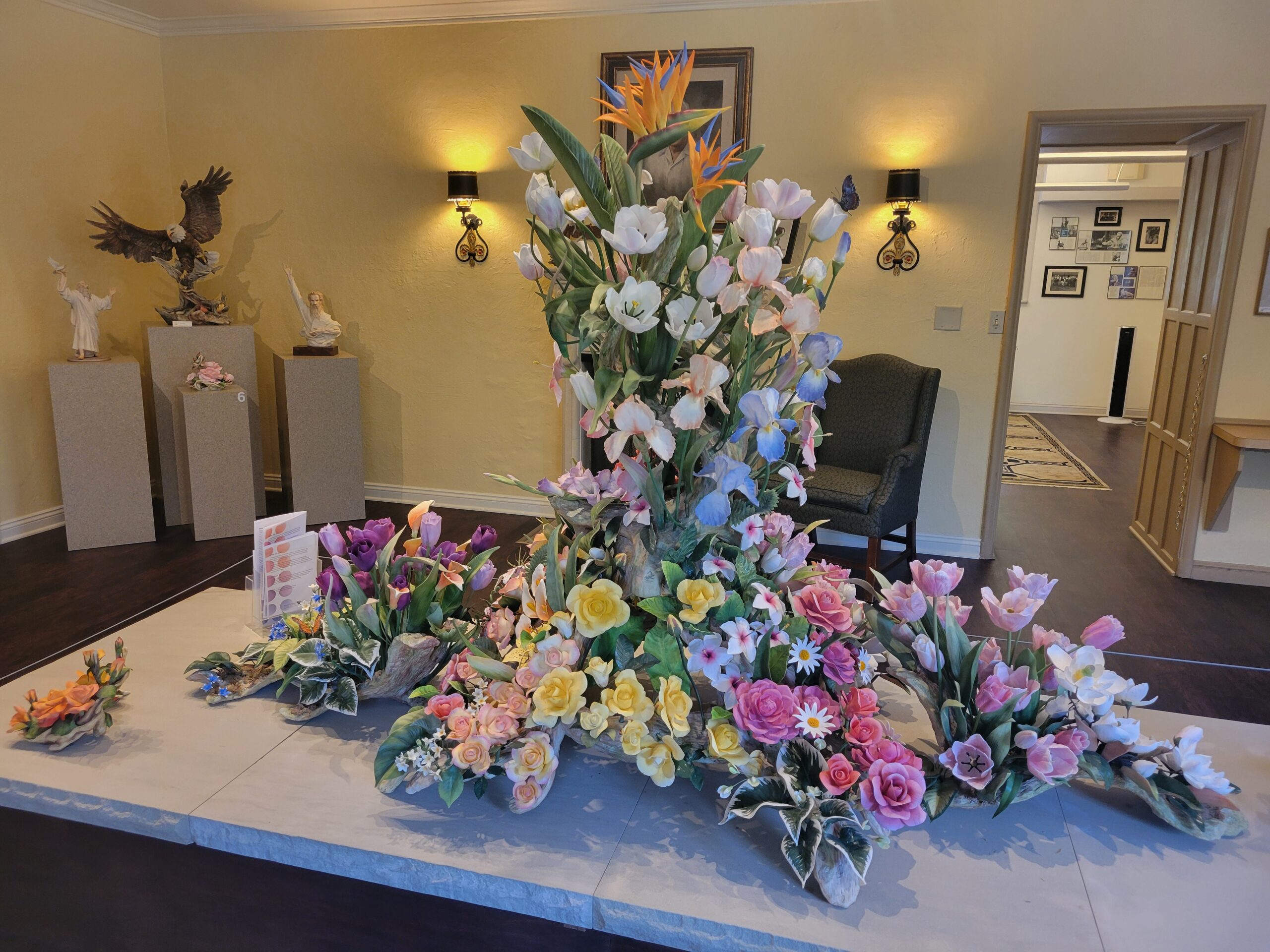
[Image above] The Garden of Spring sculpture at the Museum of American Porcelain Art is said to be is the largest floral sculpture ever made in porcelain. Credit: Laurel Sheppard
Learn more about the CTT special series on the Ohio Creativity Trail and find links to all the ceramic and glass sites highlighted in this post.
As a bibliophile, I love visiting different libraries and perusing their shelves, as well as purchasing any books for sale so I can help support the library in a small way. But who knew that at one library I would also be able to enjoy a beautiful exhibition of art pottery. That’s what I discovered in September 2025, when I visited the Rocky River Public Library on the west side of Cleveland.
Housed within the library is the Cowan Pottery Museum, which was founded in 1978 after a generous donation. After library renovations 29 years later, the exhibits were expanded and improved. The museum now holds more than 1,200 examples of Cowan pottery, the largest publicly owned collection in the world, with about 40% on view.

Credit: The American Ceramic Society, YouTube
Guy Cowan: A pioneer in American art pottery
The man behind the pottery, Reginald Guy Cowan (1884–1957), was born to a family of potters in East Liverpool, Ohio (another major pottery center; stay tuned for an article about the Museum of Ceramics). Cowan’s father, Louis, taught him the basics. Guy, as he was known, wanted more education and graduated from the New York State School of Ceramics at Alfred University.
He moved to Cleveland in 1908 to become an instructor of ceramics and design at the new East Technical High School. He also joined the faculty of the Cleveland School of Art, now the Cleveland Institute of Art. In 1912, Cowan opened his own studio in Lakewood (another west Cleveland suburb) called the Cleveland Pottery and Tile Co. The company, which later became known as Cowan Pottery Studio, made a line of vases and bowls in addition to architectural tiles.
In 1917, Cowan was presented with his first award for pottery at the Art Institute of Chicago’s International Show. WWI brought the closure of the studio while Cowan served as a captain in the Chemical Warfare Service (his son Ralph Howard followed in his father’s footsteps and served in WWII). Several years after the war, Cowan had to move his operation to Rocky River when his natural gas supply ran out.
During the 1920s, the studio prospered. A nationwide dealer network, with some 1,200 outlets, was formed to distribute pottery to major stores, including Marshall Field, Kauffman, and Cleveland’s Halle’s, Kinney & Levan and Sterling & Welch. Many well-known artists were affiliated with the studio, including
- Waylande Gregory: Studied with sculptor Lorado Taft and created many well-known Cowan designs, including “Nautch Dancer.”
- Viktor Schreckengost: Designed the famous “jazz” punch bowl for First Lady Eleanor Roosevelt. She liked it so much that she ordered two more: one for her Hyde Park mansion and the other for the White House.
- Thelma Frazier Winter: Graduated from Cleveland School of Art and designed sculptural functional pieces with low-relief designs at Cowan Pottery. She later left to pursue a bachelor’s degree in art education at Western Reserve University and then taught at the Laurel School in Cleveland and the Cleveland Institute of Art.
- Margaret Postgate: Studied at the Art Institute of Chicago and New York’s Cooper Union; known for adapting her soap carvings for ceramic production, including the popular elephant bookend.
- Alexander Blazys: Considered Cleveland’s leading modernist sculptor of the 1920s (his bronze sculpture is at the Cleveland Museum of Art). He joined Cowan Pottery around 1927 and designed folk dancers and other figures while there.
- Elizabeth Anderson: Helped design limited edition, slip-cast molded ceramic sculptures, including a pair of Spanish dancers in 1927.
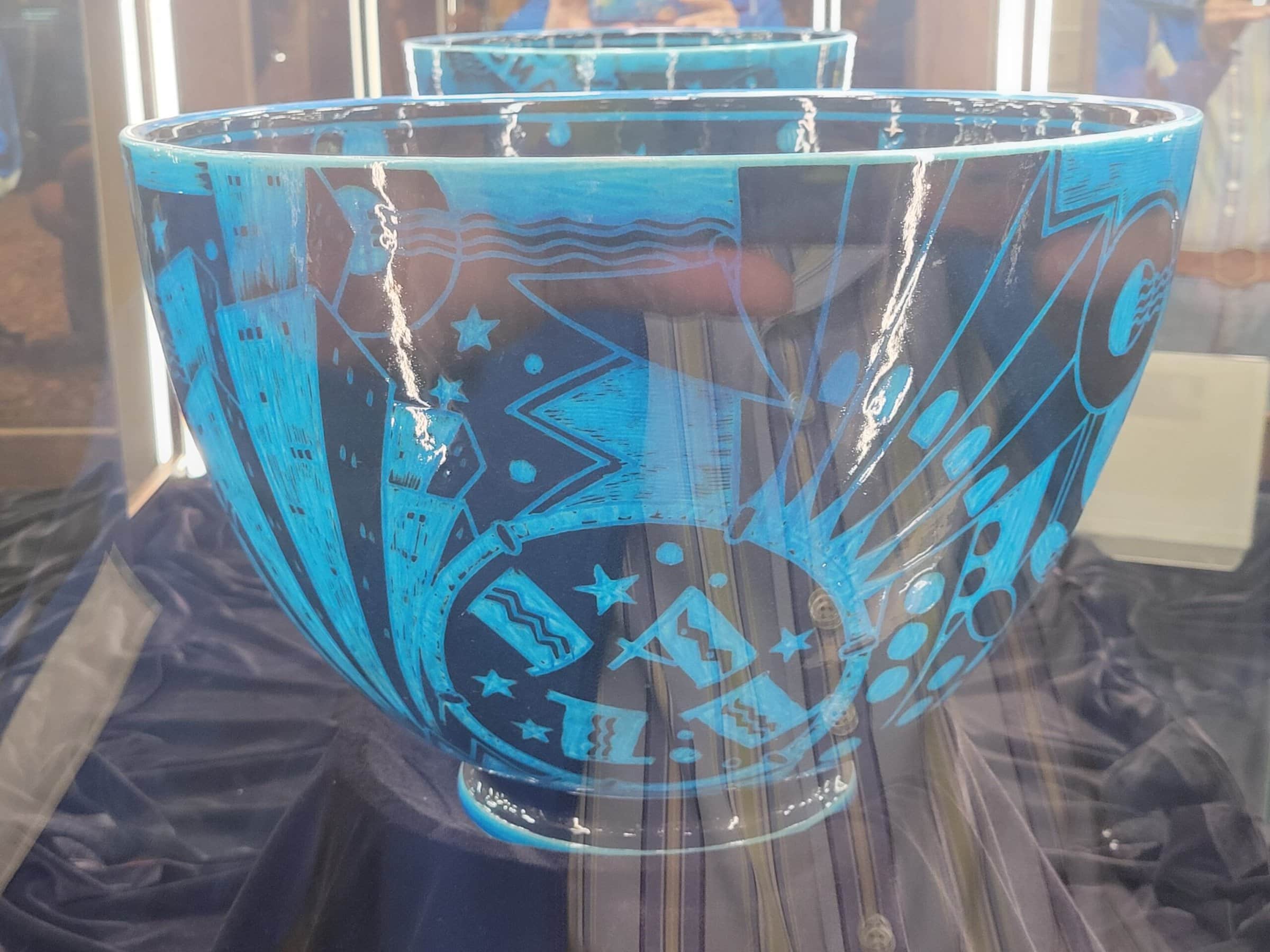
The “jazz” punch bowl created for First Lady Eleanor Roosevelt in 1930–1931. Cowan Pottery Studio subsequently produced up to 50 of this punch bowl that included four slightly different designs and three slightly different shapes. Credit: Laurel Sheppard
Popular products at Cowan Pottery included flower bowls, comports, candlesticks, vases, lamps, and candy and nut dishes. By 1928, the company had grown to a staff of 35 people and was producing 175,000 single pieces a year, ranging from unlimited stock designs to limited editions of sculptured pieces. Some of Cowan’s pieces were featured in Hollywood movies during the 1930s. Examples were also purchased by several art museums, including Boston’s and Chicago’s.
Unfortunately, Cowan Pottery could not survive the Great Depression and closed its doors in 1931. Cowan spent the rest of his life as the chief designer for Syracuse China (previously Onondaga Pottery) and as a judge and trustee for the National Ceramic Exhibitions.
Cowan’s legacy includes bringing international recognition to American art pottery and the creation of unique art forms and glazes. According to Mark Bassett, author of Cowan Pottery and the Cleveland School, in a 2009 article, “[Guy] proved there could be a marriage of arts and industry in a ceramic medium.”
Learn more about Cowan Pottery by watching the videos here and here. The Western Reserve Historical Society also houses a Cowan Pottery document collection.
MAPA: The only museum of its kind
If you want to see more beautiful ceramic art while in Cleveland, you can head east from the Cowan Pottery Museum over to the Museum of American Porcelain Art (MAPA). Located in South Euclid, MAPA is dedicated to preserving and sharing the porcelain art produced by five studios, which were based in Trenton, N.J.:
- Edward Marshall Boehm (1913–1969). This artist had a passion for birds and other wildlife and specialized in making realistic figurines. In 1950, he established the Boehm Studio, And a year later, the Metropolitan Museum of Art acquired his famous “Hereford Bull” and “Percheron Stallion” sculptures. After his death, his wife Helen took over and continued the studio’s success (I bought her memoir, With a Little Luck: An American Odyssey, from the museum shop).
- Boleslaw Cybis (1895–1957). Cybis and his wife came to the United States in 1939 after Hitler’s invasion of Poland. He helped found Cordey China Company in 1942, which he closed in 1950 to open the Cybis Porcelain Art Studio.
- Laszlo Ispanky (1919–2010). A native Hungarian, Ispanky became the master sculptor for Cybis Porcelain Art Studio in 1960 and then started his own porcelain company in 1968, Ispanky Porcelains Ltd. He created the “Basketball Players” piece for the Basketball Hall of Fame in 1974.
- Carl Irving Burgues. First a dentist, Burgues later studied art and moved from Austria to the United States in 1940. He began making porcelain art in 1960, and by 1973, his studio had more than 30 employees. His works include wildlife as well as clowns and jugglers.
- Bronn Fine China, Ltd. Established by two artists in Lancashire, England, in the early 1970s, they later opened a studio in the United States to focus on porcelain art.
Although these studios became well known by the mid-20th century, they had all closed by 2006.

Credit: The American Ceramic Society, YouTube
MAPA is housed in the historic William E. Telling Mansion, formerly the South Euclid-Lyndhurst branch of the Cuyahoga County Public Library. The museum was established by private collector Richard A Barone in 2014 (he was the tour guide for me and several other visitors when I was there). After the five studios closed, Barone realized that much of the important porcelain art would be lost to public viewing, so he began collecting pieces for the museum. The collection includes about 300 pieces from the Cybis Studio and what was left of the Boehm Studio in Trenton, N.J..
After watching a 1963 film describing the porcelain process (no glaze is used like in other ceramic processing methods—it can take months to make one piece!), our first stop was the Main Gallery in the solarium, a perfect setting for Boehm’s detailed and colorful bird sculptures. (The birds are so lifelike that you almost expect them to burst into song or even fly away!) Off this room is the Aviary, where smaller though equally detailed bird figurines are housed in a glass display case.
The Legacy Gallery showcases historical pieces presented to U.S. presidents, foreign heads of state, the Vatican, and even royalty (Helen Boehm was a major driving force behind some of these sculptures):
- Global Peace, presented to Mikhail Gorbachev by President Ronald Reagan in 1987.
- The Patriot Eagle, presented to President George Bush in 1991, which includes an American flag in thin porcelain, which looks like real cloth.
- The Princess Margaret Rose and Queen Elizabeth Rose, presented in 1982 to honor the princess and the 30th anniversary of the accession of Queen Elizabeth II.
The Legacy Gallery includes other lifelike eagle sculptures, as well as rose sculptures that you almost want to stop and sniff.. But the gallery’s centerpiece is the Garden of Spring, which the museum claims is the largest floral sculpture ever made in porcelain.
Meet the MAPA founder and curator during a tour of the museum in this video.
Although you can visit both museums in one day, I recommend devoting a day to each so you can truly appreciate the artwork. You will come away with a deeper appreciation of the U.S. ceramic industry—what a wonderful history it is!