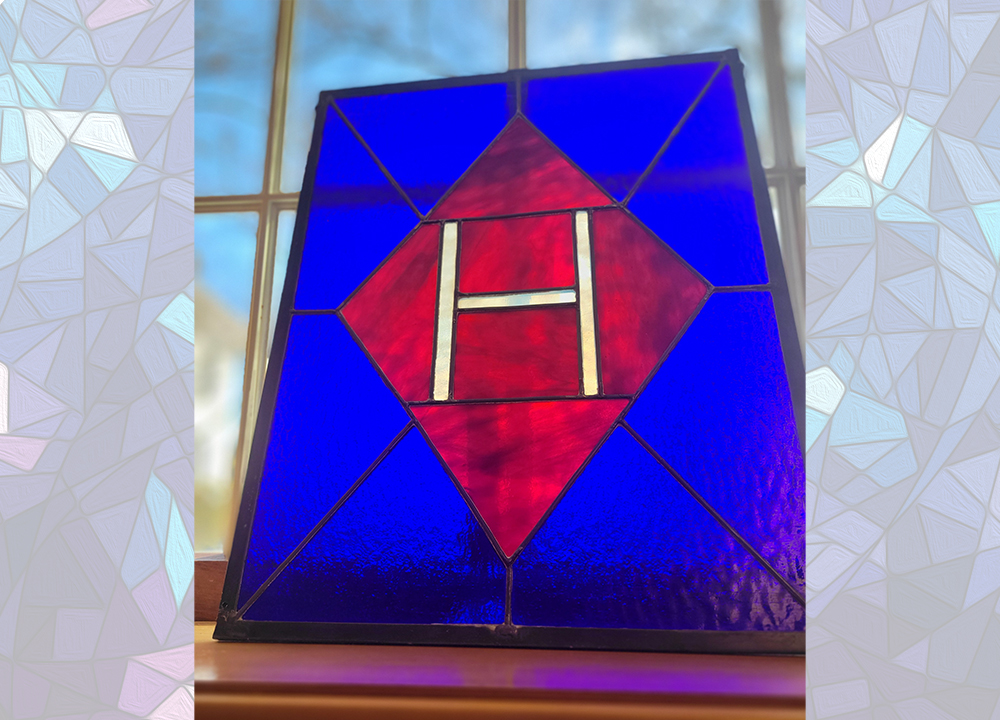
[Image above] Picture of the iconic “Diamond H” trademark used by A. H. Heisey & Company, from the Heisey Glass Museum in Newark, Ohio. Credit: (Photo) Laurel Sheppard; (Background) Chandra AP / Shutterstock
Learn more about the CTT special series on the Ohio Creativity Trail and find links to all the ceramic and glass sites highlighted in this post.
Newark, Ohio, is perhaps best known for the famous basket-shaped former headquarters of the Longaberger Company. But Newark is home to several other major manufacturers as well, such as the “flagship” facility for Owens Corning’s iconic pink Fiberglas insulation products. (The company manufactured the first all-fiber fiberglass wool there in 1956.)
Newark also played a major role in the Depression Era glass industry, as did other cities in the region. Specifically, Newark was home to A. H. Heisey & Company (1896–1957), which produced both pressed and blown glassware in many patterns and colors. It is remembered as one of “The Big Three” U.S. producers of elegant glass during that period.
Two decades after the Heisey factory closed, enthusiasts of Heisey glass converted a beautiful old Newark home into a museum containing examples of Heisey glass and other memorabilia. In addition to more than 6,000 finished pieces, the museum exhibits cuttings, etchings, engravings, tools, and experimental pieces from the Heisey factory.
I visited the Heisey Glass Museum in February 2025, and the sections below outline everything I learned about this historic glass company.

Credit: The American Ceramic Society, YouTube
The founder
In 1843, Augustus H. Heisey (1842–1922) emigrated from Germany with his family. They settled in Pennsylvania, and in 1861, Heisey began working for the King Glass Co. of Pittsburgh.
After serving in the Civil War, Heisey became one of “the best glass salesman on the road” for the Ripley Glass Co. He married Susan Duncan, daughter of one of the Ripley owners, and eventually became co-owner of Ripley with Susan’s brother.
Heisey wanted his own company, and in 1895, he began constructing his factory in Newark, Ohio. This location was chosen because of the low-cost labor and abundance of natural gas nearby.
In 1896, the Heisey factory opened with a single sixteen-pot furnace. Eventually, the factory grew to operate three furnaces and employ nearly 700 workers, and its famous “Diamond H” trademark glass products were sold all over the world.
Pressed glass was the company’s main product, and Heisey chose to revive the colonial patterns (flutes, scallops, and panels) that were popular earlier in the century. Although traditional patterns were part of the glassware’s charm, according to the museum website, Heisey glass “owed its beauty to an excellent glass formula, high quality raw materials, and to the way it was finished—fire polishing and grinding and polishing the bottoms of most pieces.”
To establish his brand, Heisey became one of the first glassmakers to use magazine advertising as a marketing tactic. Even before the factory opened, he placed an advertisement in the China, Glass and Lamps trade journal for the first two patterns produced by A. H. Heisey & Co.
The company was also the first to make fancy pressed stemware, which became a widely adopted innovation that replaced traditional pulled stemware. Many different designs, including the Diamond Point and 1776 Kalonyal, were patented under Heisey’s name.
Other innovations were introduced after Heisey’s death in 1922. For example, in the 1930s, a new process called “silhouette” or “deep plate” etching was developed to etch out the whole design rather than just the outline as was usually done. Additionally, a clear pressed and thin-blown glass pattern called Crystolite became known for its brilliance and clarity, while the Crystal Innovation Candle Lamp featured a unique design in which the stopper also served as the candle holder.
Heisey regularly organized social events for his employees, including company picnics and dances. The workers never held a strike, and many remained at Heisey for several decades or more.
A woman’s touch
Several women made significant contributions to the Heisey company. Louise Adkins, one of only three women working in the company when she was hired in 1896, was eventually put in charge of the stock room. She later supervised the cutting and grinding department, followed by the blowing and finishing department.
Under her supervision, both the etching and cutting departments produced some of the now most highly collected wares of the company. Etching patterns that sold well during her tenure included the 503 Minuet, 507 Orchid, and 515 Rose. When Adkins retired after 55 years with the company in 1951, she was the largest non-family minority stock holder in the company.
Two years after Adkins retired, Eva Zeisel was hired as art director. A native of Budapest, Hungary, she designed items for Heisey from her New York City studio. These designs were more amorphous with clean lines in keeping with the current trends. Zeisel also helped the company develop and introduce a new smoke/dark gray color called Dawn, which complemented home decorating styles at the time. Zeisel, who also designed for Redwing Pottery, Hall China, and Federal Glass, died Dec. 30, 2011, at the age of 105.
Highlights from the museum
The Heisey Collectors of America, Inc. was established in 1971 by 20 dedicated collectors of Heisey glass. This group, which now totals more than 1,300 members nationally, owns and operates the Heisey Glass Museum and the offsite warehouse where the original Heisey molds are stored.
There are several floors of exhibits in the museum (the current layout is only slightly different from this 2017 map shared on the Heisey Glass Museum website). The main gallery on the first floor, where the library and gift shop are also located, consists of a counterclockwise chronological history of the company with relevant glassware covering the following periods:
- 1896–1899. Four new colors were introduced: a dark green, a pale yellow, an opaque yellow (custard), and an opaque white (milk glass).
- 1900–1909. Heisey began marking its glass with the Diamond H trademark. Twenty-seven new patterns were introduced.
- 1910–1919. A shop for blowing glass was established, which allowed glassware with etchings or cuttings to be produced. Heisey basket vases were also introduced.
- 1920–1929. A. H. Heisey died in 1922 and his son, Edgar Wilson Heisey, became president. He added five new colors.
- 1930–1939. Yet another five new colors were introduced. The repeal of Prohibition led to new bar sets that helped increase sales.
- 1940–1949. In 1942, Edgar Wilson died and his brother, Thomas Clarence Heisey, took over. The company stopped producing colors and came out with several war-inspired designs: a military cap ashtray and an etching of an eagle with V-shaped wings. Animal figurines were also developed.
- 1950–1957. Competition came from less expensive machine-made glass from overseas and alternative materials such as plastic and aluminum. Three new colors were introduced: amber, a pale aqua, and charcoal gray. Despite these new colors, the factory closed for Christmas in 1957 and never opened again.
The museum’s second floor is home to Gallery 2, which has exhibits showing groupings of related items. The stairwell up to this floor shows photos of how Heisey glass was used in Hollywood. Meanwhile, on the lower level, there are several pieces of factory equipment on display.
Over in the connected King House is Gallery 3. This house was originally built as the home for local attorney Samuel Dennis King in 1831, and it was moved to its present location in 1973 to serve as the museum building. (The section holding the main galleries, library, and gift shop was a later addition to the house in 1993). Gallery 3 consists of five rooms and is accessed from Gallery 1. Two of these rooms focus on the Heisey colors while another is a formal dining room, with the table set with Heisey glassware that changes with the seasons.
In conclusion, the Heisey Glass Museum houses a treasure trove of glassware and shows how glass styles and production have changed throughout the years. A. H. Heisey & Co. is an important part of Newark’s history, and as the museum’s website notes, the museum tells the company’s story very well: “[King House] has become the showplace of Newark’s most outstanding product—Heisey Glass!”
Further information
You can watch a video about A H. Heisey & Co. at https://heiseymuseum.org/a-h-heisey-company-video.
Take a deep dive into all things Heisey, including more information about Louise Adkins, by perusing the Heisey newsletters: https://heiseymuseum.org/heisey-news.