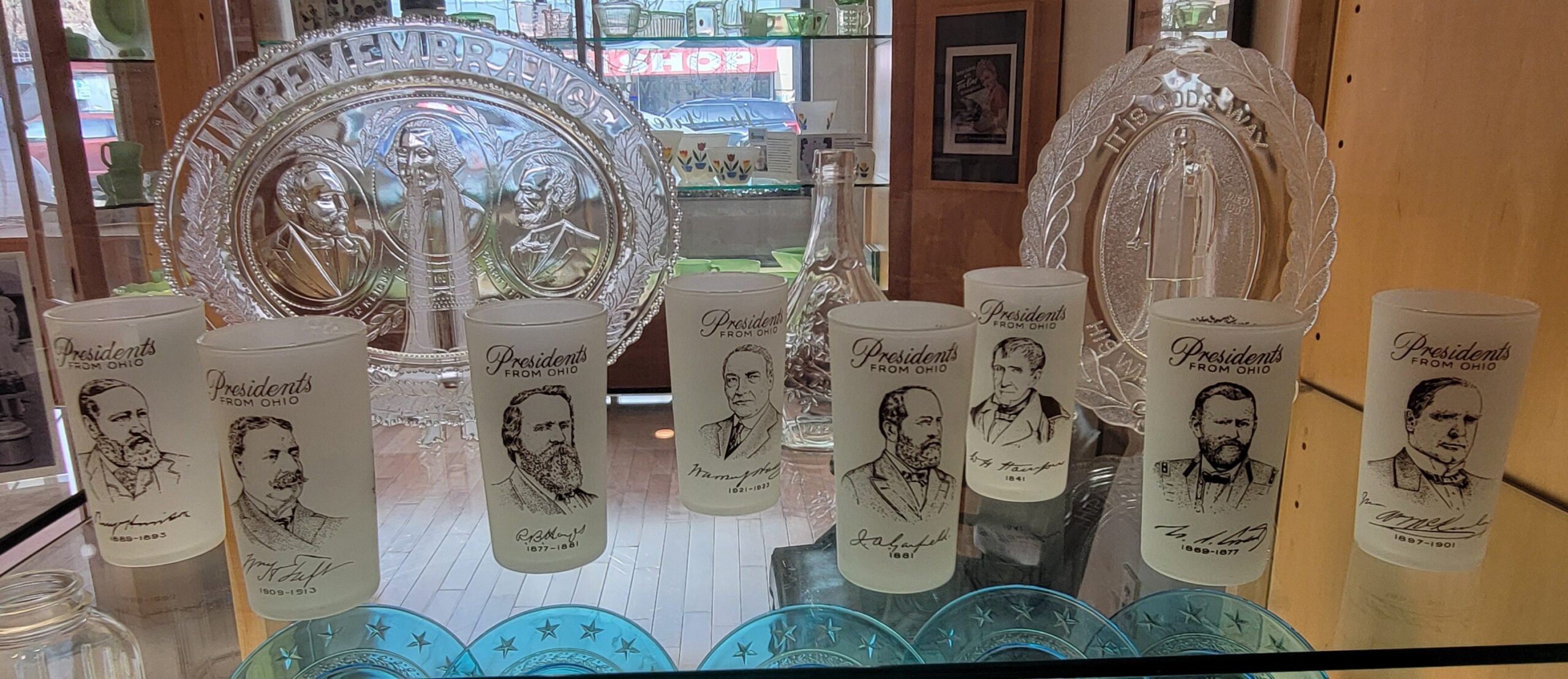
[Image above] Set of glasses featuring U.S. presidents from Ohio on display at the Ohio Glass Museum. Credit: Laurel Sheppard
Learn more about the CTT special series on the Ohio Creativity Trail and find links to all the ceramic and glass sites highlighted in this post.
With vast reserves of natural gas and high-quality silica sand, Ohio became a glass manufacturing powerhouse during the 1800s. All around the state, in large cities and smaller towns, factories sprung up to take advantage of these resources.
Toledo often receives a lot of attention for its glass history, even sporting the nickname The Glass City. This nickname is due largely to the famous Libbey Glass Company (now Libbey Inc.), which was initially founded in 1818 in Cambridge, Mass., but has operated out of Toledo since 1888. (Stay tuned for a future article about the Toledo Museum of Art’s Glass Pavilion.)
However, there is another smaller city in Ohio that is also known as The Glass City: Lancaster, located about 30 miles southeast of Columbus in Fairfield County. Although some of the earlier glass companies in this region went out of business after only a couple years, Anchor Hocking (founded in 1905 as the Hocking Glass Company) is still in business.
Anchor Hocking grew into one of the world’s largest manufacturers of household glassware through several early acquisitions and mergers, including Lancaster Glass Company in 1924 and Anchor Cap and Closure Corporation in 1937. The company still produces bakeware, serveware, food storage, and drinkware, and if you check your kitchen cupboards, I’m sure you will probably have at least one of their products. (I have several measuring cups and storage containers.)
You can take a deep dive into Anchor Hocking and Lancaster’s glass history by visiting the Ohio Glass Museum, which I did in December 2025.
Ohio Glass Museum: Exploring society through glassware
The Ohio Glass Museum features unique exhibitions that change throughout the year. I was fortunate that the exhibit during my visit—Shaping Society: Glassware as Social Commentary, which runs through August 2026—focused so heavily on the history of glassware.
The Shaping Society exhibit explores how manufactured glassware tells a deeper story about society. As the brochure states, each item was chosen to “highlight the significant, yet often overlooked, role of everyday glassware in shaping and reflecting cultural narratives.” You can see some of these items in the video below.

Credit: The American Ceramic Society, YouTube
The Museum’s collection also includes pieces from other Ohio glass companies outside of Lancaster and Fairfield County. For instance, 500 pieces manufactured by the Degenhart Crystal Art Glass Company in Cambridge, Ohio, were donated in 2012. Founded by John and Elizabeth Degenhart in 1947, the company produced glass paperweights, salt and pepper shakers, and various figurines, among others. Elizabeth assumed sole ownership of the company after John died in 1964, and she helped establish the Degenhart Paperweight & Glass Museum in Cambridge. She was so well known in Ohio’s glassmaking industry that Governor James A. Rhodes declared her the state’s “First Lady of Glass” in 1975.
Being of Swedish descent, I was also thrilled to learn about two Swedish brothers, Carl and Steven Erickson. Carl worked for several glass companies, including Libbey Glass, and designed a chandelier used in the movie Camille, starring Swedish-born actress Greta Garbo. Carl also reproduced many historical pieces for major museums, including the Smithsonian and the Metropolitan Museum of Art.
In 1943, the Erickson brothers opened their own glassworks in Bremen, Ohio, and continued to operate it until 1961. Erickson Glassworks was famous for its “controlled bubble” or bullicante glass, where bubbles are evenly distributed throughout the piece, as well as its “flame” technique, which involved trapping vibrant colored, wispy glass designs between two layers of clear glass.
You can also try making glass yourself at the museum’s hot glass studio, which was established in 2010. Take a look at their classes at this link and watch museum glassblowers in action in this video.
Gay Fad Studios: Barware like no other
Lancaster is also home to Gay Fad Studios, which was originally run by artist and businesswoman Frances “Fran” Taylor from 1945 to 1962. Taylor was a pioneer in decorating everyday glassware, including drinkware, and also recognized other talented women artists by employing them in both artistic and leadership roles.
Sixty years after the company originally closed, Gay Fad Studios was resurrected by Jason and David Annecy in 2022. In addition to a retail store, the company’s storefront in Lancaster houses a museum showcasing a collection of more than 6,000 original glassware, along with original photographs, artwork, and other artifacts. Read more about Gay Fad Studios’ history and revival in this June 2024 CTT.
Further information
Watch this video to learn more about the history of glass manufacturing in Fairfield County Ohio, including a connection to the Statue of Liberty.
Watch this video to experience a virtual tour of the Ohio Glass Museum and Gay Fad Studios.