
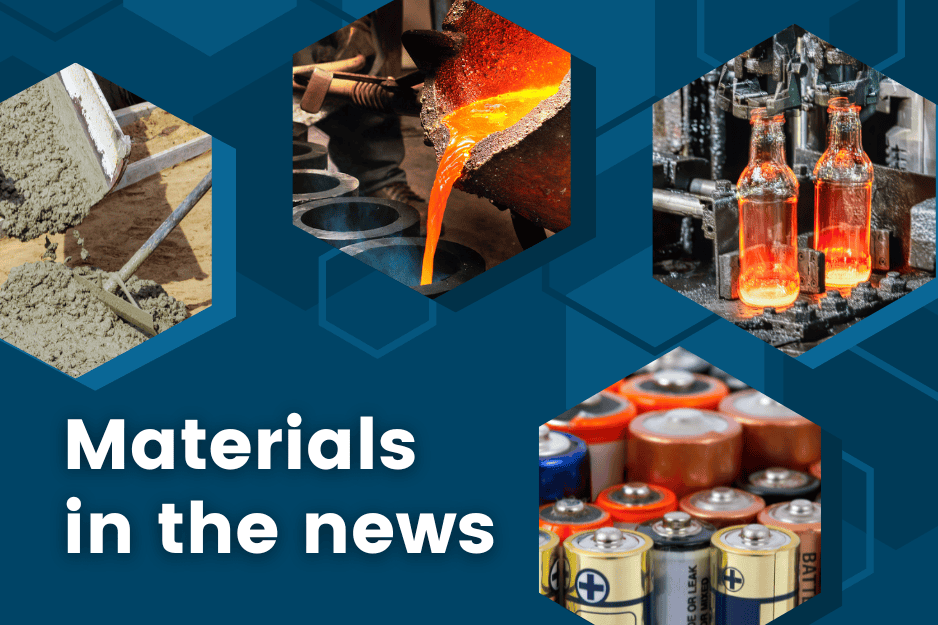
[Image above] Credit: ACerS
NANOMATERIALS
Engineers reveal molecular dynamics that underpin concrete’s durability
A new molecular dynamics study by Rice University researchers reveals how water and ions move through the nanopores of calcium silicate hydrate, the fundamental building block of cement.
Imaging of twist domains and polarities in 2D materials
Researchers led by National Institute for Materials Science produced nanoscale images of two key features in monolayer molybdenum disulfide—twist domains (areas where one atomic layer is slightly rotated relative to another) and polarities (differences in atomic orientation)—by combining scanning transmission electron microscopy with artificial intelligence.
ENERGY
First graphene-based solar cells used to power temperature sensors
Researchers at the University of Arkansas and the University of Michigan reported the first use of ultralow-power temperature sensors using graphene-based solar cells. The end goal is development of multimodal sensors using the energy-harvesting capability of graphene.
‘Energy sandwich’ could power next-generation solar and lighting
University of Cambridge researchers used a vapor-based technique to grow 3D and 2D halide perovskites one layer at a time, which enabled them to control the thicknesses of the films down to fractions of an atom.
MANUFACTURING
Gas-switch-triggered reduction technique enables alloying in supported catalysts
Nagoya Institute of Technology researchers presented a simple, scalable method for synthesizing supported catalysts with alloyed metals. They achieved simple impregnation-based alloying of an immiscible ternary rhodium–palladium–platinum system on nonreducible alumina via a gas-switch-triggered reduction method.
Smarter robots could help autistic adults thrive in manufacturing jobs
Researchers at Virginia Tech are aiming to increase autistic employment rates in manufacturing jobs by designing collaborative robots, or “cobots,” that can work alongside neurodivergent workers and provide real-time feedback and personalized support.
OTHER STORIES
‘Hyperconnected’ atomic state determines if glass shatters or bends
Seoul National University researchers experimentally confirmed a “hyperconnected” state in glass under pressure 120,000 times that of the atmosphere. They determined that different types of glass reach this hyperconnected state at different pressures, and this variation dictates their breaking characteristics.
Researchers help break thermal conductivity barrier with boron arsenide discovery
In a collaborative study with the University of California, Santa Barbara, and Boston College, University of Houston researchers found the thermal conductivity of boron arsenide can compete with diamond.
Reading a quantum clock costs more energy than running it
Researchers led by the University of Oxford identified a surprising source of entropy in quantum timekeeping: the act of measurement itself. They demonstrated that the energy cost of reading a quantum clock far outweighs the cost of running it, with implications for the design of future quantum technologies.
Physicists discover new state of matter in electrons
Florida State University physicists showed the conditions necessary to stabilize a phase of matter in which electrons exist in a solid crystalline lattice but can “melt” into a liquid state, known as a generalized Wigner crystal.