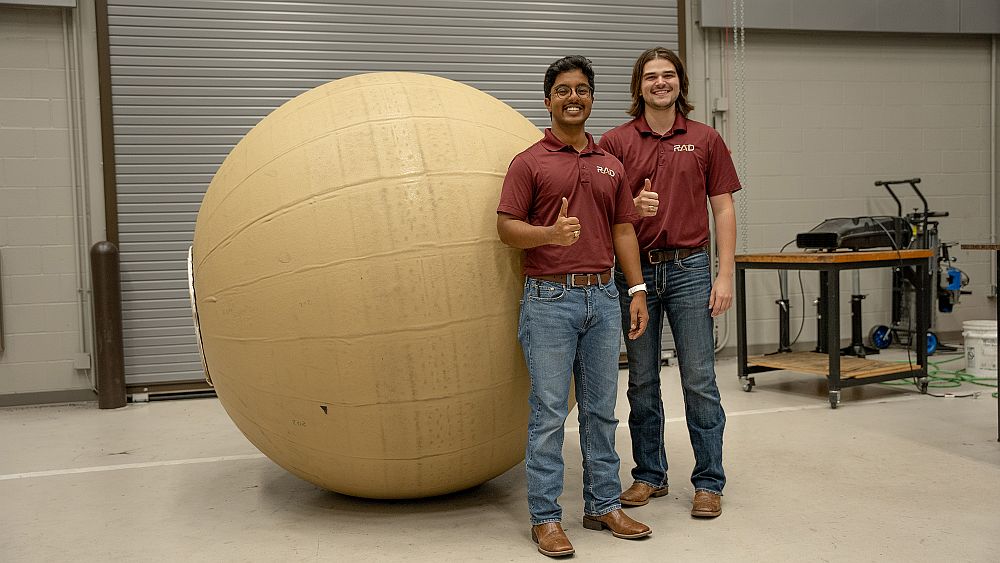
[Image above] Graduate students Rishi Jangale (left) and Derek Pravecek standing next to RoboBall III. Credit: Emily Oswald, Texas A&M Engineering
R2-D2 is an icon of the Star Wars cinematic universe, appearing in all nine main films and often holding the critical information necessary to save the galaxy. But putting aside his spunky personality and heroic acts, R2-D2’s design faced some major technological drawbacks, notably the inability to right himself after falling over.
Enter BB-8, a next-generation droid who appeared in the sequel trilogy films. In contrast to R2-D2’s three-leg design, BB-8 had a half-dome head on top of a rotating spherical body, allowing him to overcome the mobility and stability challenges faced by his predecessor.
However, although BB-8 effortlessly traverses difficult terrain in the movies, designing and building a robot with no fixed top or bottom in real life remains a difficult task. It requires engineers to balance nonlinear internal mechanics with dynamic environmental interactions, culminating in a highly complex system that no one has yet perfected.
In 2003, Robert Ambrose dabbled with sphere-shaped robots when working at NASA, but he shelved the idea to focus on drivable rovers for astronauts instead. However, after joining Texas A&M University as a faculty member in 2021, he rekindled his work on spherical designs through the newly established Robotics and Automation Design Lab (RAD Lab).
Ambrose’s research on sphere-shaped robots centers around the RoboBall, the design he originally conceived of at NASA. This soft-shelled, rugged spherical ball is driven by a two-degree-of-freedom pendulum for forward propulsion and steering.
All essential components for the RoboBall are completely sealed within the protective shell. This design choice protects the robot’s sensitive hardware, allowing it to “roll out of water onto sand without worrying about orientation,” says Ambrose in a press release. However, it also means the robot can only be accessed electronically, and so any mechanical failure requires the RoboBall to be completely disassembled and rebuilt.
Graduate students Rishi Jangale and Derek Pravecek have played a significant part in the RoboBall’s development. Their efforts led to versions two and three of the RoboBall, which are two feet and six feet in diameter, respectively.
“The autonomy Rishi and Derek have is exactly what a project like this needs,” Ambrose says in the press release. “They’re not just following instructions—they’re inventing the next generation of exploration tools.”
Learn more about the RoboBall, which can currently reach up to 20 miles per hour, in the video below.

Credit: Texas A&M Engineering, YouTube
_______________________________
April 4–12 is National Robotics Week in the United States. Learn about events taking place nationwide to celebrate the robotics industry at this link: https://www.nationalroboticsweek.org/events.