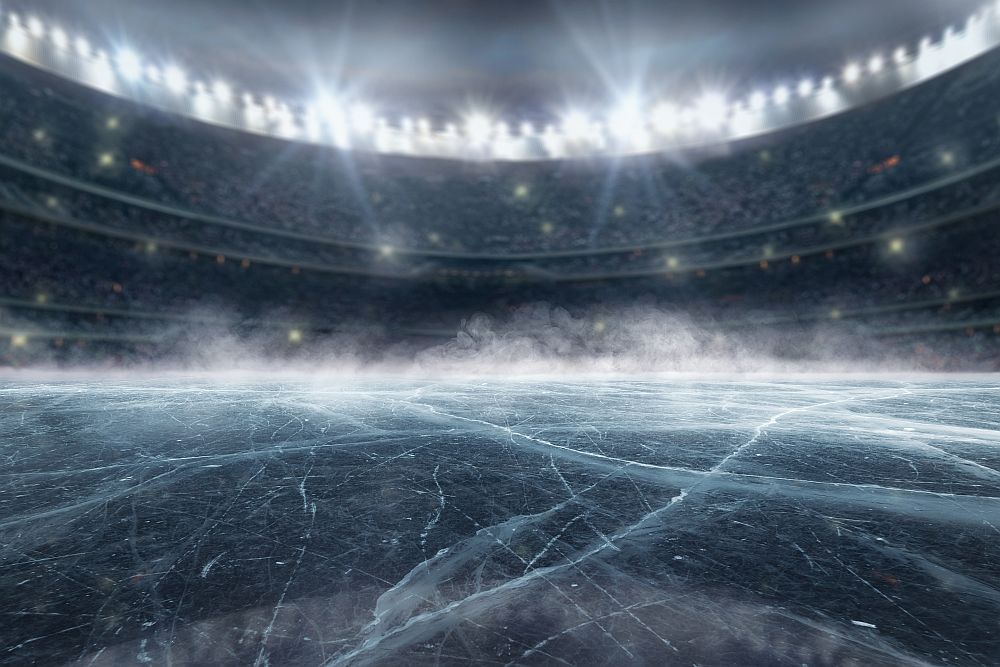
[Image above] Close-up picture of ice in a hockey rink. Credit: Igor Link, Shutterstock
As an uncoordinated 4-year-old learning to move around in hand-me-down, double-bladed, strap-on skates, I viewed ice as a treacherous enemy. The town pond’s surface never saw a Zamboni, and we were lucky if it was even thoroughly shoveled. It was a wildly uneven surface, but the thrill of almost effortlessly sliding across it was undeniable. (At least until you hit a random stick or rock embedded in the surface—worth the risk of some bruises, for sure.)
Back then I did not know that indoor ice existed or that its physical characteristics could be manipulated in precise ways to tailor its surface. But as I watched the early Olympic training rounds for speed skating, curling, and hockey, I recognized the work of a cadre of ice meisters monitoring conditions behind the scenes.
Adding to their challenges, the Milan Cortina Olympics have created the first temporary speed-skating oval ever built in a convention center. One of the hockey rinks is also temporary, leaning into this Olympic city’s commitment to sustainability. Permanent arenas have their pipes buried in concrete. In Milan, Italy, they are exposed on the floor, meaning the ice thickness must be perfectly uniform to prevent a 6-ton Zamboni from crushing the tubes or shifting the insulation.
Regardless of whether you are making childhood memories on a natural pond or demonstrating peak athleticism on precisely tuned indoor ovals, the underlying physics of ice remains a challenge for those tasked with caring for these slippery surfaces. This CTT looks at the ways in which ice properties are manipulated to provide the ideal surfaces for a variety of indoor winter Olympic sports.
(Although I will not discuss the outdoor sliding track sports, such as bobsled, luge, and skeleton, because the ice is subject to additional weather-related factors, I will for sure be watching them!)
Speed-skating ice: Hardness as a function of purity
Traveling 3 to 5 kilometers (2 to 3 miles) on a spongy woodland path or soft sandy beach can be exhausting because the unstable surface deforms with every step, wasting energy that otherwise would be used on forward motion. But traveling that same distance while trying to keep your balance at up to 64 km/hour (40 mph) on a thin layer of low-friction ice can be terrifying. Yet that is exactly what the sport of speed skating calls for, which is why the organizers of the Milan Cortina games brought in Mark Messer, a veteran ice meister from Calgary, Canada, to supervise their temporary long-track speed skating venue.
Speed-skating ice is kept at −7 to −4°C (19 to 25°F) for optimal hardness. But the water it is made from also has an optimal chemistry. To allow the least amount of friction, the water must be very pure. However, it cannot be just H2O. It needs a certain quantity of additional ions or it becomes brittle. Ions such as calcium anchor the crystal structure and prevent the ice from shattering under the immense pressure of high-speed turns. To achieve this chemistry, speed-skating ice is made from ultrapurified water that then has a small quantity of a specific mix of total dissolved solids added back in.
Another significant challenge is balancing the humidity and temperature of the indoor venue, especially when the refrigeration system needs to counteract the body heat of up to 7,500 spectators. The short-track speed-skating venue has another complication because the ice surface will be shared with the figure skaters, who need different ice conditions.
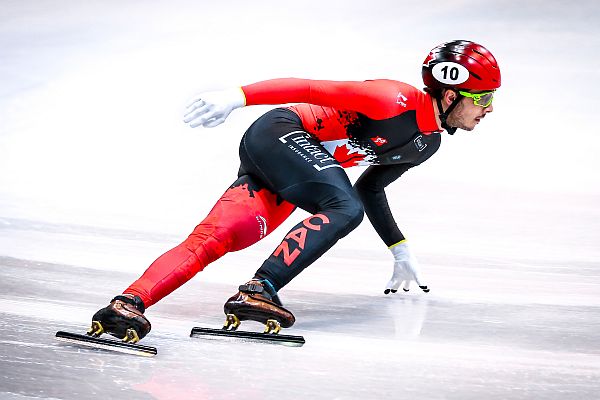
Picture of Canadian speed skater Samuel Girard competing during the 2019 ISU Short Track Speed Skating World Championship at the EnergieVerbund Arena in Dresden, Germany. Credit: Michele Morrone, Shutterstock
Hockey vs. figure skating: Who’s got the edge?
As any fan of the classic movie The Cutting Edge can tell you, a toe pick can really mess up your day. Beyond the blade geometry, figure skating and hockey require different ice surfaces as well, which can make competitions difficult to manage in a multipurpose rink.
Hockey ice is, like its stereotypical players, tough. (Are there any other Broad Street Bullies fans out there?) It is typically kept at approximately −6 to −5°C (21 to 23°F) to minimize friction for the puck and maximize glide for the skater. Hockey involves constant, explosive changes in direction by 12 heavily padded and helmeted players all on the ice simultaneously. Therefore, it must have high compressive strength. If it is too soft, the ice fragments, creating a layer of debris that slows the puck and increases drag.
Hockey blades have a curve on each end and a groove between the two outer edges. This geometry allows the skater to dig in for a turn, but the ice must be hard enough to resist deep gouging so that conditions are tolerable for the entire 20-minute period.
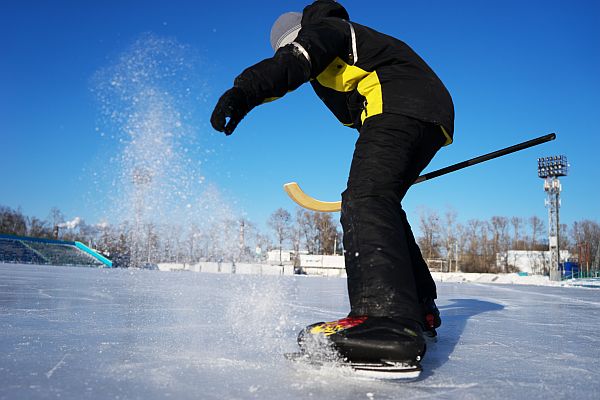
Example of ice fragmenting under the high compressive strength of a hockey player’s skates. Credit: Svetlana Bogomolova, Shutterstock
Figure skating ice is kept warmer, at approximately −4 to −3°C (25 to 27°F) to provide a cushion for landings and a grip for intricate edge work. At these warmer temperatures, the ice is more plastic than brittle. When a figure skater lands a triple Axel, they exert a force of 5–8 times their body weight on a single steel edge. The thermodynamics of this impact converts kinetic energy to heat, momentarily melting a microscopic path of ice, which then refreezes almost instantly.
The jagged tip of a figure-skate blade (called the toe pick) facilitates the athlete’s impressive leaps and twirls. The toe pick penetrates the ice to create a pivot point. If the ice were as hard as hockey ice, the toe pick would likely shatter the surface or skid across it, leading to a catastrophic fall. The warmer, softer ice allows the teeth to anchor securely into the lattice.
The figure skating blade, like a hockey skate, also has a groove. Figure skaters use a deeper groove with a smaller radius than hockey players. This geometry creates more bite into the softer ice, allowing for the extreme lean angles seen in pairs competitions. After a grueling routine, the warmer ice allows the ruts carved by toe-picks to be easily repaired by the Zamboni’s hot-water spray through rapid phase-change bonding.
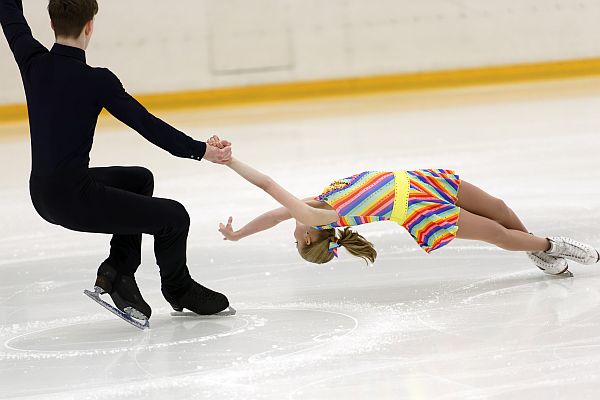
Figure skaters competing in the 2017 Prix of the St. Petersburg Federation. Credit: StockphotoVideo, Shutterstock
Considering these differences between hockey and figure skating, it is no wonder that practitioners of each sport may struggle to adapt to each other’s specialties, as this lighthearted two-part video challenge shows:
The great curling enigma
I saved the best for last: Curling involves pushing a 19.1-kg (42-pound) chunk of granite down a uniquely textured runway of ice. Additional team members vigorously sweep the ice ahead of the stone to try to guide it to the target zone (the house).
At the Olympics, all the curling stones come from Ailsa Craig, an island off the coast of Scotland. (Here comes the geology again!) The Ailsa Craig granite is fine grained and chemically distinct from other granites in the British Isles. Its hardness and mineralogical uniformity makes it prized as the material for stones at the highest levels of competition. The stones are concave on the bottom with only a 3- to 5-mm running band of stone touching the ice.
Like the granite of the stones, curling itself originated in what is now Scotland. The first written mention of the sport (in Latin) dates from 1540 CE, but the game is believed to be much older. The mechanics of curling are complicated, and the behavior of the curling stone particularly has been baffling to scientists for more than 100 years. Curling stones, unlike a baseball pitcher’s curve ball or a golfer’s slice, curve in the direction of their spin. That might be the weirdest part about curling, but the ice is unusual, too.
The surface of curling ice has a pebbled texture, created by spraying extremely pure warm water on the ice surface. The bed of the curling sheet is laid in thin layers, just as in ice skating sports. However, once it reaches an appropriate thickness, the curling ice technician adds texture. Purified water is heated to greater than 35°C (95°F) to remove the free oxygen and eliminate the potential for bubbles. Warm water freezes quickly, producing evenly distributed pebbles.
The pebbled texture and geometry of the stone must be considered together with the applied force to create the desired outcome. Obviously, curling was first played on natural ice, which as I mentioned can have an unpredictable surface. That surface became a key part of the game.
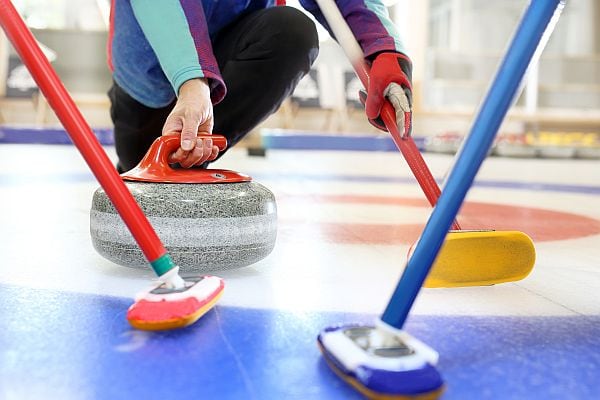
Close-up picture of a curling stone, brushes, and the pebbled ice. Credit: Robert Przybysz, Shutterstock
The future of indoor ice sports
While the skill of Olympic athletes is undeniable, their feats are made possible by the ice meisters who prepare the highly engineered rinks on which they perform. The Milan Cortina games will be a test of the first temporary indoor ice facilities, perhaps enabling the introduction of ice sports to wider audiences. It may also inspire a new career path for students studying ceramics, as ice is a unique material that arguably falls in the ceramist’s wheelhouse!