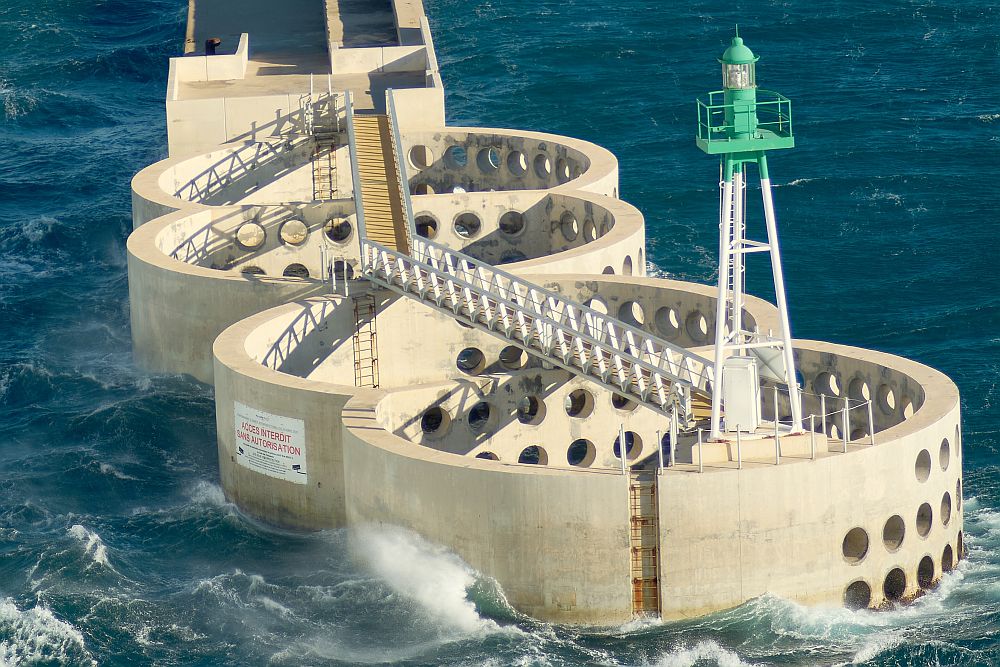
[Image above] Example of a wave energy converter installed along the Marseille coast in France. These converters are designed to serve as both energy producers and coastal defenses. Credit: Mundofoto / Shutterstock
When discussing trends in renewable energy, solar and wind power typically dominate the headlines. But we tend to overlook another substantial source of renewable power capacity—hydropower.
Hydropower is one of the oldest sources of energy, with confirmed early applications dating back more than 2,000 years. It involves harnessing the kinetic energy of moving water to generate mechanical or electrical energy, although the latter is a relatively recent development coinciding with the development of electricity as a usable energy source in the 19th century.
Hydropower is consistently ranked as the largest renewable energy source, but its relative percentage of global power capacity is decreasing due to other sources (notably solar) growing at a faster rate. There are numerous factors at play in this trend, but one is that hydropower requires specific topography—such as rivers with consistent flow and suitable valleys—and most ideal sites are already developed.
However, these statistics are slightly misleading because they are not based on all types of hydropower. As explained on the International Hydropower Association’s website, there are four main types of hydropower projects: run-of-river, storage, pumped storage, and offshore. The first three types are based on water movement in rivers and reservoirs, and these types are the ones used in global energy projections.
In contrast, offshore hydropower refers to a less established but growing group of technologies that use tidal currents or the power of waves to generate electricity from seawater. It holds immense global potential as a renewable and predictable power source, but because the technology is still in the early stages of development, it does not factor into most global power estimates.
Developing offshore hydropower systems comes with unique challenges, however, compared to the traditional river and reservoir systems. For example,
- Harsher environment: Unlike river or reservoir systems, which operate in freshwater, tidal and wave systems are exposed to corrosive saltwater. They are also typically exposed to more extreme weather events, which damage equipment and increase maintenance costs.
- Lower energy density: Tidal and wave systems operate with much lower water head (height difference) than river and reservoir systems, which typically use water falling tens or hundreds of feet. The lower water head makes energy extraction less efficient.
- Less predictability: While river and reservoir systems are designed to control the water flow, allowing for predictable electricity generation, tidal and wave systems rely on natural, ocean-based movements. The variable flow conditions influence turbine design, requiring robust control systems to handle dynamic loads and maintain efficiency.
Considering all these challenges, it can be difficult to efficiently test the feasibility of new designs. Fortunately, a group of researchers from several different universities recognized this dilemma, and in February 2026, they published the first standardized methodology for prototyping small-scale wave energy converters.
The researchers are led by the University of Michigan and include collaborators from Cornell University, Georgia Institute of Technology, and Princeton University. To create their open-source framework, they designed and validated two wave energy converter architectures: a heaving point absorber, which bobs up and down with waves, and an oscillating surge wave energy converter, which rotates about a hinge.
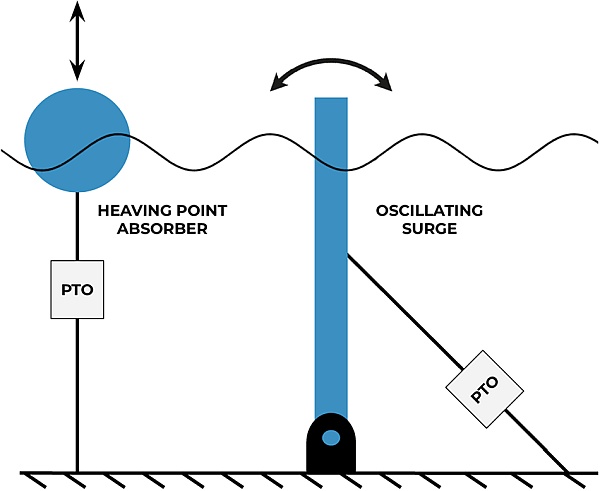
The heaving point absorber (left) bobs up and down with waves while the oscillating surge wave energy converter (right) rotates laterally with the waves. Both prototypes are moored to the floor with a power take-off (PTO) attached to convert wave motion into rotational motion needed for electricity generation. Credit: Vitale et al., Journal of Mechanical Design (CC BY 4.0)
During the design process, the researchers recorded detailed notes on relevant design considerations, including the testing facility, fluid regime, model physics, mechanical design, and electrical design. They also developed solutions to two common small-scale engineering hurdles, namely friction (addressed using a rack-and-pinion power take-off) and electrical resolution (addressed using motor controllers).
In a press release, senior author Maha Haji, assistant professor of mechanical engineering at the University of Michigan, says that “Having this standardized methodology will reduce repeated mistakes in early development, launching the technology further toward commercialization.”
The open-access paper, published in Journal of Mechanical Design, is “Design, build, and analysis of small-scale wave energy converter prototypes” (DOI: 10.1115/1.4070757).