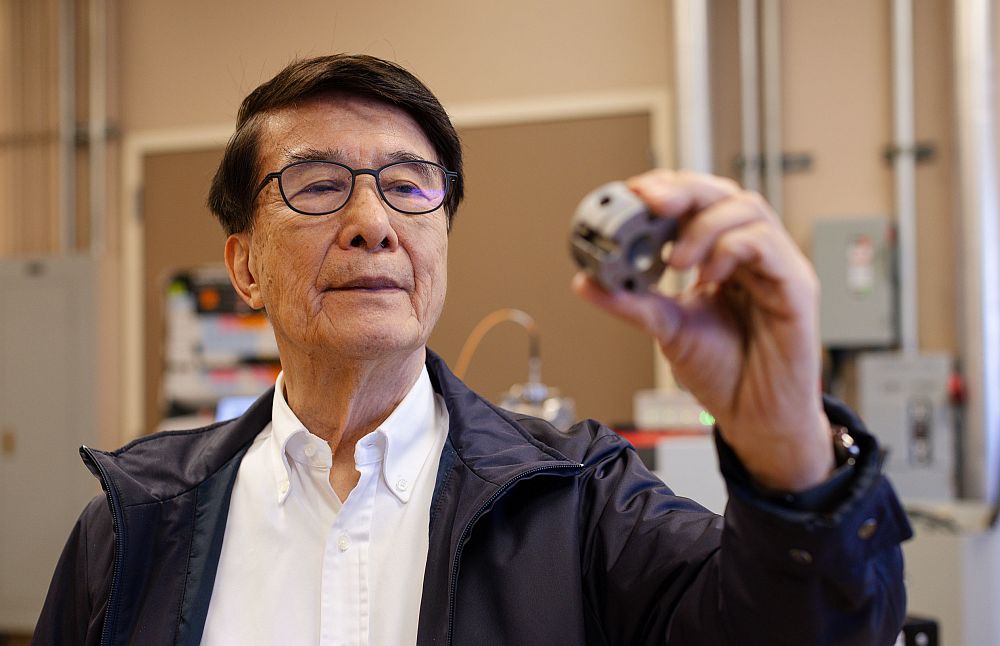
[Image above] Professor Ching-Wu Chu holds a diamond anvil cell in a University of Houston lab. The cell was used to help UH researchers break the temperature record for superconductivity at ambient pressure. Credit: University of Houston
Media hoaxes are a whimsical tradition for April Fool’s Day, but sometimes real scientific breakthroughs can be overlooked if the public announcement is unfortunately planned for that day. But seeing as today is April 2, you can trust that the three recent studies described below are all genuine—surprising as the results may be.
Record high superconductivity temperature at ambient pressure
On March 10, the University of Houston (UH) announced that researchers at its Texas Center for Superconductivity broke the ambient-pressure temperature record for superconductivity—an achievement that could eventually lead to more efficient ways to generate, transmit, and store energy.
Superconductivity is a quantum phenomenon in which materials exhibit no electrical resistance and expel magnetic fields when cooled below a so-called “critical temperature.” The lack of electrical resistance means that superconducting cables might carry up to 10 times more power than conventional cables, a property that could overhaul power grids to be more sustainable.
Since the phenomenon was discovered in 1911, researchers have slowly uncovered new kinds of superconducting materials that can achieve this unique quantum state at higher and higher temperatures. However, for the past three decades, no group has beaten the ambient-pressure record set by the mercury-based copper oxide known as Hg-1223, which superconducts at up to -140.15°C (133 K).
The UH researchers broke this longstanding record when they achieved ambient-pressure superconductivity at -122.15°C (151 K). Their novel superconducting material is also a mercury-based copper oxide, but they used a special treatment technique called pressure quenching to beat Hg-1223’s record by 18 degrees.
Pressure quenching involves applying intense pressure to a material to enhance its superconducting properties. The material is then cooled to a specific temperature before the pressure is rapidly released, effectively “locking in” the enhanced superconducting properties.
In a press release, senior author Ching-Wu Chu, T.L.L. Temple Chair of Science and chief scientist at the UH Texas Center for Superconductivity, says, “This finding has great potential. We believe, with enough people working on it and given enough time, we should be able to realize the potential.”
The open-access paper, published in Proceedings of the National Academy of Sciences, is “Ambient-pressure 151-K superconductivity in HgBa2Ca2Cu3O8+δ via pressure quench” (DOI: 10.1073/pnas.2536178123).
Chu is also co-author on a companion perspective paper that outlines six different methods for tuning or transforming materials to reach higher-temperature superconductivity, including pressure quenching. Read that open-access paper here.
Collective magnetic dynamics challenge 300-year-old law of friction
On March 18, researchers at the University of Konstanz (UKON) in Germany reported a new mechanism of sliding friction: a non-monotonic resistance to motion driven purely by collective magnetic dynamics.
This finding challenges the laws of friction developed by French inventor and physicist Guillaume Amontons in 1699. Specifically, Amontons’ first law asserts that there exists a monotonic relationship between frictional force and the applied load. In other words, as two surfaces are pressed together more forcefully, friction also increases proportionately.
In the new paper, the UKON researchers carried out a tabletop experiment that contradicts this long-accepted law. Their experiment involved moving a 2D array of freely rotating magnetic elements above a second magnetic layer. Although the two layers never came into physical contact, their magnetic coupling gave rise to a measurable friction force. This force peaked at intermediate distances and then decreased as the layers moved closer together, in contrast to Amontons’ established linear relationship between frictional force and the applied load.
“What is remarkable is that friction here arises entirely from internal reorganization,” says senior author Clemens Bechinger, professor of soft condensed matter at UKON, in a press release. “There is no wear, no surface roughness, and no direct contact. Dissipation is generated solely by collective magnetic rearrangements.”
The researchers express hope that in the long term, this finding will open new possibilities for contactless friction control; magnetic sensing; and the design of reconfigurable, wear-free frictional interfaces and metamaterials.
The paper, published in Nature Materials, is “Non-monotonic magnetic friction from collective rotor dynamics” (DOI: 10.1038/s41563-026-02538-1).
Single-phase solid embraces both crystalline and amorphous structural order
On March 23, the University of Twente (UT) in the Netherlands announced that researchers led by its MESA+ Institute for Nanotechnology created a single-phase material with both crystalline and amorphous structural order depending on the dimension being observed.
People often assume that order or disorder is a property of the whole material, says senior author Mark Huijben, full professor of nanomaterials for energy conversion and storage at UT, in a press release. However, “Our work shows it can also be a matter of direction.”
The new material consists of extremely thin layers of niobium–tungsten–oxygen with no repeating pattern within each layer. However, the layers are stacked on top of one another in a perfectly periodic sequence. As a result, X-ray scattering analyses of the material resulted in diffuse patterns within two directions (suggesting an amorphous structure) and sharp signals in the third direction (suggesting a crystalline structure).
“Many emerging materials rely on properties that lie between amorphous and crystalline regimes,” the researchers write in the open-access paper. “Our work opens important avenues of exploration and provides a unique platform for computational modeling of the 2D amorphous matter stacking.”
The open-access paper, published in Nature Communications, is “Orientation-dependent mutual crystalline and amorphous order in a single phase solid” (DOI: 10.1038/s41467-026-69359-3).