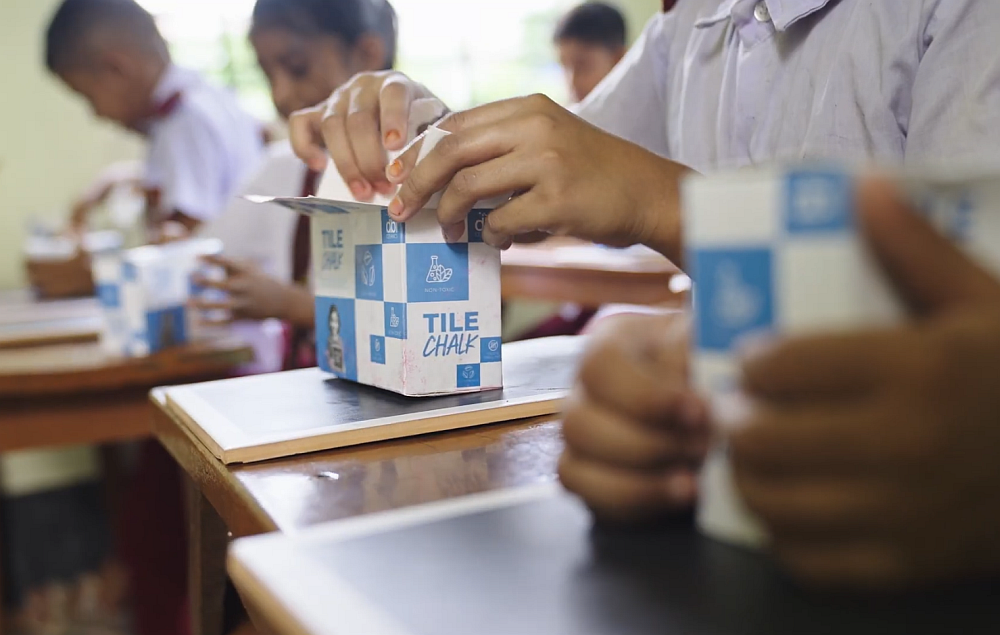
[Image] Students at an underserved school in Bangladesh use chalk sticks and slate boards created from wastewater sludge and broken tiles, respectively. Credit: DBL Ceramics, YouTube
Ceramics manufacturing is a time- and energy-intensive process, which means upfront costs can be substantial. But given the right market demands, investing in this industry can pay off in the long term, as we are currently seeing in the South Asian country of Bangladesh.
Traditionally, Bangladesh’s economy is overdependent on a single sector: ready-made garments. This sector accounts for more than 84% of national exports and nearly 20% of national GDP.
But between 2008 and 2018, strong domestic demand from a rising middle class contributed to Bangladesh’s ceramic industry experiencing significant growth in its production capacity—approximately 200%—according to a study funded by the United States Agency for International Development.
Bangladesh now exports ceramic products to more than 50 countries. But it is not yet a net exporter “Because we still have challenges in sustainable cost competitiveness, design innovation, logistics efficiency, productivity, and energy management,” said Sheikh Bashir Uddin, advisor to the Ministry of Commerce, while inaugurating Ceramic Expo Bangladesh 2025. “We need to identify these [challenges] and move toward realistic solutions.”
In October 2025, tile producer DBL Ceramics announced an innovative solution to one of the main challenges: what to do with the waste generated by ceramics manufacturing.
The waste in this case is a type of residue sludge generated during the water recycling processes at the company’s ceramics plant. As explained in a Branding in Asia article, DBL Ceramics determined the sludge could not be discharged into landfills without risking soil and water contamination, so they needed another way to handle the waste.
DBL Ceramics partnered with chalk manufacturers and, through six months of experimentation, found a way to reengineer the residue sludge into chalk sticks. They also developed a process to repurpose broken tiles into lightweight slate boards, and now the first batch of 10,000 chalk-and-board sets has been distributed to underserved schools across Bangladesh through partnerships with local nongovernmental organizations.
To scale the impact, DBL Ceramics made the formula for their waste-based TileChalk sticks open-source and even sent letters to competitors, urging them to adopt similar practices. The company also signed memorandums of understanding with local chalk manufacturers “to give them raw material free of charge in order to revive the dying industry,” according to the Branding in Asia article.
Learn more about how TileChalk is created in the video below.