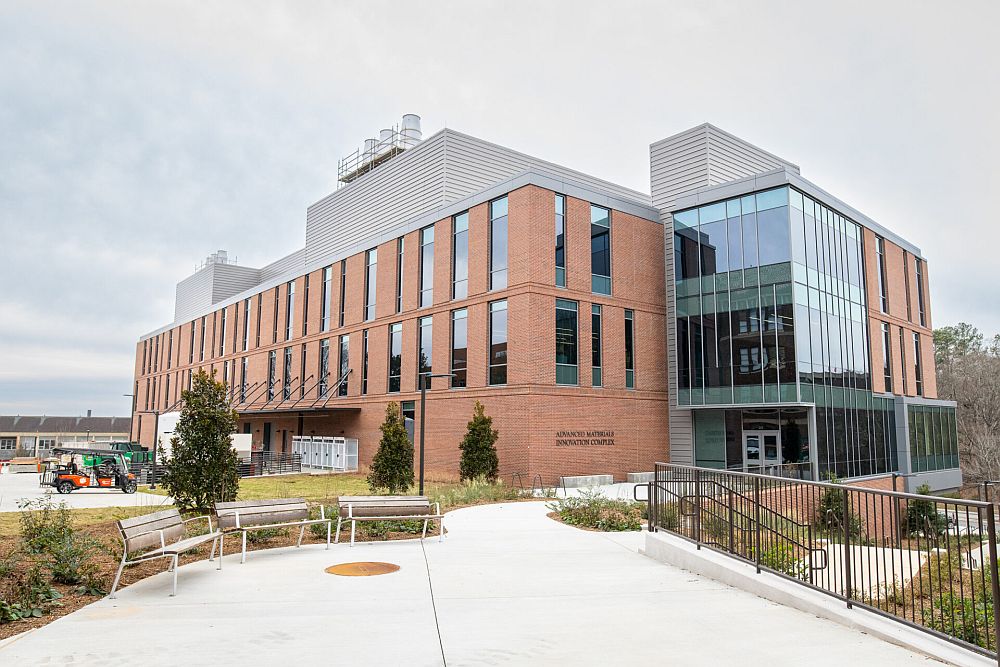
[Image above] The Advanced Materials Innovation Complex at Clemson University, shown here, demonstrates one way to continue supporting basic science research in the face of recent federal funding cuts. Credit: Clemson University
The last year has been devastating for federal research funding in the United States. As knock-on effects reverberate across the academic spectrum, the withdrawal of support for basic research and development is beginning to signal an innovation drought for private industry.
But even though U.S. researchers have come to rely on federal funding to support fundamental science studies since the mid-20th century, studies which largely take place at universities, it is not the only paradigm for funding basic research. The recent grand opening of Clemson University’s newest research hub, the Advanced Materials Innovation Complex (AMIC), is a prime example of how basic science can continue to persist during these economically fraught times.
Inside the shifting federal funding landscape
Sweeping changes by the U.S. government under the current administration have produced significant disruptions in grants from the National Science Foundation (NSF), the National Institutes of Health (NIH), and the Environmental Protection Agency (EPA). The traditional federal grants that remain available have higher competition and lower success rates. The continuation of these grants also faces more conservative funding decisions.
Furthermore, the recent funding cuts are reducing opportunities for the pipeline of qualified, young researchers. The Fulbright program, once the gold standard for academic exchange, has been particularly hard hit. In protest, its board resigned en masse in 2025. Additionally, immigration bans and new student visa requirements have further reduced the pool of available university students.
These factors together represent a great risk to basic research, which faces drastic funding cuts. But every scientist knows that you cannot get useful inventions and applications if the basic research does not happen. The innovation pipeline for the 2030s is effectively being capped by today’s reduced funding levels.
The talent magnet: Clemson’s AMIC attracts the best and brightest
In this era of constrained federal research and development budgets, Clemson built a magnet to supply a highly skilled workforce to South Carolina’s advanced materials industries.
The US$130 million, 150,000-square-foot state-of-the-art AMIC facility houses the University’s materials science and engineering (MSE), chemistry, and chemical and biomolecular engineering departments. The space is designed to let ideas naturally flow between disciplines.
Clemson University is one of South Carolina’s public land-grant universities, meaning that it is funded by the state. So, although the University received federal scientific grant money for the research taking place at AMIC, the building’s construction was paid for with state money and private investments.
The success of the building’s mission is evidenced by the recent arrival of Fulbright Scholar Merle Wellmann. Wellmann researches advanced ceramics for energy technologies (solid-oxide fuel cells) and was drawn specifically to AMIC’s unique capabilities. The facility holds equipment for electrical conductivity relaxation experiments, a rare technique that has accelerated Wellmann’s expertise.
Clemson University had a reputation for high-quality research before building the AMIC. The new facility will provide greater scope for innovators such as Jessica Larson, who is developing nanoparticles that could pass an RNA vaccine through the blood–brain barrier to treat Alzheimer’s disease or bring therapies past the blood–nerve barrier to treat nerve pain.
The open labs and synergistic classrooms within the AMIC are intended to break down silos between disciplines. Such interdisciplinary science and engineering buildings are a recent trend on university campuses to enable cross-pollination between researchers (see this other example at the University of Delaware). They are also designed to attract investment from private corporations, who rely on access to low-stakes research and development supported by universities. This setup is particularly relevant in the United States today.
Bridging the gap: The new university funding playbook
What can other universities learn from the AMIC’s success? Building industry partnerships is becoming more important. Clemson leverages its location in South Carolina, which is home to more than 950 advanced materials companies, to secure corporate R&D investment. An example is the recent donation from Kyocera AVX to support the AMIC’s interdisciplinary laboratories, with naming rights to the lobby.
Of course, philanthropy and private donors have always been a strong source of university funding. My own alma mater was renamed Colgate University in 1890 to honor the financial support of the Colgate family (yes, the toothpaste people—although the family was not consulted about the change). However, private philanthropic donations carry some ethical concerns. The negative consequences of extending naming rights to private individuals is perhaps best evidenced by the case of the Sackler family.
Another strategy for funding includes the creation of regional innovation centers. Many academic institutions are becoming economic engines for their states, securing state-level funding by promising workforce development and local job creation. Local industry clusters such as biotech in Massachusetts and the greater Philadelphia region, quantum technology in Maryland and Chicago, and the nuclear hub in Idaho and Wyoming.
A third option for replacing federal grant money is to promote entrepreneurship among Ph.D. students. This approach leverages the value of intellectual capital to generate revenue through patents and startups. The National Science Foundation’s Innovation Corps was developed as a federally supported kickstarter for private capital access. Examples of centers designed to bridge the gap between academia and entrepreneurship include the University of Delaware’s STAR Campus, the University of Pennsylvania’s Pennovation Works, and the Spark Innovation Center at the University of Tennessee.
Learn about additional options for securing basic research funding to fill the government gap in the April 2026 Bulletin, which publishes online tomorrow!
A model for the future
Despite the reduced federal funding opportunities for basic research and development in the U.S., there are glimmers of promise. The AMIC and other centers like it are strategic responses to a changing financial ecosystem. Such infrastructure-first strategies represent a feasible way for U.S. universities to remain competitive in advanced materials research and development during lean federal years.
Innovation always finds a way, as evidenced by the saying “necessity is the mother of invention.” This saying is originally attributed to Plato more than 2,000 years ago, who wrote in The Republic that “our need will be the real creator.” Making good on such a promise, however, requires a more diverse portfolio of support than ever before.