Webinar Description
Hosted by: ACerS Art, Archaeology & Conservation Science Division
Friday, March 20, 2026; 12:00–1:00 p.m. Eastern US time
Sponsored by the ACerS Art, Archaeology & Conservation Science Division, the March webinar will feature one speaker: From Glass Furnaces to the Illuminator’s Palette: Experimental Insights into Byzantine Lead–Tin Yellow Synthesis
Description
From Glass Furnaces to the Illuminator’s Palette: Experimental Insights into Byzantine Lead–Tin Yellow Synthesis
Lead-tin yellow was a very popular pigment, loved by artists for its bright color and opacity. It is most well-known for its use in oil paintings in the 15th-17th centuries, but recent findings have revealed its presence in objects from as early as the 12th century. Since traditional understanding of its production stems from recipes dating to the 15th century, these early occurrences open questions about how it was being made three centuries earlier. In this webinar, we’ll explore what the earliest known object containing lead-tin yellow can tell us about the origins of this pigment. We will introduce its two forms—Type I (Pb₂SnO₄) and Type II (PbSn₁₋ₓSiₓO₃)—and why their differences matter. Finally, we will discuss some current experimental research aimed at understanding historical production conditions and investigating why both types of lead-tin yellow appear together in a Byzantine manuscript.
Join us for a deep dive into an early synthetic pigment, discover how its story is being informed by science, and explore an intriguing potential link to glassmaking.
Biography
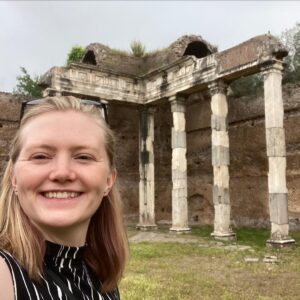
Sarah Grabowski, Archaeological Scientist
Sarah Grabowski is an archaeological scientist studying ancient materials and technologies. She holds a BS in Optical Engineering from the University of Rochester and an MSc in Archaeological Science: Materials and Technology from University College London where her dissertation explored the pottery traditions of the Neolithic site of Soline, in modern-day Croatia. In her recent position as a graduate intern at the Getty Conservation Institute, she researched the Byzantine production of lead-tin yellow pigments through experimental investigations. Currently, she is pursuing her PhD at the University of Cambridge, where she examines early Egyptian metallurgical practices through the study of copper funerary objects at the British Museum—a collaboration funded through the UKRI Arts and Humanities Research Council (AHRC). Broadly, her research focuses on understanding the production of inorganic cultural heritage materials—including metals, ceramics, glass, and pigments—with an emphasis on spectroscopic techniques.
ACerS member: no cost
ACerS GGRN and Material Advantage student member: no cost
Non-member: no cost
Non-member student: no cost
If you have any questions, please contact Vicki Evans.
This webinar is brought to you by the ACerS Art, Archaeology & Conservation Science Division.
To view past ACerS webinars, click here.