Webinar Description
Hosted by: ACerS International Italy Chapter and ACerS International Türkiye Chapter
Monday, April 20, 2026; 8:00a.m. – 9:00a.m. Eastern US time
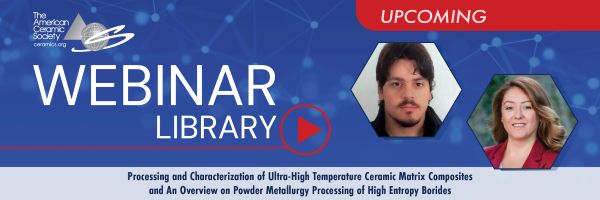
Sponsored by the ACerS International Italy Chapter and ACerS International Türkiye Chapter, the April webinar will feature two speakers: Processing and characterization of Ultra-high temperature ceramic matrix composites and An Overview on Powder Metallurgy Processing of High Entropy Borides
DESCRIPTION
Processing and characterization of Ultra-high temperature ceramic matrix composites
There is a growing demand for materials able to withstand the increasingly more challenging environments of aerospace, characterized by extremely hot temperatures, high mechanical stresses and thermal shocks, hot corrosion and wear. The most promising materials for these applications are based on a ultra-refractory ceramic matrix (carbides and borides of transition metals) reinforced with carbon fibres, that couple the high mechanical properties and toughness of the fibres with the refractoriness and oxidation resistance of the ceramic matrix. Several processing routes and ceramic matrix compositions have been studied and tested: the most common processes include chemical vapour infiltration (CVI), polymer infiltration and pyrolysis (PIP), reactive melt infiltration (RMI), and sintering by hot pressing (HP) or spark plasma sintering (SPS). This work provides an overview of the performance of the current state of the art materials, both in therms of mechanical properties and oxidation resistance. Within this framework, alternative approaches such as the use of graded structures or coatings were also considered and investigated. The results obtained so far suggest that ceramic matrices obtained by sintering provide the highest degree of protection but also require a more careful control of the processing parameters.
An Overview on Powder Metallurgy Processing of High Entropy Borides
The need for advanced materials has increased dramatically in recent years in a variety of industries, including electronics, biomedical engineering, energy, aerospace, automotive, and medicine. High-entropy alloys (HEAs) have become a potential class of materials to meet these changing demands. HEAs are made up of four or more principal elements combined in about equimolar ratios, as opposed to traditional alloys, which usually consist of one primary element with minor additions. Surprisingly, they frequently solidify into straightforward solid-solution phases rather than the anticipated complex intermetallic phases. HEAs often crystallize into single phase structures, most frequently displaying body-centered cubic (BCC) or face centered cubic (FCC) configurations, despite their complicated constituents. The existence of hexagonal close-packed (HCP) structures in certain compositions has also been documented in more recent studies.
Four fundamental core effects govern the unique behavior of HEAs: the severe lattice distortion effect, which affects the mechanical and crystal lattice behavior; the sluggish diffusion effect, which is linked to slower atomic mobility; the high-entropy effect, which influences thermodynamic stability; and the cocktail effect, which describes the synergistic interactions among the various elements involved. These processes enable HEAs to have a variety of remarkable features, such as extraordinary strength and fracture toughness, high hardness, superior wear, corrosion, and oxidation resistance, and great thermal and chemical stability. Because of these qualities, HEAs may be used in challenging fields such sophisticated cutting tools, refractory materials, maritime engineering, and aerospace components.
Recent years have seen an increase in study into the creation of high-entropy ceramics, which are based on the idea of HEAs. A wide range of compounds, such as oxides, carbides, nitrides, silicides, silicates and borides, are included in this new class of sophisticated materials. The presentation reports on the some examples of high entropy carbides, borides and silicates prepared via powder metallurgy methods such as mechanical milling, pressureless sintering, spark plasma sintering and their detailed characterization in terms of compositional, microstructural, mechanical and thermal properties.
The concept of creating high-entropy metal borides, which are recognized as a novel class of ultra-high-temperature ceramics and high-entropy materials, has been contemplated for the past ten years. The outstanding qualities of ceramics, such as high density, exceptional high temperature strength, high wear and corrosion resistance, and particular physical (optical, electrical, and magnetic) capabilities, are combined in high entropy metal borides. Because of their superior qualities, they will be able to find a variety of application sectors in the years to come. Unlike the architectures of HEAs, high entropy metal borides feature a single-phase hexagonal AlB2 type crystal structure. This presentation includes the synthesizing of Hf/Ti/Zr/Ta/W/Cr/Mo/Mn based high-entropy boride ceramics by mechanical alloying and spark plasma sintering methods, and detailed characterization studies.
BIOGRAPHIES

Dr. Antonio Vinci, Researcher, Institute of Science, Technology, and Sustainability for Ceramics, Faenza, Italy
Dr. Antonio Vinci received his B.Sc. with honors in Industrial Chemistry at the University of Catania in 2013, and his M.Sc in Industrial Chemistry at the University of Bologna in 2015. He obtained his PhD in Materials Science and Technology at the University of Parma in 2019 and he is currently a researcher at the Institute of Science, Technology, and Sustainability for Ceramics in Faenza, Italy. He authored/co-authored over 40 scientific papers published in peer-reviewed journals and holds 1 patent on the fabrication of refractory composites. His research focuses on the processing and characterization of ultra-high-temperature ceramic matrix composites, particularly on processing techniques such as slurry infiltration, hot pressing, spark plasma sintering, reactive melt infiltration, and polymer infiltration and pyrolysis. Throughout his academic career, he won several JECS Trust awards and conducted research at various international laboratories, leading to several joint publications. He co-supervised 1 PhD student and holds lectures on General and Inorganic Chemistry at the University of Bologna.

Dr. Dugyu Ağaoğulları, Associate Professor, Istanbul Technical University (ITU), Türkiye
Dr. Duygu Ağaoğulları received her B.Sc. degree from the Department of Metallurgical and Materials Engineering at Istanbul Technical University (ITU) in 2004, and her second B.Sc. degree through a Double Major Program in the Department of Chemical Engineering in 2006. She completed her M.Sc. and Ph.D. studies in the Materials Science and Engineering Program at the Graduate School of Science, Engineering and Technology at ITU in 2007 and 2014, respectively.
Between 2005 and 2013, she worked as a Research Assistant in the department, and between 2013 and 2020, she served as a Researcher (Ph.D.) in an engineering position. In 2014–2015, she was awarded the TÜBİTAK 2219 International Postdoctoral Research Fellowship and conducted her postdoctoral research at Stanford University, Department of Materials Science and Engineering, in the United States. In 2020, she was awarded the title of Associate Professor by the Interuniversity Council. In the same year, she was appointed as an Assistant Professor Dr. Faculty Member in the Department of Metallurgical and Materials Engineering at ITU, and in 2021, she was promoted to Associate Professor. Between 2020 and 2021, she served as Vice Chair of the Department and Unit Quality Coordinator. Between 2022 and 2023, she served as the Director of the ITU Prof. Dr. Adnan Tekin Materials Science and Production Technologies Research and Application Center. Since 2022, she has been a Commission Member of the ITU Scientific Research Projects Unit, and since 2023, she has been serving as the Coordinator of the Materials Science and Engineering M.Sc. and Ph.D. Programs.
She received the ITU Best Ph.D. Thesis Award in 2015. In 2021, she was awarded the Young Scientist Award Program of the Turkish Academy of Sciences (TÜBA–GEBİP), and in 2022, she received the National Young Women Scientists Award in the field of Physical Sciences, presented through the collaboration of L’Oréal Turkey and the UNESCO Turkish National Commission. In 2022, 2023, and 2024, she was also recognized as the faculty member with the highest number of scientific publications at ITU on a departmental basis and was granted awards accordingly.
She is the head of the “Particulate Materials Laboratories” and the “Graphene and Two-Dimensional Materials Laboratory,” which are among the concept laboratories of the Department of Metallurgical and Materials Engineering at ITU. She actively works on a wide range of topics, including the synthesis of metal boride/carbide/silicide/oxide-containing powder materials using powder metallurgy techniques; the production of densified bodies through various sintering methods; the advanced characterization of powder and sintered materials; the synthesis of nanoparticles from different precursors via chemical vapor deposition; the coating of material surfaces with graphene-like two-dimensional structures; the fabrication of particle-reinforced metal- and ceramic-matrix composite materials; the development of next-generation two-dimensional materials; the production of high-entropy metal boride/carbide systems; the additive manufacturing of boron-containing composites; and the development of potential materials for use in fusion reactors.
She was appointed to the position of Professor in February 2026 at the same department. Up to now, she has published a total of 95 international journal articles and presented 152 international conference papers. She has served as the principal investigator in 23 research projects (including those funded by TÜBİTAK, TENMAK, BOREN, the Council of Higher Education Priority Areas Program, and ITU Scientific Research Projects, among others) and has taken part as a researcher in 17 additional projects.
ACerS member: no cost
ACerS GGRN and Material Advantage student member: no cost
Non-member: no cost
Non-member student: no cost
If you have any questions, please contact Vicki Evans.
This webinar is brought to you by the ACerS International Italy Chapter and ACerS International Türkiye Chapter.
To view past ACerS webinars click here.