
William Carty
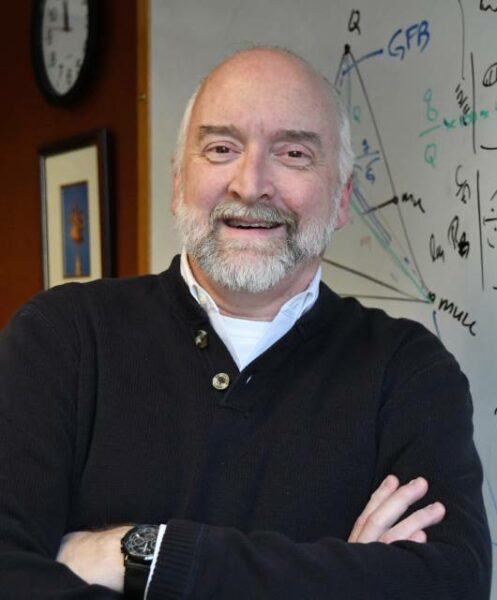
Bill Carty
William Carty, Ph.D., is Professor Emeritus of Ceramic Engineering at the New York State College of Ceramics at Alfred University. He earned the B.S. and M.S. in Ceramic Engineering from the University of Missouri-Rolla (Missouri S&T) and the Ph.D. in Materials Science and Engineering from the University of Washington (Seattle). He joined the faculty at Alfred University in 1993 after a one-year post-doc with Royal Dutch Shell Research and retired from teaching at the end of 2020. Dr. Carty has likely taught most, if not all, of the ceramic engineering students graduating from Alfred University since the mid-1990s. His primary area of research is the understanding of ceramic processing, including powder characterization, suspension rheology, forming processes, and microstructure evolution. He strongly believes that ceramic manufacturing begins with well-understood ceramic processing and without this process control is difficult if not impossible to develop. Dr. Carty now resides in New Hampshire and is an active consultant for the ceramic manufacturing industry.
Title: Ceramic Processing: Think Like a Particle?
Abstract: With few exceptions, ceramics are produced from powders. Understanding how to control the behavior of these powders, including particle size reduction, agglomeration, rheology, and forming behavior, and sintering, is critical the development of robust, well-controlled ceramic manufacturing processes. The application of colloidal processing theory to ceramic materials is relatively new, as DLVO was only published in the 1940s. The role of the suspension medium, the contribution of pH, and the use of dispersants are then coupled with particle packing, forming and consolidation, and eventually drying and sintering. Each of these steps, while seemingly independent, are, of course, connected. Defects, while often blamed on drying or firing, are usually rooted in the powder processing. The introduction of Additive Manufacturing appears to provide a short-cut that eliminates the need for powder processing, but unfortunately, this is simply untrue – the need for processing is even more critical if AM is to be successful, and even then some approaches are simply not viable for ceramics.