
Xiaodan Gu
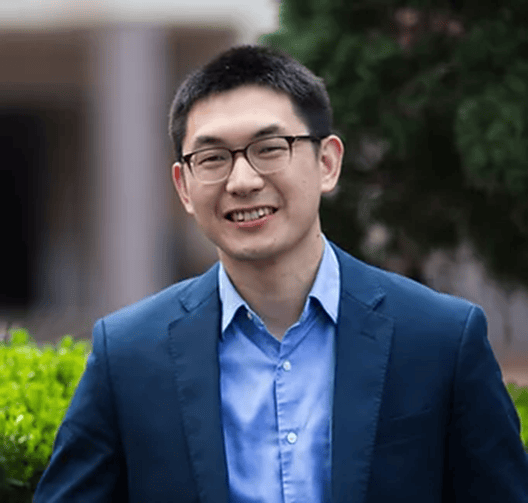
Xiaodan Gu received his Ph.D. in Polymer Science and Engineering from the University of Massachusetts Amherst in 2014, where he worked with Prof. Thomas Russell on the self-assembly of block copolymers and their applications in lithography patterning and directed self-assembly. He then completed postdoctoral training at Stanford University and SLAC National Accelerator Laboratory with Prof. Zhenan Bao and Prof. Mike Toney, where he investigated the morphology of roll-to-roll printed electronic materials for solar cells using real-time X-ray scattering at synchrotron beamlines. He is currently the Associate Professor in the School of Polymer Science and Engineering at the University of Southern Mississippi, and director for Center for Optoelectronic Materials and Devices. His research has been recognized with the NSF CAREER Award, DOE Early Career Award, the Presidential Early Career Award for Scientists and Engineers (PECASE), ACS PMSE Young Investigator Award, 3M Non-Tenured Faculty Award, and ORAU Ralph E. Powe Junior Faculty Enhancement Award.
Abstract Title: Unveiling the Invisible: Leveraging Neutron Scattering to Decode the Hierarchy of Structure and Dynamics in Conjugated Polymers
Abstract:
Organic semiconducting polymers have revolutionized the landscape of functional electronics, enabling a new generation of flexible displays, wearable sensors, neuromorphic computing, and bioelectronic interfaces. While traditional research has focused heavily on optimizing electronic metrics like charge carrier mobility and energy bandgaps, the underlying polymer physics—including chain rigidity, molecular entanglement, and glass transition behavior—remains the “black box” that dictates device reliability and performance.
In this talk, I will demonstrate how neutron scattering serves as the definitive lens for peering into these complex systems. Unlike X-ray techniques, neutron scattering combined with selective deuteration allows us to “label” specific molecular segments, providing a unique way to isolate single-chain conformations within dense, disordered environments.
I will discuss our recent efforts using Small-Angle Neutron Scattering and contrast matching to resolve the transition between aggregated and de-aggregated states in solution. Furthermore, I will highlight how these neutron-derived structural insights—specifically regarding backbone rigidity and persistence length—inform the design of polymers with superior solid-state morphology. By bridging the gap between fundamental chain dynamics and macroscopic device engineering, we show that neutron tools are not just characterization methods, but essential drivers for the next generation of organic electronic materials.