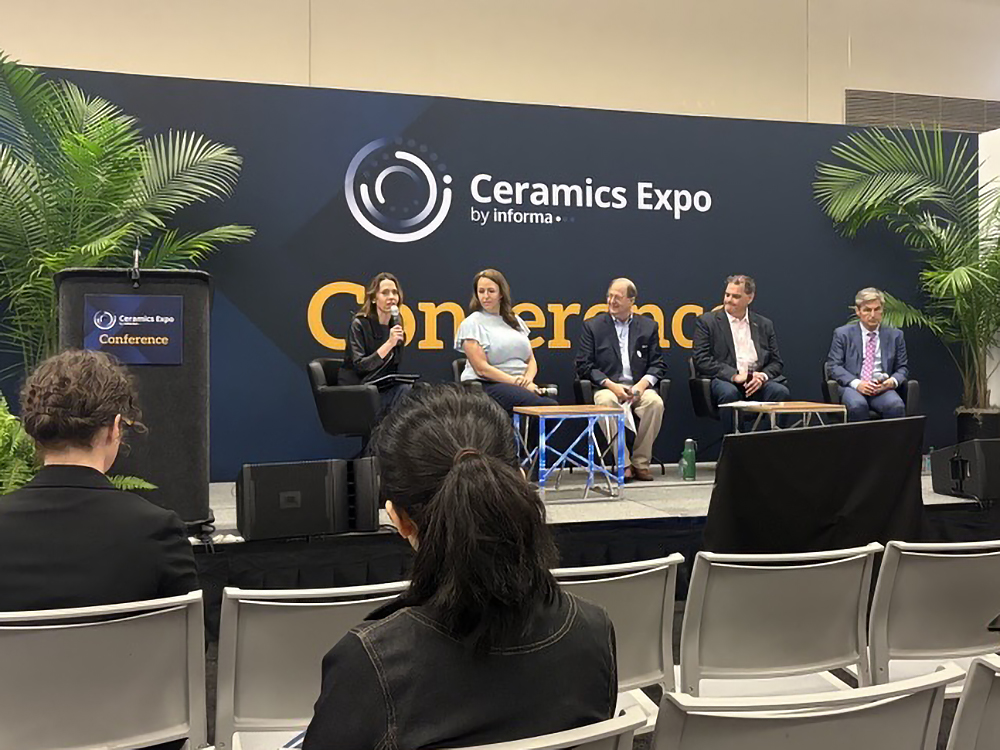
[Image above] Jennifer Scheel (far left), executive attraction officer for the City of Cleveland, led a panel discussion on what universities, government laboratories, and companies across Ohio are doing to advance ceramic research and development in the state. Panelists from left: Marissa Reigel, director of R&D at Saint-Gobain NorPro; Daniel Gisser, president of Tillerline Associates LLC; Nick Barendt, assistant vice president of research for technology and ecosystem growth at Case Western Reserve University; and Matt Dolan, CEO of Team NEO. Credit: ACerS
Things are heating up in the world of engineered materials as next-generation aerospace, energy, and electronic applications push manufacturers toward better thermal management solutions. Ceramics in particular have an important role to play in this regard, as demonstrated at the annual Ceramics Expo.
Ceramics Expo is the leading annual supply chain exhibition and conference for the advanced ceramics and glass industry. After three years in Novi, Mich., this year’s event returned to its original home of Cleveland, Ohio, from May 5–6, 2026.
Ceramics Expo kicked off Monday night with a VIP networking event, where the mayor of Cleveland gave a talk welcoming the conference back to the city. The following two days were filled with exhibiting and conference talks at the Huntington Convention Center of Cleveland, which ran alongside the co-located Thermal Management Expo.
The welcome address on Tuesday morning by Andrea Ross, director of meetings, membership, and marketing at The American Ceramic Society, wasted no time outlining the benefits of ceramics for thermal management. She noted that ceramics have been used in traditional thermal management applications for centuries, such as metallurgical processing, and then highlighted recent ACerS Bulletin articles that demonstrate the use of ceramics in more advanced sectors, such as nuclear energy and silicon carbide semiconductors.
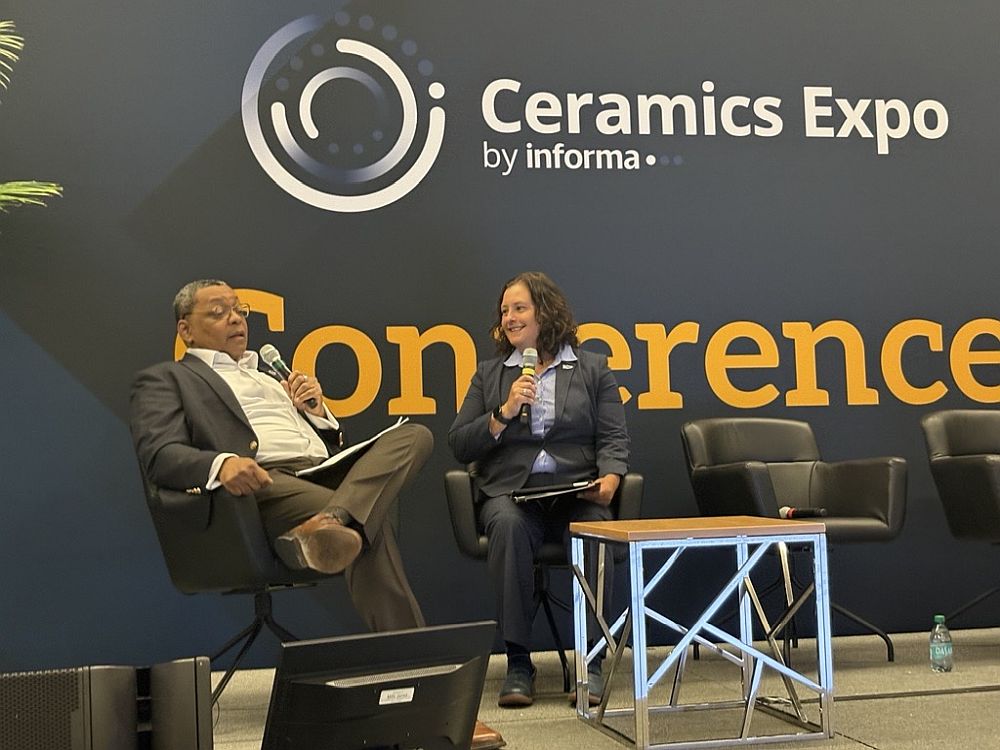
In addition to giving the welcome address, Andrea Ross (right) also moderated the morning keynote by Jon Goldsby (left) of NASA Glenn Research Center, who presented on ultrahigh-temperature ceramics for space and aeropropulsion applications. Credit: ACerS
To support the development of engineered ceramics for thermal management and other advanced applications, organizations across the United States are funding projects and collaborations that will lead to accelerated discovery. The American Ceramic Society is doing its part through the U.S. Department of Defense-funded Hypersonic Training Program, held in partnership with the United States Advanced Ceramics Association.
“The push for hypersonic vehicles and the growth of the private space sector is driving demand for new materials that can handle the high-temperature, corrosive environments experienced in both applications,” Ross explains. “That is why the Department of Defense funded our workforce training partnership to build and deliver courses, recruit instructors, and run outreach on hypersonics topics.”
ACerS is not the only Ohio-based organization supporting advanced ceramics research and development—the state in general has become known as a national leader in this area. The opening panel session, moderated by City of Cleveland Executive Attraction Officer Jennifer Scheel, talked with four experts from across Ohio about how universities, government laboratories, and companies are collaborating to advance ceramic research and development in the state.
Discussion during the panel centered on Ohio’s competitive advantages in materials science, talent pipelines, and manufacturing capacity, as well as the role of federal funding mechanisms in supporting the acceleration of thermal management innovations. Besides the market conversations, panelist also took the time to share brief reflections on what they love about living in Ohio, with answers ranging from affordability to the state’s natural beauty.
In addition to the focus on engineered materials for thermal management applications, featured talks also covered some of the practical challenges of advanced ceramics processing. Additive manufacturing was touched on several times, as usual, but discussion of nanomanufacturing, quality control systems, and how to transition laboratory innovations to commercial deployment took place as well.
A special roundtable discussion on artificial intelligence also took place on Tuesday morning. Delivered in alliance with the Greater Cleveland Partnership, the discussion titled “Enterprise capacity through AI/ML: Scaling what you already do well” brought together chief information officers from across the advanced manufacturing sector for a candid conversation about AI integration. They noted that even though industry has been making use of AI for years now, it remains an expensive practice with no clear return on investment in sight.
Again this year, Ceramics Expo 2026 included a Solutions Innovation Stage alongside the main conference presentations. This stage provides an opportunity for ceramic suppliers and manufacturers to present real-world examples of the solutions discussed during the main talks.
The number of presentations on the Solutions Innovation Stage grew noticeably this year. Representatives from Alloy Enterprises, Fabric8Labs, Lucideon, Eurofins EAG Laboratories, Laird Technologies, American Elements, Almatis, Switzer, Fabrisonic, ThermStar System, Alpha HPA, Case Western Reserve University, Resonac Corporation, and West Ohio Tool Co. all gave talks.
Overall, this year’s conference demonstrated the bright future ahead for engineered ceramics. Next year, Ceramics Expo will take place in Cleveland, Ohio, April 20–21, 2027.