

[Image above] The 61st Annual Symposium on Refractories began with a social event on Monday evening at Westport Social. Credit: ACerS
The iron and steel industry is the largest consumer of refractory materials, accounting for between 60% to 70% of total global demand. Yet the market for nonferrous metals is growing rapidly in response to the electrification, renewable energy, and digital transformations. Processing these metals comes with unique challenges compared to the iron and steel industry, and this year’s 61st Annual Symposium on Refractories shed light on some of these difficulties and offered possible solutions.
The ACerS Greater Missouri Section and Refractory Ceramics Division co-hosted the Annual Symposium, which this year welcomed more than 190 attendees from 15 countries to St. Louis from March 30–April 1, 2026. Kimberley Peterson of Christy Refractories and Dan Gower of Refractory Minerals Co. co-programmed the event, which served as an opportunity for both valuable knowledge sharing and networking.
“This year featured many excellent presentations that provided both a valuable overview of and new technical advancements in nonferrous refractories. Beyond the valuable technical insights on refractories, the symposium was a great reminder of the strength of our community. It was truly a pleasure reconnecting with old friends while also welcoming so many new faces into the conversation,” Gower says.
Below are highlights from the 61st Annual Symposium on Refractories.
The multifaceted challenges of nonferrous metals production
Before solutions could be offered, many of this year’s talks focused on outlining the challenges that come with nonferrous metals production. In particular, weakening of the refractory’s mechanical properties is a perennial concern, be that from corrosion or other factors.
For example, Roger Smith of Plibrico Company kicked off the symposium by reviewing causes of corundum formation in aluminum furnaces. Corundum is a dense crystalline form of aluminum oxide. In aluminum melting furnaces, chemical reactions between the molten metal and aluminosilicate refractories will cause corundum to form on furnace walls, doors, and burners. Over time, this expansive growth reduces furnace capacity, increases energy consumption, and causes premature refractory failure.
Smith discussed the factors that can promote or exacerbate corundum growth, specifically high temperature, presence of oxygen, alloy composition, and the use of fluxes and fluoride salts. He then suggested ways to fight this formation, including the use of nonwetting additives, dense oxide barrier formers, pore size reducers, and physically removing the growth.
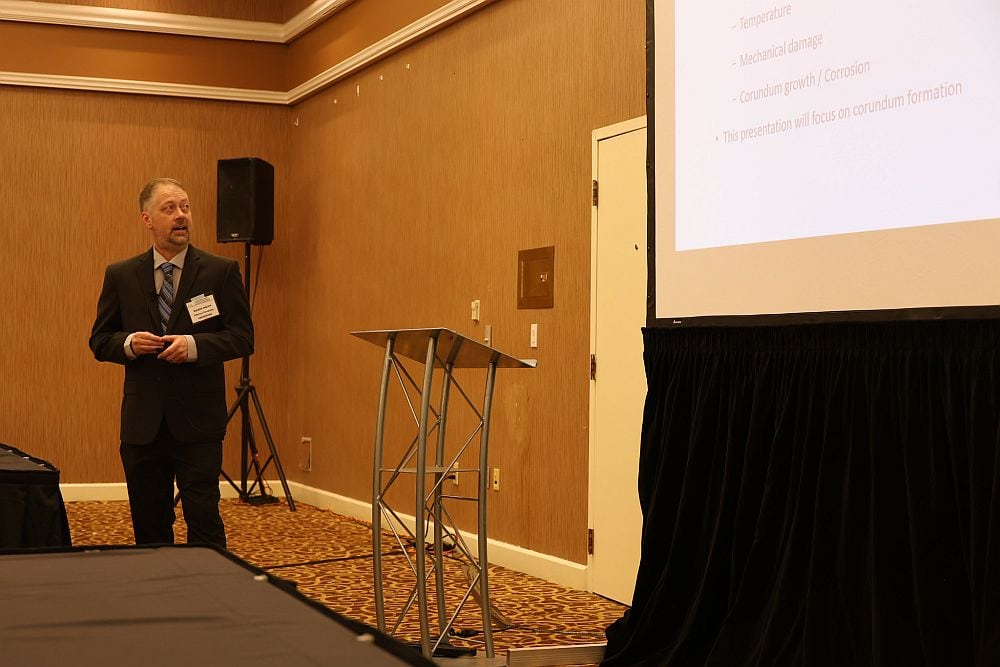
Roger Smith of Plibrico Company noted that boosting heat is a common technique to hasten aluminum production, but it can have the unattended effect of exacerbating corundum formation as well. Credit: ACerS
Following talks went into more detail on the refractories themselves, such as the development of silica-free refractories to mitigate corundum growth in aluminum furnaces as well as to better withstand hydrogen-fired operations. Refractories for the copper industry also had their moment when Somnath Mandal of Vesuvius talked about the development of chromium-free refractories to avoid the formation of carcinogenic hexavalent chromium, which has associated human health and environmental concerns.
The development of novel and alternative binders for refractories also received a fair amount of attention, with the aim of reducing reliance on calcium aluminate cement prompting many studies. This common high-performance hydraulic binder can suffer from several technical problems, such as reduced strength due to the formation of undesirable hydration products during curing and a potential for explosive spalling during the first heating. Several speakers discussed the potential of phosphate binders for nonferrous applications, with varying results based on the specific application.
Addressing refractory challenges through invention and innovation
While identifying and developing solutions to known problems is a first step, manufacturers must successfully implement and commercialize that idea to add value to their processes. How companies can accomplish this task was the focus of this year’s Theodore J. Planje Refractories Award lecture, delivered by Tomas Richter of MaterialsPro Technologies LLC.
Richter explained how there are different types of challenges that all manufacturers face, specifically existing problems, anticipated issues, and perceived difficulties. Listening to customers is a good way for manufacturers to determine which of these challenges requires immediate focus.
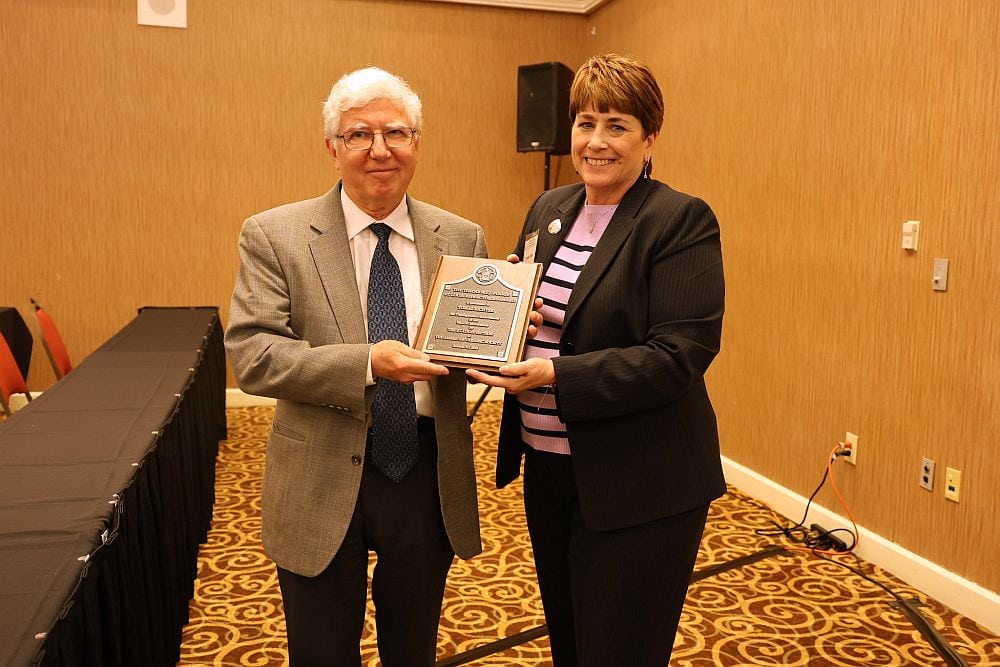
ACerS Fellow Nancy E. Bunt of Imerys, right, presents Tomas Richter with the 2026 Theodore J. Planje Refractories Award. Credit: ACerS
Many of the talks on Wednesday, April 1, provided real-world examples of putting Richter’s suggestions into practice. For example, Paschoal Bonadia of Bautek Minerais Industriais discussed the development of high-performance sintered bauxite and high-purity brown fused alumina using Brazilian sources at Barro Alto as an alternative to China’s grasp on the market. Similarly, Gibran Sánchez of Pyrotek talked about Mexico’s reliance on other countries for many raw materials and the need for fast testing methods to screen alternative formulations, in this case noncontact dilatometry.
See more photos from the 61st Annual Symposium on Refractories on the ACerS Flickr page. We look forward to seeing you in St. Louis next year!