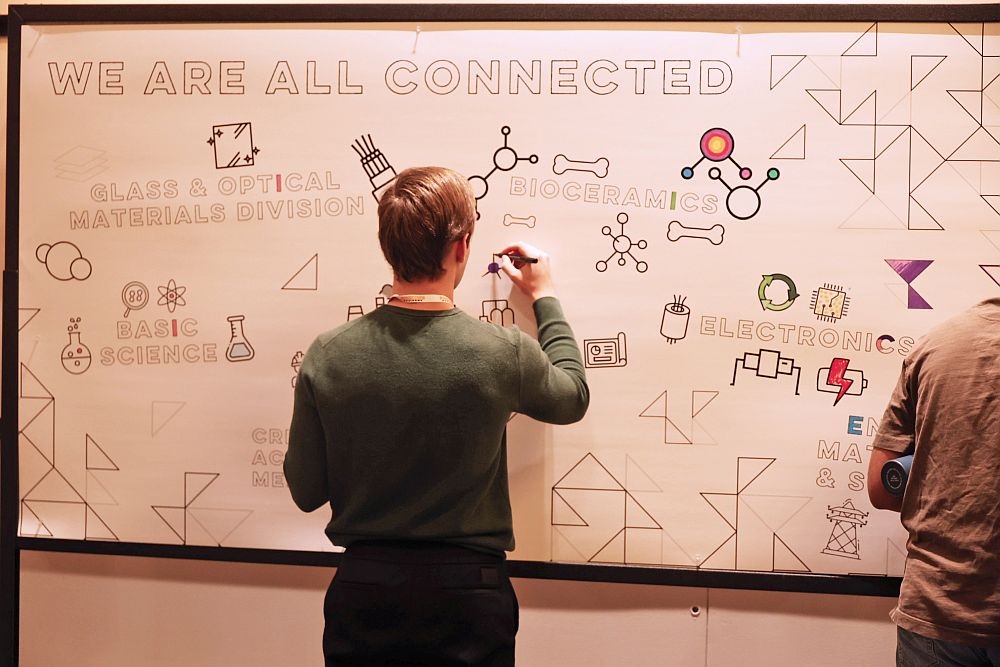
[Image above] An attendee helps color in a poster celebrating the “We are all connected” theme of Spring Meeting 2026. Credit: ACerS
When Edward Orton, Jr. and his colleagues founded The American Ceramic Society in 1898, the technical study of ceramics to address the practical needs of industry was a novel concept. Yet as the benefits of such studies became more apparent to manufacturers, the Society’s membership grew and became more specialized, leading to the creation of professional divisions in 1919.
Although some members feared that the creation of divisions would cause the Society to split apart, Orton wrote confidently in an early report that “the Society is not to be divided physically into sections meeting in different places, but that the division is a sort of intangible one … to stir up debates, papers and program material—in other words, to build off the work of the Society, each in his own field.”
Over the next hundred years, new divisions were created and others metamorphosed as science and industry advanced. As of today, 11 Divisions represent the diverse interests and research areas of ACerS members, ranging from traditional structural and processing applications to advanced electronic and biomedical devices.
This spring, six Divisions joined hands to launch a new chapter in ACerS history with the inaugural Spring Meeting. This meeting, which took place April 12–17, 2026, in Bellevue, Wash., is a new venture for the Society that is not to be confused with ACerS Annual Meeting, which takes place in the fall. Instead, Spring Meeting is a Division-focused event that gives the six participating Divisions an opportunity to host their usual Division meeting agendas alongside jointly organized events and symposia. It is thus a prime example of Orton’s dream, whereby specialized scientists and engineers work together collaboratively to advance ceramic and glass science and technology.
Nearly 670 attendees from 29 countries, including 245 students, participated in the inaugural Spring Meeting. The six Divisions involved are Basic Science, Bioceramics, Electronics, Energy Materials and Systems, Glass & Optical Materials, and Manufacturing.
ACerS President Mario Affatigato says, “The new Spring Meeting fulfilled every expectation by providing an amazing, multidisciplinary arena for the exchange of scientific ideas and the formation of new friendships and collaborations. I very much look forward to an even larger and more exciting conference next year!”
Conference Chair Rajendra Bordia echoed his sentiments, saying, “Due to the vision, leadership, and hard work of the volunteer leaders and ACerS staff, this first-ever Spring Meeting of ACerS was a resounding success. The participants appreciated high quality technical symposia, contemporary plenary talks, and engaging networking sessions. As a result, the meeting successfully met the twin goals—technical programming that is true to the needs of the participating Divisions’ Divisional meetings, including joint Divisional programming where appropriate, and a forum where a large community of ceramic scientists and engineers could network and connect with friends and colleagues.”
Highlights from Spring Meeting 2026 are below.
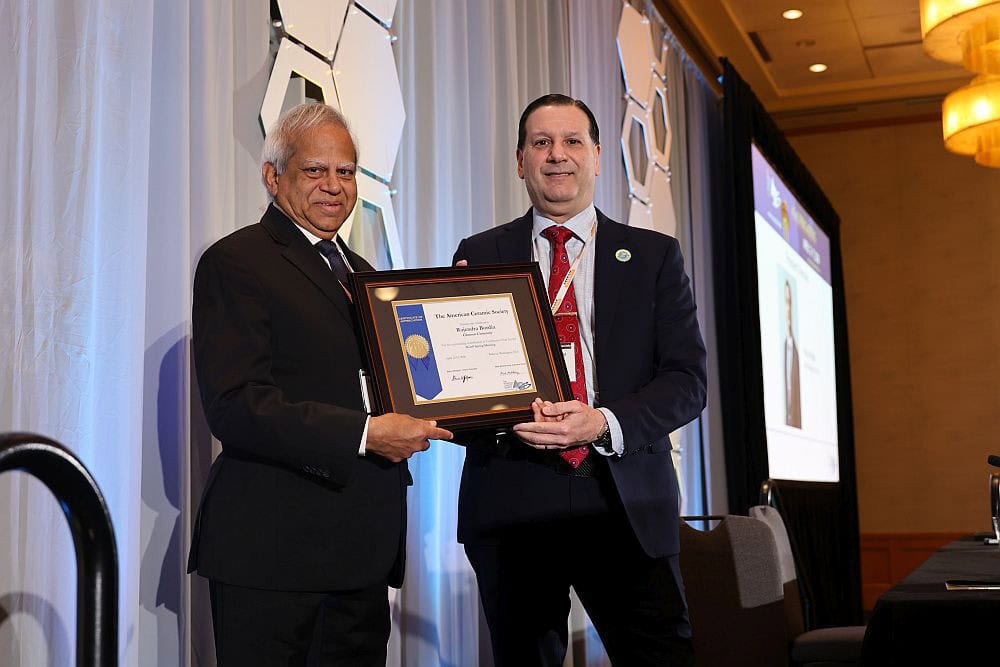
ACerS President Mario Affatigato, right, presents Rajendra Bordia with a certificate of appreciation for his work organizing the inaugural Spring Meeting. Credit: ACerS
Plenary talks welcome speakers from all six Divisions
From Monday through Wednesday of the conference, each morning started with two plenary talks given by a representative from each of the six Divisions.
On Monday, Basic Science Division speaker Elizabeth Dickey of Carnegie Mellon University discussed the role of defects in tuning the electrical properties of ceramics. She was followed by Electronics Division speaker Eric Wachsman of the Maryland Energy Innovation Institute, who talked about how his company ION Storage Systems is developing lithium-based solid-state batteries.
On Tuesday, Energy Materials and Systems Division speaker Maarit Karppinen of Aalto University shared her research on thin-film materials created using atomic layer and molecular layer deposition, with the former technique being created by another professor at her university. Glass & Optical Materials Division speaker Srikanth Sastry of Jawaharlal Nehru Centre for Advanced Scientific Research then spoke about using machine learning to help model fatigue failure behavior in sheared glasses.
On Wednesday, Manufacturing Division speaker William Carty of Alfred University gave an overview of ceramic processing, a topic that he will elaborate on further during an upcoming ACerS short course. Bioceramics Division speaker Candan Tamerler of the University of Kansas then gave a thorough rundown of the evolution of biomaterials from bioinert to biofunctional, with acknowledgments to Larry Hench and Rustum Roy for their impact on this field.
Division award lectures recognize luminaries in their fields
Several Division award lectures were delivered at Spring Meeting, with each recognizing important topics of discussion in the ceramics and glass field today.
On Monday, Jon-Paul Maria of The Pennsylvania State University delivered the Basic Science Sosman Award lecture on the topic of ferroelectrics. Both he and plenary speaker Dickey earlier that morning expressed excitement about once again attending an ACerS meeting in the spring. (The ACerS Annual Meeting used to be held in the spring before being moved to the fall.)
On Wednesday, Daniel Schwoerer of Bullseye Glass Co. delivered the Stookey Lecture of Discovery on his company’s unique process of creating hand-cast multicolored glass. The technique has been used to help create some well-known global pieces, including the United Methodist Church of the Resurrection stained-glass window in Leawood, Kan.
On Thursday, Timothy Gross of Corning Inc. delivered the Varshneya Frontiers of Glass Technology Lecture on the design of damage-resistant glasses. He discussed several different techniques for doing so, with examples pulled from his experience at Corning.
Besides the award lectures, several other Division awards were handed out at Spring Meeting:
- David Pye Glass Hall of Fame (Glass & Optical Materials Division): Lisa Klein of Rutgers, The State University of New Jersey, and James E. Shelby of the New York State College of Ceramics at Alfred University
- George W. Morey Award (Glass & Optical Materials Division): Sabyasachi Sen of the University of California, Davis (will deliver a lecture at ACerS Annual Meeting at MS&T26)
- Norbert J. Kreidl Award (Glass & Optical Materials Division): Cosmin-Constantin Popescu of 2 Pi Inc. (will deliver a lecture at ACerS Annual Meeting at MS&T26)
- Varshneya-Mauro-Jain Guru-Chela Travel Fund (Glass & Optical Materials Division): Jincheng Du and Cristina Lopez Puga of the University of North Texas
- John E. Marquis Award (Manufacturing Division): Hong Li of Nippon Electric Glass
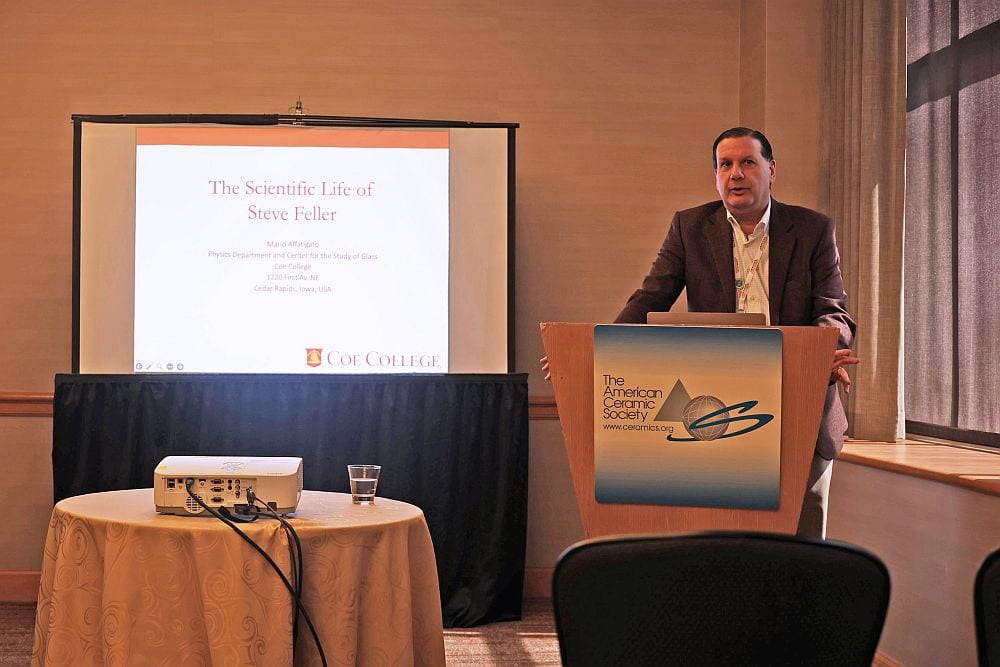
Besides the Division award lectures, a special symposium took place on Wednesday and Thursday in honor of ACerS Fellow Steve Feller, who died in November 2025. Moderating the symposium was ACerS President Mario Affatigato (pictured), a long-time student, colleague, and friend of Feller’s at Coe College (Cedar Rapids, Iowa). Credit: ACerS
Roundtable discussion on the resilience of US research
The state of federal science funding in the United States has been a topic of great concern over the past two years. Considering this concern, a roundtable discussion took place on Tuesday to discuss the resilience of U.S. research. Reeja Jayan of Carnegie Mellon University moderated the discussion, which included ACerS President Mario Affatigato, Christina Rost of Virginia Tech, and Rost’s student John Barber as panelists. The panelists worked with attendees to “brainstorm opportunities not just to survive but to thrive,” as Jayan summarized it.
New glass design and poster competitions provide additional opportunities for students
ACerS meetings are always filled with various student-oriented events, including the Basic Science and Manufacturing Divisions tutorials that previously took place at the now-retired Electronic Materials and Applications Conference. (This year’s tutorials were delivered by Zhantao Chen of The University of Texas at Austin and Rehan Afzal of Blasch Precision Ceramics, respectively.) Spring Meeting 2026 welcomed two new additions to the student roster, specifically a glass design competition and poster competition.
The Glass Strengthening Competition, organized by the Ceramic and Glass Industry Foundation, challenged participants to strengthen identical glass samples using different strengthening techniques. They then brought the strengthened samples, which were prepared prior to the conference, and competed to see whose sample performed best during on-site impact testing.
The Edwin Fuller Student Poster Competition celebrates outstanding student research in ceramic and glass science and engineering while honoring the remarkable career and contributions of the late Edwin H. Fuller, an ACerS Distinguished Life Member, past Society president, and respected industry leader. Fuller’s wife, Barbara, attended Spring Meeting to present the students with their awards.
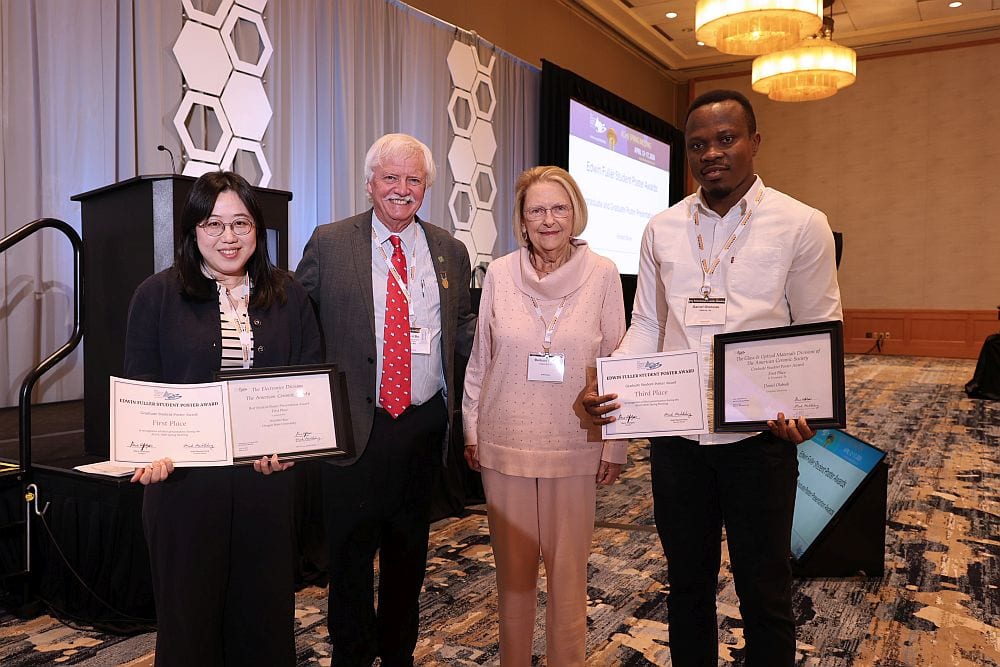
Barbara Fuller, second from right, stands with two winners of the Edwin Fuller Student Poster Competition as well as Richard Brow, second from left, who announced the award. Credit: ACerS
View more images from the conference on ACerS Flickr page. Spring Meeting 2027 will take place May 23–28, 2027, in San Francisco, Calif. See you next year!
Update 05/12/2026 – Corrected the George W. Morey award winner for 2026.