[Image above] Credit: Bulent camci / Shutterstock
Hydrogen continues to dominate the clean energy spotlight as the world aims to reach net-zero carbon emissions. But as production and application of hydrogen start overcoming some of the long-standing challenges, the conversation has shifted toward the challenges of transporting hydrogen on the larger scales needed for widespread utilization.
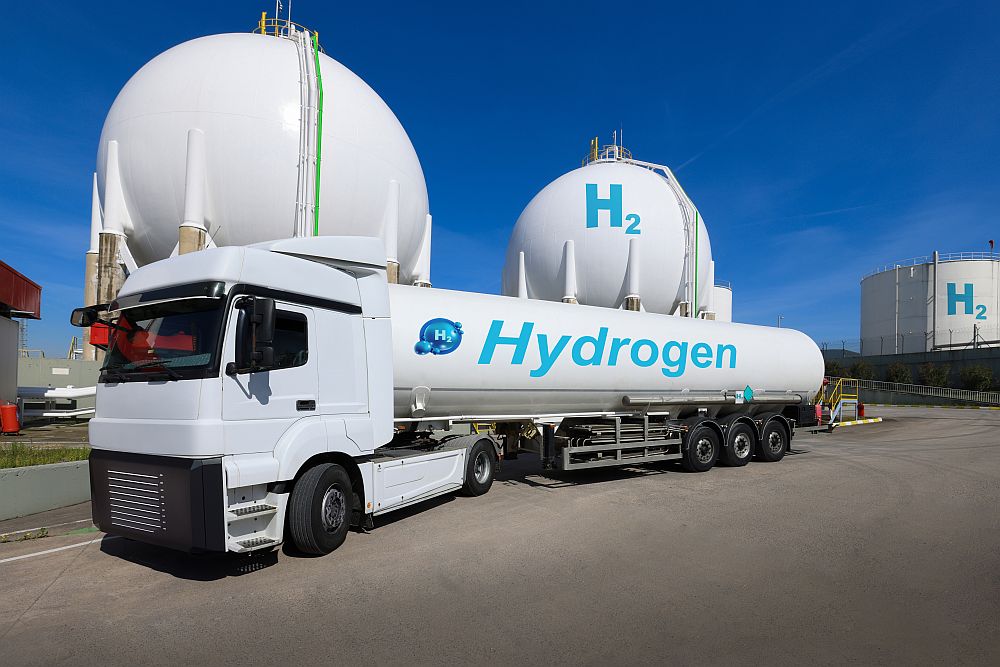
Hydrogen is the lightest element in the universe, and its extremely low density makes it notoriously difficult to transport. In general, hydrogen is transported in one of two ways: as a high-pressure gas or as a cryogenic liquid. While solid-state transportation is possible using sorption-based technologies, this novel approach is still in the very early stages of development.
Pipeline transportation of compressed hydrogen gas is considered the most efficient method for large-scale transportation. However, it and other fluid-based methods of transport require substantial infrastructure investments, and they can cause brittleness and cracking of the metal structures used for transport, which in turn can lead to leakage, high repair costs, and safety hazards.
In today’s CTT, we will explore in more detail which aspects of the hydrogen infrastructure are causing a bottleneck in scaling up the hydrogen economy. We will also include an overview of companies that are working to expand hydrogen transportation and distribution infrastructure.
The bottleneck: Hydrogen distribution develops slowly
A recent study led by researchers at Heriot-Watt University in Edinburgh, Scotland, measured patent citation hazards to identify improvement rates for various hydrogen technologies.
Patent citation hazards refer to the probability that a patent will receive a new citation at a specific time, given it has survived without a citation until that point. The study explains that patent citation networks can help indicate how quickly and successfully technological knowledge is evolving, with higher hazards (i.e., a shorter time to the first citation) indicating faster improvement.
The researchers reviewed issued patents in the literature and patents database Lens.org and found 777,695 hydrogen technology-related patents that have received citations. These patents span 182 years and range from just one citation to 1,660.
By analyzing the number of published patents and citations per year, the researchers were able to identify production, storage, and fuel cells as the subdomains of hydrogen technology with the fastest improvements. In contrast, hydrogen transportation and distribution technology is developing at half the speed, which “will be expected to be a bottleneck in the development of a hydrogen economy,” the researchers write in the open-access paper.
While the model in the study can only detect deficiencies indirectly based on citation timing, the bottleneck effect can likely be related to “issues such as maximum hydrogen blending into natural gas pipelines, regulatory jurisdiction, technology challenges, and cost considerations,” according to an issue brief from the Policy, Education, and Outreach work group of the Hydrogen Economy Collaborative.
“Distribution will become the dominant cost in any hydrogen system. Even as we get better at producing and using hydrogen, getting it where it is needed stays expensive,” says lead author David Dekker, Research Fellow at Edinburgh Business School, in a press release.
The open-access paper, published in Sustainable Futures, is “Dynamics of knowledge production: A relational-event analysis of patent citation hazards in hydrogen technologies” (DOI: 10.1016/j.sftr.2025.101460).
Advancing global hydrogen infrastructure
Despite the challenges that come with developing large-scale hydrogen transportation, some companies are working to improve different types of hydrogen infrastructure, similar to the national roadmaps that have come to light during the clean energy transition.
For example, in 2025, France-based TEAL Mobility added seven new hydrogen refueling stations, bringing their total to 15 hydrogen stations across five European countries. Plans for expansion in 2026 are already underway, with five new projects aimed at connecting Europe’s logistics pipelines to reliable hydrogen supplies.
In Rotterdam, the Netherlands, Plug Power Inc. recently completed the first hydrogen fill of Hynetwork’s 32-kilometer hydrogen pipeline. Hynetwork aims to connect the hydrogen network in the Netherlands, and the new Rotterdam section marks a milestone for the Netherlands’ greater national hydrogen network, which ultimately will connect to other parts of Europe.
Also in Europe, the European Hydrogen Backbone initiative “aims to accelerate Europe’s decarbonisation journey by defining the critical role of hydrogen infrastructure—based on existing and new pipelines—in enabling the development of a competitive, liquid, pan-European renewable and low-carbon hydrogen market.” For a full list of participating companies, visit https://ehb.eu.
Petro China, already a dominate player in China’s hydrogen economy, aims to solidify its position as a foundational producer and transporter of hydrogen. In March 2024, Petro China opened a green hydrogen facility at the Yumen Oilfield with a capacity of 2,100 tons annually. In June 2025, the company also secured a bid to construct a 190-kilometer dedicated hydrogen pipeline. Petro China has ambitious plans to continue expanding in 2026.
Across the way in Oceania, the Victoria and New South Wales governments are each investing $10 million in a renewable hydrogen refueling network dubbed the Hume Hydrogen Highway. The goal is to develop at least four refueling stations along the existing Hume Highway and commission 25 hydrogen-powered heavy freight vehicles to utilize zero-emission technology.
In South America, there are 141 green hydrogen projects worth nearly $263 billion in potential capital spending, according to a recent Insight Report by the Energy Industries Council trade association. Despite global market uncertainty, the Council feels optimistic that the region has potential to advance their green hydrogen economy even further.
The U.S. also has developed plans to advance the Regional Clean Hydrogen Hubs (H2Hubs) program despite market uncertainty. In January 2025, five out of seven approved regional hydrogen hubs were awarded with funding for their initial Phase 1 activities.
However, in October 2025, two regional hydrogen hubs received significant funding reductions, with the hydrogen and clean energy sectors receiving major federal funding cuts overall under the Trump administration.
As federal priorities transition, it is unclear how funding for H2Hubs will be impacted in 2026 and beyond. In response, some U.S. hydrogen producers such as Air Products and Bloom Energy have shifted to localized hydrogen hubs to avoid the costs associated with long-distance supply chains.
Future hydrogen sector growth
Although hydrogen technology has seen multiple boons throughout the last 50 years, low-emissions hydrogen appears to be steadily—and stealthily—growing in recent years. Low-emissions hydrogen typically includes hydrogen produced from renewable energy via electrolysis (green hydrogen) or hydrogen gathered via carbon capture, utilization, and storage (blue hydrogen).
According to a recent IEA report, low-emissions hydrogen production, including projects that utilize carbon capture and electrolysis, has increased from just over 0.5 million tons in 2020 to nearly 1 million ton in 2025, with an estimate of 4 million tons by 2030.
If this estimate is achieved, it “would make growth in low-emissions hydrogen production comparable to the fast expansions of other clean energy technologies seen in recent years,” the authors write.
Access the full IEA report at https://www.iea.org/commentaries/what-it-would-take-to-unlock-the-next-phase-of-hydrogen-growth.