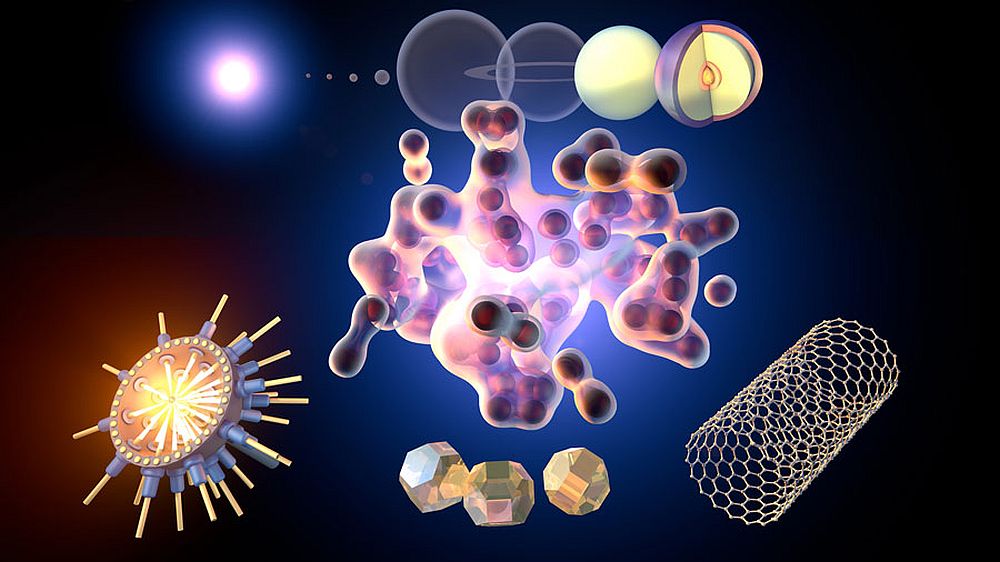
[Image above] An artist’s impression of liquid carbon (center) and the places where it may be found in a permanent or transient state. Credit: Martin Kuensting, Helmholtz-Zentrum Dresden-Rossendorf
Carbon, nitrogen, and boron are the basic building blocks for nonoxide ceramics. But as we have shown previously on CTT, such as here and here, these fundamental ceramic components still hold surprises for us in their elemental form.
Today’s CTT highlights three discoveries from the past year that provide new perspectives on these core nonoxide constituents.
Structure of liquid carbon revealed
In May 2025, an international research collaboration led by the University of Rostock and Helmholtz-Zentrum Dresden-Rossendorf in Germany used complementary technologies from the Science and Technology Facilities Council (STFC) in the U.K. and the European X-ray Free Electron Laser (European XFEL) in Germany to create and study the structure of liquid carbon for the first time.
Carbon typically is known for its solid forms here on Earth, serving as everything from the graphite in pencils to the diamonds in jewelry to the charcoal in furnaces. However, if we drill down deep enough into Earth or other planets, you can find carbon in a liquid form due to the extreme temperature (>4,000°C) and pressure (>10 MPa) found at those depths.
Because of the extreme environment required for carbon to exist in a stable liquid state, studying this form of carbon is extremely challenging. However, liquid carbon can also show up as a transient state in the synthesis of advanced carbon materials, such as graphene and nanodiamonds, and during the initial implosion phase in nuclear fusion reactors. Studying the liquid form of carbon is thus a worthy goal for both planetary scientists and materials scientists working on advanced materials and next-generation technologies.
In the recent study, the researchers used a high-performance laser called DiPOLE 100-X developed by the STFC’s Central Laser Facility to drive compression waves through a solid carbon sample and liquefy the material for nanoseconds. During this brief time, the sample is irradiated with the ultrashort X-ray laser flash of the European XFEL, which allows for a diffraction pattern to be captured.
Because each experiment lasts only fractions of a second, the researchers repeated it many times with slightly different parameters to generate a large set of diffraction patterns. They then combined the diffraction patterns to create a comprehensive picture of carbon’s transition from solid to liquid phase.
The measurements revealed that with four nearest neighbors each, the systemics of liquid carbon are like solid diamond. They also revealed that the melting point is around 4,500°C, which was a significant discovery because until now, the theoretical predictions on the structure and melting point had diverged significantly.
“We now have the toolbox to characterize matter under highly exotic conditions in incredible detail,” says Ulf Zastrau, group leader of the High Energy Density experimental station at the European XFEL, in a press release.
The open-access paper, published in Nature, is “The structure of liquid carbon elucidated by in situ X-ray diffraction” (DOI: 10.1038/s41586-025-09035-6).
Successful synthesis of neutral N6
In June 2025, three researchers from the Institute of Organic Chemistry at Justus Liebig University Giessen in Germany successfully created the first neutral allotrope of nitrogen besides diatomic nitrogen (N2).
Neutral allotropes are different structural forms of a single chemical element. They are composed of atoms in the same physical state (e.g., all gas or all solid) and have no net electrical charge and are not a free radical (i.e., they have no unpaired electrons available for reactions).
While carbon has several primary, well-known neutral allotropes, including graphite and diamond, the only known neutral allotrope of nitrogen was N2. However, in the recent study, the researchers showed that hexanitrogen (N6) can be another metastable molecular nitrogen allotrope beyond N2, although specific environmental conditions are required to achieve this form.
The researchers prepared N6 at room temperature through the gas-phase reaction of chlorine or bromine with silver azide, followed by trapping in argon matrices at cryogenic conditions (10 K or -263.15°C) to stabilize and isolate the highly reactive N6. They then prepared a film of N6 at liquid nitrogen temperature (77 K or -196.15°C).
Computational calculations suggested a half-life of more than 132 years for N6 at cryogenic conditions; at room temperature, it would have only a half-life of 35.7 milliseconds.
In addition to this study “[challenging] the long-held belief of the elusiveness of neutral molecular nitrogen allotropes,” computations suggest that the decomposition of N6 would release an exceptional amount of energy—2.2 times more per unit mass than the known explosive TNT. As a result, the preparation of hexanitrogen “possibly opens new opportunities for future energy-storage concepts,” the researchers conclude.
The open-access paper, published in Nature, is “Preparation of a neutral nitrogen allotrope hexanitrogen C2h-N6” (DOI: 10.1038/s41586-025-09032-9).
Boron mimics the reaction behavior of metals
In September 2025, researchers at Julius Maximilian University of Würzburg in Germany demonstrated that under certain conditions, boron can mimic the reaction behavior of metals, opening a new approach to π-coordination chemistry.
π-coordination chemistry involves the bonding of unsaturated, π-electron-rich molecules (such as alkenes, alkynes, arenes, carbonyls) to metal centers. This bonding profoundly alters ligand reactivity and activates them for catalysis.
π-coordination chemistry is used for various industrial purposes, notably polymer production to control the polymerization mechanisms. However, it traditionally relies on toxic and expensive heavy metals, and researchers are working to develop more environmentally friendly and affordable alternatives.
In the recent study, the researchers showed that boron can form π complexes with olefins, a class of unsaturated hydrocarbons that are key building blocks for plastics, synthetic rubber, detergents, and chemicals.
“Our discovery opens up a whole new area of the periodic table for π coordination,” says senior author Holger Braunschweig, head and chair of the inorganic chemistry department at Julius Maximilian University of Würzburg, in a press release. “In the long term, our main goal is to replace toxic and costly heavy metals in industrial processes with main group elements.”
The paper, published in Nature Chemistry, is “Olefin π-coordination chemistry at low-oxidation-state boron” (DOI: 10.1038/s41557-025-01952-3).