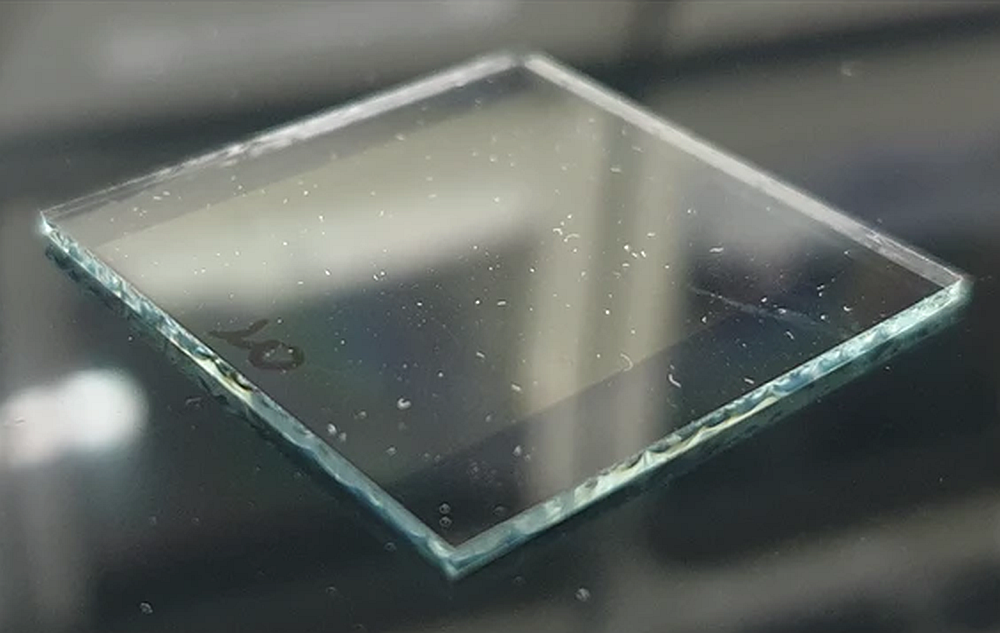
[Image above] Photo showing evidence of test dust deposited onto a glass/indium tin oxide substrate prior to tin(IV) oxide deposition. Credit: Lacey et al., Communications Materials (CC BY 4.0)
Every superhero has their weakness, with Superman’s vulnerability to Kryptonite being the most obvious example. In the materials world, perovskites are being hailed as the heroes to overcome the limitations of silicon-based solar cells. However, the irony is that this emerging class of photovoltaic materials are known to degrade rapidly when exposed to the sun.
Perovskites are also susceptible to moisture, heat, and oxygen, which combined with sunny skies perfectly describes the usual environment in which perovskite solar cells are intended to operate. The result is that scientists spend a lot of time on developing ways to stabilize the perovskite layer, from introducing cross-linked molecular contacts into the cell to decoupling the synergistic role of water and oxygen in degradation.
With such a long list of environmental triggers, it would be easy to conclude that perovskites and the outside world just don’t mix. But in a recent open-access paper, researchers from Swansea University in the U.K. showed there is at least one external stimuli that perovskites can brush off with no problem—dust.
Dust is a critical concern in the production of silicon solar cells because it can lead to defects and reduced performance. So, silicon solar cells are manufactured in cleanrooms to mitigate contamination, but this requirement makes it difficult for less developed economies to establish photovoltaic manufacturing capabilities because cleanrooms are an expensive and energy-intensive investment.
While it is known that dust particles can cause defects in perovskite films as well, “very little research has gone into quantifying precisely how dust particles present during manufacture affect the performance of a PSC [perovskite solar cell],” the Swansea researchers write. So, they decided “to compare and analyse lab scale devices made in a cleanroom environment with those from the same batch placed purposely into a controlled dusty environment.”
The researchers used a nonconductive cotton fiber dust as the test material so they could assess the physical impact of a foreign particle on the cells’ performance. They deposited the dust using a special test box that was equivalent to weeks or even months of passive dust accumulation to ensure “that any potential impact of dust—especially at specific fabrication stages—is exaggerated enough to reveal even subtle performance losses,” they explain.
Testing revealed that the dust-covered perovskite solar cells performed almost the same as those made in sterile cleanrooms. The researchers attribute this outcome to the perovskite crystals simply growing around and over the dust particles, so their ability to generate current was not significantly impacted. Furthermore, the dust contamination did not cause the cells to degrade any faster than other mechanisms, even when exposed to high heat and humidity.
“Our findings are a major win for the future of affordable green energy,” says first author Kathryn Lacey, facilities manager of the SPECIFIC innovation and knowledge center at Swansea University, in a press release. “For a long time, we believed high-quality perovskite solar cells had to be made in expensive, ultrasterile environments. However, our research shows that these cells are surprisingly resilient—they can still perform remarkably well even when exposed to common dust.”
The main limitation of this study is that it focused on small-area perovskite solar cells and does not extend to full module-scale devices. So, an important direction for future investigation is “Evaluating the influence of particulate contamination on large-area modules ( > 10 cm²), where defect propagation and electrical interconnection losses may play a more critical role,” the researchers conclude.
The open-access paper, published in Communications Materials, is “Manufacturing planar perovskite solar cells in dusty environments” (DOI: 10.1038/s43246-025-00993-y).