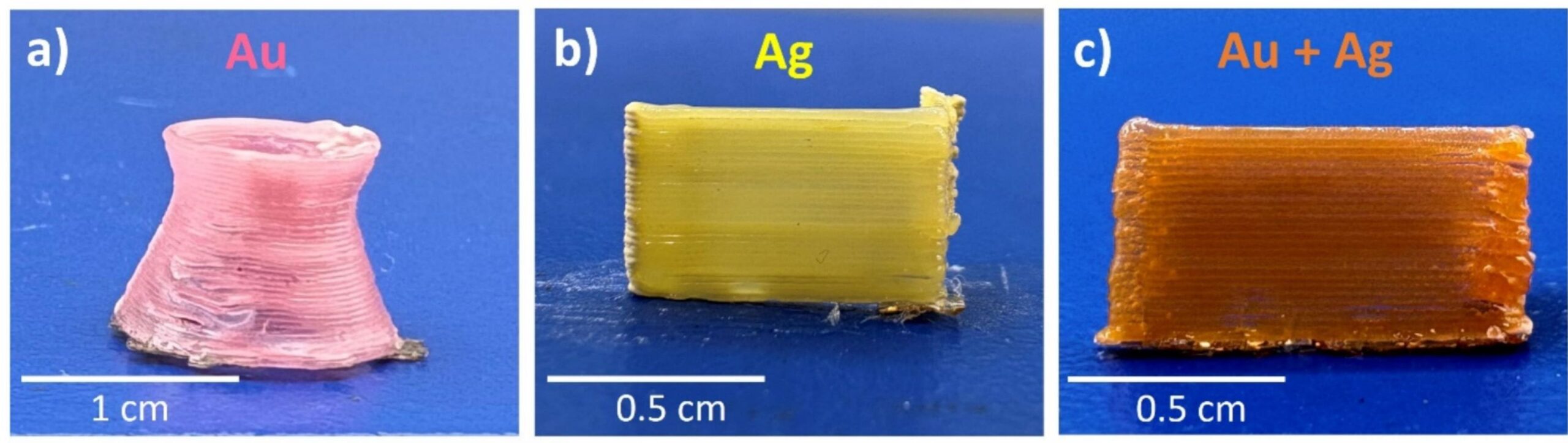
[Image above] Examples of 3D-printed glass objects created using a novel laser-assisted melt printing process. The glass ink in a) was doped with AuCl3, and during the laser melting, the gold atoms form nanoparticles that stain the glass red. Meanwhile, silver nanoparticles stain the glass yellow, as shown in b), while mixing gold and silver produces the orange color seen in c). Credit: Schadte et al., Materials & Design (CC BY-NC-ND 4.0)
Among the materials that can be 3D printed, glass has taken longer to gain traction in the additive manufacturing community due to technical barriers (e.g., high melting point) and lack of a clear market. But CTT has continued to track advancements in this research area over the past 10 years, with posts in 2015 (here and here), 2019, and most recently 2024 highlighting notable developments.
Advances in 3D-printed glass have continued since the November 2024 post, and a recent open-access review article by researchers from several Australian universities provides a comprehensive comparison of a variety of glass 3D-printing processes, including directed energy deposition, selective laser melting, fused deposition modeling, and various binder-based methods (such as direct ink writing).
Several more recent glass 3D-printing developments are described below, including innovations that lower processing temperatures and eliminate binders. Potential applications of these developments span a wide variety of products, including high-precision lenses, photonics components, biomedical devices, and complex microfluidic circuits.
Unique resin reduces shrinkage at lower processing temperatures
Although well above the record low temperatures for glass 3D printing achieved by researchers at Georgia Institute of Technology (220°C) and Massachusetts Institute of Technology (250°C), the new method developed by researchers at Yokohama National University in Japan still reduces the processing temperature considerably compared to typical glassmaking temperatures, from more than 1,000°C to just 650–700°C. This reduction is enabled through the use of a unique low-density polyhedral oligomeric silsesquioxane (POSS)-based resin.
Previous experiments using POSS resins have reduced the processing temperature to under 700°C, but the formulations typically require additional organic monomers to reduce glass viscosity. The monomer addition reduces the silica content in the resin, resulting in 42% shrinkage during calcination.
Compared to conventional POSS resins, the Yokohama group’s resin does not contain any additional organic monomers and keeps shrinkage to only about 36%. This reduced shrinkage means less cracking and warping during calcination and allows both high‑resolution two‑photon polymerization (2PP) and lower‑cost single‑photon stereolithography (SLA) to be used for processing.
The researchers developed two types of POSS resins for the different processing techniques. The resin for 2PP processing has just two ingredients: a cross-linkable high-silica content POSS monomer and a small amount of a photoinitiator. The resin for single-photon SLA contains two additional ingredients: a photoabsorber and polymerization inhibitor.
For single-photon SLA, the researchers used a semiconductor laser to focus blue light on the POSS resin, which was then scanned in three directions to create a 3D object. For 2PP, the researchers used a system incorporating a femtosecond laser with tunable oscillation wavelength. Scanning this laser results in a solid polymer network consisting of an organic matrix and embedded POSS nanoclusters.
For both processes, cleaning and drying steps are required, followed by low-temperature calcination, which produced fused silica at 650°C during 2PP. The SLA method required heating at 700°C in an electric tubular furnace to completely remove the organic components.
In the future, the researchers plan to further optimize the printing parameters and cleaning processes to improve the precision of the features. They also plan to combine the 2PP and single-photon SLA processes to enable multiscale fabrication, i.e., centimeter-sized structures with submicron resolution. The commercialization of the Yokohama process “… will enable hybrid integration with semiconductor, MEMS, and photonic devices,” says senior author Shoji Maruo, professor at Yokohama National University, in a press release.
The open-access paper, published in Polymers, is “Low-temperature glass 3D printing via two-photon and single-photon polymerization of oligo-silsesquioxanes” (DOI: 10.3390/polym17233204).
Sol-gel reaction enables binder-free printing
Sol-gel precursor solutions are being combined with photopolymerization for 3D printing of both ceramics and glass. Using light to trigger a chemical reaction that forms glass structures, organic additives and extreme heat are eliminated that are usually required for stereolithography-based glass printing. Because of the precision and speed of the process, novel components are possible for optics, photonics, and biomedical applications.
Researchers at The Hebrew University of Jerusalem recently described a new sol-gel process in an open-access paper. Their process can produce silica objects at the centimeter scale using conventional low-cost, digital-light-processing 3D printers.
The method relies on a photobase generator called N-methyl nifedipine, which upon irradiation undergoes a photochemical reaction that directly generates a hydroxide ion, unlike conventional photogenerators. It also has “sufficient absorption at the wavelength range of most commercial printers to induce a localized pH change upon irradiation, resulting in spatially controlled sol-gel polymerization,” the researchers write.
The researchers used tetraethyl orthosilicate as the silica precursor. After printing and rinsing with ethanol, they transformed the gel objects into pure inorganic mesoporous silica through heat treatment at 250°C.
The printed silica objects demonstrated moderate transparency, minimal shrinkage (~25%), and a well-defined mesoporous structure with pore sizes predominantly in the 4-8 nm range. Unfortunately, supercritical drying was required to avoid a cracking problem, adding time and cost to the overall process. Therefore, the researchers will investigate alternative drying approaches to address this problem.
The process has the potential to incorporate organic functional materials into printed silica and to use a broader range of sol-gel systems, including those based on zirconium and titanium alkoxides.
The open-access paper, published in Materials Today, is “Stereolithography-based 3D printing of silica with solutions without organic binders” (DOI: 10.1016/j.mattod.2025.08.026).
3D-printed glasses incorporate quantum dots for photonics
Researchers from various universities in China developed a simple, cost-effective method for creating a library of 3D-printed glasses incorporating quantum dots with advanced photonic capabilities. Photoluminescence of these dot-filled glasses is tunable in the ultraviolet, visible, and infrared spectrums.
The process of creating these novel glasses consists of four steps:
- Sol–gel ink formulation consisting of a photopolymerizable silica–alumina glass system incorporating metal ions, photoabsorber, photoinitiator, and an acrylic group.
- Vat photopolymerization and 3D printing of the wet gel structure, followed by drying to remove the solvent and form an xerogel.
- Formation of 3D-printed, metal ion-doped nanoglasses by heating in air at 650°C.
- Final functionalization of the glasses with quantum dots using a precursor solution.
The 3D-printed nanoglasses had a pore size of 4 nm with a smooth surface and a transparency above 90% in the visible range. A variety of semiconducting quantum dots were incorporated, including ZnS, CsPbBrCl2, CsPbBr3, CdS, CdSe, CsPbI3, AgInS2, CdTe, Ag2S, PbS, and PbSe.
Ultimatelty, the researchers conclude that “this method establishes two-dimensional bandgap engineering capabilities within monolithic glass objectives, permitting independent control of both QD [quantum dot] composition and physical dimensions at micron resolution.”
The open-access paper, published in Nature Communications, is “3D printing of glasses with tunable UV–VIS–IR photoluminescence via low-temperature nanoscale engineering” (DOI: 10.1038/s41467-026-68523-z).
Novel LAMP process shows promise
Researchers at Kiel University in Germany announced a novel laser-assisted melt printing (LAMP) process that does not require extensive post-processing treatments to achieve the final object.
A combination of direct ink writing and laser melting, LAMP directly forms 3D objects made from a glass ink consisting of pure 40-nm silicate nanoparticles, 40-µm borosilicate microparticles, water, polyethylene glycol, and 0.2 vol.% acetic acid. The researchers note that the bimodal size distribution of the particles allows higher filling factors, reduces gas trapping and shrinkage, and improves ink flow.
They applied the ink in layers and then fused it using a focused CO2 laser beam. The fusion occurred in two stages. First, the binder is oxidized by the cooler edges of the laser beam and removed without leaving any residue. The ink contains a binder polymer, which burns under the laser irradiation in the presence of oxygen. The hot core of the laser then melts the glass particles selectively so that they bond with the underlying layer.
By adding metal ions to the ink, nanoparticles were synthesized in situ, producing glass of various colors. With increasing laser power, the color became less intense, which was attributed to less particles in the glass. Gold or silver ions are also transformed into nanoscale particles by the laser, producing optical filters.
Gradients and sharp transitions of optical properties are possible by adjusting the laser power. Additionally, iron or nickel could be added to produce magnetic properties, and carbon nanotubes could be used to mechanically reinforce the glass. The researchers note that the LAMP process also has the potential to be adapted for other ceramics and multimaterial composites.
The open-access paper, published in Materials & Design, is “LAMP: laser-assisted melt printing for direct silica glass 3D printing with in-situ nanoparticle synthesis” (DOI: 10.1016/j.matdes.2025.114972).
Future goals: Achieving 1-micrometer features
In February 2025, the National Science Foundation funded a three-year project called STELLAR: Scalable low temperature ultrafast laser materials manufacturing. Led by researchers at the University of Utah’s John and Marcia Price College of Engineering, the $1.4 million award is split between the University of Utah and two Irish institutions, the University of Galway and Queen’s University Belfast. The project leaders, Berardi Sensale-Rodriguez and Rajesh Menon, are both professors in the University of Utah’s Department of Electrical & Computer Engineering.
The goal is to develop a glass-based 3D-printing system capable of manufacturing features as small as 1 micrometer over centimeter areas, which is not possible with current technologies. The system will combine femtosecond lasers (which turn on and off in a millionth of a billionth of a second) with advanced beam shaping and computational modeling. This combination will provide unprecedented control while using 80% of the energy of traditional methods.
“If we can shape glass on a microstructural level, we can gain new levels of control over light across different wavelengths of the electromagnetic spectrum,” says Menon in a press release.
The researchers will test their system by printing a glass planar resonance sensor.
“This kind of sensor can actually test the mechanical properties of the glass itself,” Sensale-Rodriguez notes in the press release. “So, we are taking advantage of the printing of the material as a way to test the properties of the material simultaneously.” Other potential applications include nanosatellite telescope lenses.