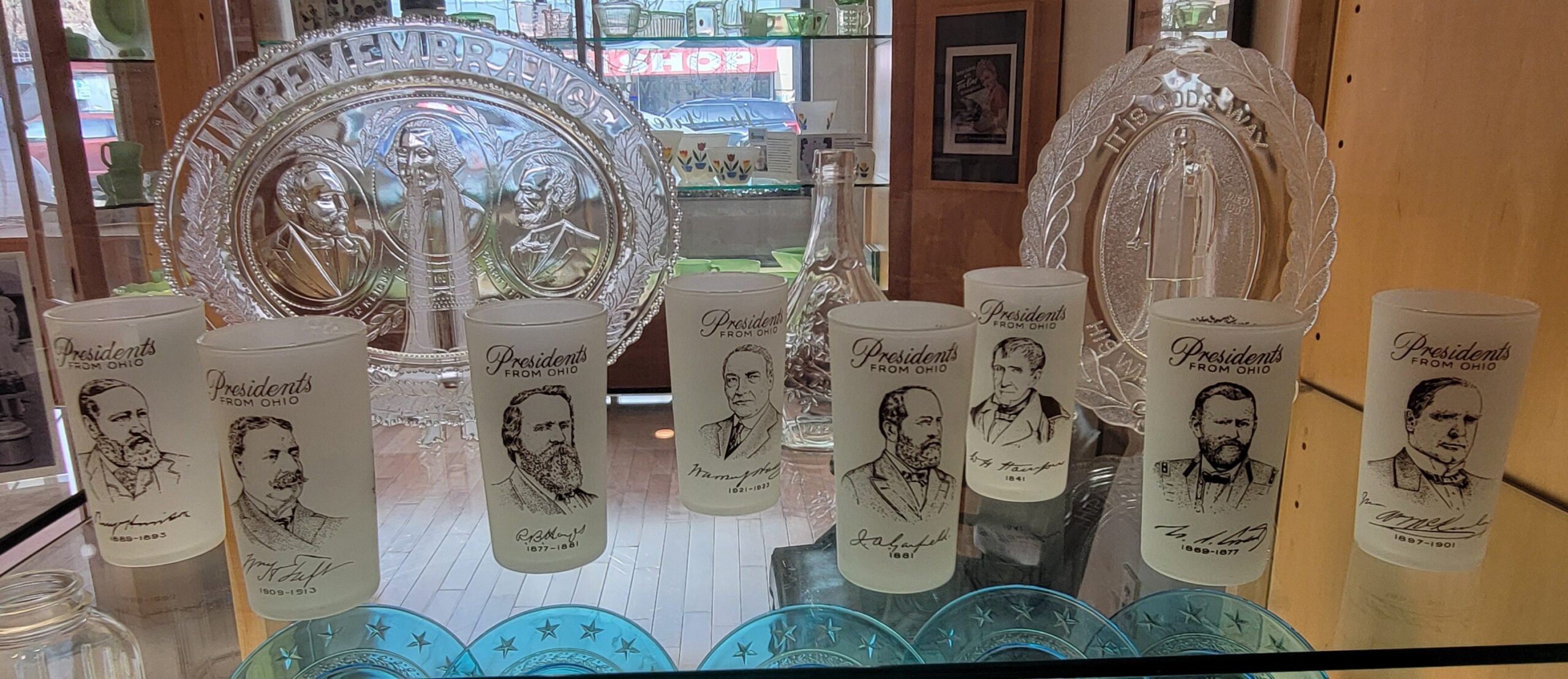
[Image above] Babak Anasori (center) with his students Ornoba Chowdhury (left) and Jacob Patenaude (right) examine a MXene synthesized in their lab. Credit: Purdue University
If I asked you to list all 50 U.S. states in alphabetical order, many people would admit defeat before even starting. But for any choir kids out there, a “silly little song” from elementary school may emerge from the depths of your mind to supply an easy solution to this apparently difficult task.
Music is a brilliant mnemonic device (learning technique) to help you recall complex information. It engages multiple brain areas including language, emotion, and memory, and the inherent rhythm, rhyme, and repetition attributes provide strong retrieval cues. These factors are why you can recall lyrics to songs that haven’t graced your ears for years, even trivial advertising jingles.
For ACerS member Babak Anasori, Reilly Rising Star associate professor of materials and mechanical engineering at Purdue University, he has long admired the positive impact that music can have on science outreach, particularly through the annual Dance Your Ph.D. competition. While none of his students have submitted to the competition (yet!), this year he found another outlet for his music inspirations—writing science-based lyrics that, through the use of artificial intelligence programs MusicGPT and Udio, can be transformed into full songs.
Classroom activity turned public outreach
In an email, Anasori explains that he’s always been “heavily involved” in science popularization, especially through visual mediums such as the annual NanoArtography competition. Music, however, was something he used locally within his research group and classes rather than publicly.
“Students who take my classes know that I offer bonus points if they can relate a song they hear on the radio to a course concept. It is a way to deepen their understanding and make the material memorable,” he says.
The song “Titanium” by David Guetta and Sia is an obvious example, but Anasori also encourages his students to think more abstractly.
“In ‘Lift Me Up’ by Rihanna, from ‘Black Panther: Wakanda Forever,’ I have used the entire lyrics in my 2D Materials graduate course to describe how one atom might be ‘singing’ to another during chemical vapor deposition growth of a 2D material or during the high-temperature phase transformation of MXenes,” he says. “Metaphorically speaking, although atoms must leave their original configuration, the transformation can lead to something more useful and ultimately better.”
During the 2025 spring semester, one of Anasori’s Ph.D. students went beyond relating existing songs to course concepts and instead used an AI program to create music about MXenes.
“That day was the start of my new journey,” says Anasori. “Their dedication to go above and beyond using existing songs inspired me to create songs of my own.”
Creating materials-inspired songs
The first step to creating the materials-inspired songs is writing the lyrics. While musical composition is a new venture for Anasori, he says the process is not entirely unfamiliar due to his long experience with writing poetry.
“Writing poetry has been part of my life for a long time, often as a way of communicating meaningful moments in my family,” he says. “My mom is a published author, with books in psychology and literature, so I would say it may very well be in my genes.”
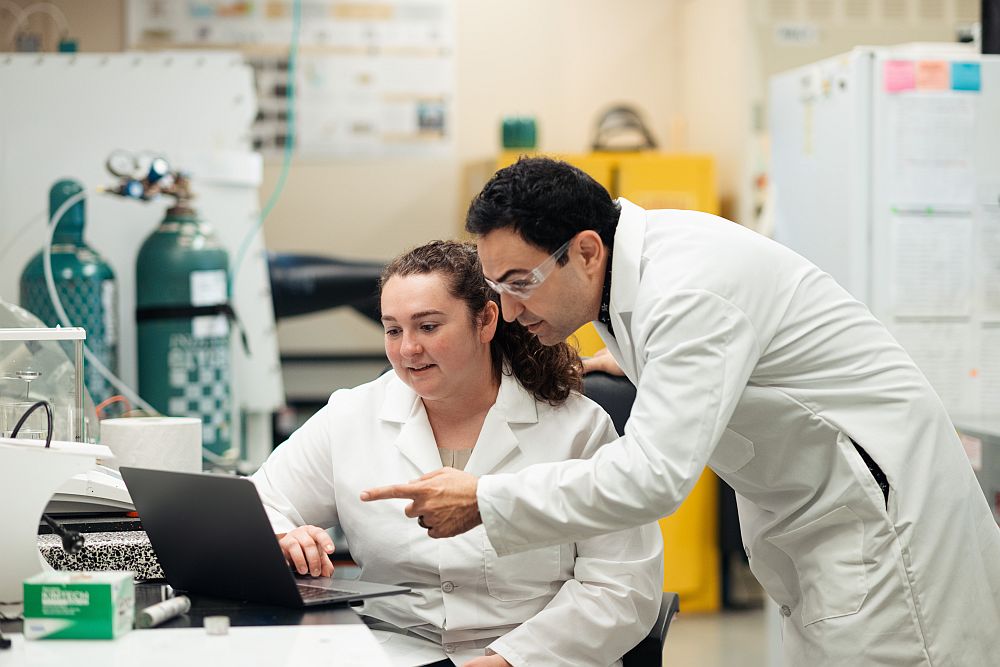
Banak Anasori (right) and his student Annabelle Bedford (left), an ACerS 2025 GEMS Diamond awardee, look at data on the computer. Credit: Purdue University
To prepare himself to write, Anasori says he must first enter a “state of flow,” or a mental state characterized by being fully immersed in the present. He primes himself to reach this deeply focused state by listening to carefully curated soundtracks, which he also uses to work on his research proposals and papers. Anasori educates his students about flow, too, because he believes this state “is essential for becoming more successful researchers, developing a deeper understanding of the topic, enjoying the work, and ultimately achieving breakthroughs.”
After entering the flow state, he will write or voice record the initial lyrics and then polish them himself or with the use of AI. He then feeds the lyrics into MusicGPT or Udio, which will generate a song based on the lyrics and other prompts.
Anasori acknowledges that what he originally imagines and what the AI produces are often very different at first. So, it usually takes between 50 to 100 attempts “to get a piece that truly fits the lyrics and the mood I am aiming for,” he says. He frequently listens to each attempt on his drive home from work, which he says has made the commute “more meaningful and rewarding.”
Though the process of achieving his poetic vision can be tricky, “Turning those ideas into full musical compositions makes them more accessible for students and the general public,” he says. “It is also a lot of fun for me, and that has encouraged me to tap into my poetic side more openly.”
Sharing the magic of MXenes through music
Anasori’s research focuses on the 2D material family of MXenes, and all the songs he has created to date aim to explain different aspects of these materials. In the song that Ceramic Tech Today shared in October 2025, he explained what constitutes a “high entropy” classification for MAX phases and MXenes as a complement to his group’s recent paper.
With the winter holidays coming up, Anasori has now composed a special festive edition about entropy called “A Thousand Femto-Miles Away,” which draws its name from the fact that MXene flakes are around 1.6 nm thick. The lyrics contain a lot of metaphors and double meanings, “which is the super exciting part for me,” Anasori says.
Anasori’s two favorite versions of the song are embedded below, followed by an explanation of the lyrics for each verse. You can find all his MXene-inspired songs on YouTube at this link.

Credit: Babak Anasori, YouTube

Credit: Babak Anasori, YouTube
We were far, so far away, a thousand femto-miles away,
Each in our own layer on a winter holiday.
But through the dance of seven lights, under festive starry skies,
We found our love in layers, where the holiday lights rise.
Here, I imagine two atoms on separate atomic layers in a MXene, which is roughly 1.6 nanometers apart or a thousand femto-miles. These lyrics serve as a metaphor for two lovers far from one another, each in their own layer on a winter holiday. The “seven lights” serve as an interchangeable image: It refers to celestial stars in the festive night sky and the transition-metal elements that guide the structure. As these stars dance, poetically and in the reaction, the two atoms meet, finding each other and coming together in perfect harmony.
Molybdenum spreads the cheer outside,
Titanium keeps our hearts warm inside.
Nine stars in crystal light,
Gather ’round our diamond knight.
The first two lines are a reference to the ordered MXene phases, where molybdenum resides on the outer layer and titanium occupies the inner layers. I chose Mo2Ti2C3 as the reference composition here because it was one of the first ordered MXene systems discovered in 2015, when I was a postdoc at Drexel University.
When all nine elements (from groups 4, 5, and 6 of the periodic table) are placed together in the tube furnace, the “crystal light” appears. I imagine the furnace as a crystal light because it is made of alumina, a crystalline ceramic, and glows very bright at 1,600°C. In that heat, the nine metals (or “stars”) gather around the central carbon atom, the “diamond knight.”
My referring to carbon as “diamond” in the lyrics has two purposes: diamond is a form of carbon, and carbon is precious like a diamond because it is essential for MAX and MXene formation. By calling it our “diamond knight,” I imagine carbon as the noble guardian at the center—the element that unites and anchors all the others, allowing them to bond and form the ordered structure.
[Chorus] It’s the magic of entropy,
Twinkling through the Christmas tree.
In these MXene sheets I see,
A love that’s meant to be.
Every bond that holds us tight,
Glows like diamonds in candlelight.
Seven stars whisper through the winter storm,
Now we’re all together in this crystalline holiday.
Two main metaphors appear here. “Glows like diamonds in candlelight” draws from the fascinating fact that burning a candle creates millions of nanodiamonds per second in the flame. I love this poetic image and even discuss it in some of my classes. While this phenomenon is unrelated to MXenes, diamonds serve as a simile for the strength of the bonds holding the atoms together.
“Crystalline holiday” carries a dual meaning. In a traditional holiday song, it evokes snow with its beautiful crystalline structure. In the context of this song, it refers to the crystal structures of MAX phases and MXenes.
Forty faces shining bright,
Whispers drift through winter night.
We placed our hopes in the flame’s warm glow,
Hearts entwined beneath the snow.
Through the fire, hand in hand,
Love’s the bond that nature planned.
“Forty faces shining bright” refers to the approximately 40 MAX phases and 40 MXenes we discovered in our September 2025 paper on high-entropy layered and 2D carbides. “The flame’s warm glow” is the 1,600°C furnace where we placed all the precursor materials together, and I imagine running that furnace on a cold, snowy Indiana night—the contrast between extreme heat and winter quiet.
The line “Love’s the bond that nature planned” points to thermodynamics: Nature’s rules guide which bonds form, which structures emerge, and how everything ultimately comes together. Though this paper described how we created these phases for the first time, we were ultimately following nature—thermodynamics—all the way. This line becomes a metaphor for two people whose connection is shaped by something fundamental and inevitable.
Molybdenum guards the cheer,
Titanium keeps us near.
Nine stars in crystal light,
Now the carols start at night.
“Now the carols start at night” is my metaphor for the reaction itself: Once the furnace reaches its full temperature late at night (it takes several hours to go from room temperature to 1,600°C), the atoms begin to move, dance, and rearrange. Their high-temperature choreography becomes the “carol,” the music of the reaction, as new bonds form and the structure takes shape.
[Chorus]
Under mistletoe, bonds ignite,
Dreams and love in bright light.
From pico-miles to holiday cheer,
Love has brought us ever near.
Rules dissolve in silver light,
Now your touch feels just right.
“Under mistletoe, bonds ignite” blends the holiday tradition with the scientific reality of bond formation—a playful way of linking human connection to atomic connection. (For clarity, we do not hang mistletoe over our furnace, but it is my imagination here!)
“From pico-miles to holiday cheer” brings back the roughly 1.6 nm thickness of a MXene flake, the tiny distance the atoms were once separated by, now closed as they come together in one atomic plane in the warmth of the entropy-stabilized holiday moment.
“Rules dissolve in silver light” refers to the 1,600°C furnace glow: the bright, almost silver light where heat and entropy overcome enthalpic preferences (enthalpic rules) for ordering. In that high-temperature environment, the atoms can finally reorganize into the same layer—essentially allowing the two atoms, and metaphorically the two lovers, to touch.
[Chorus]