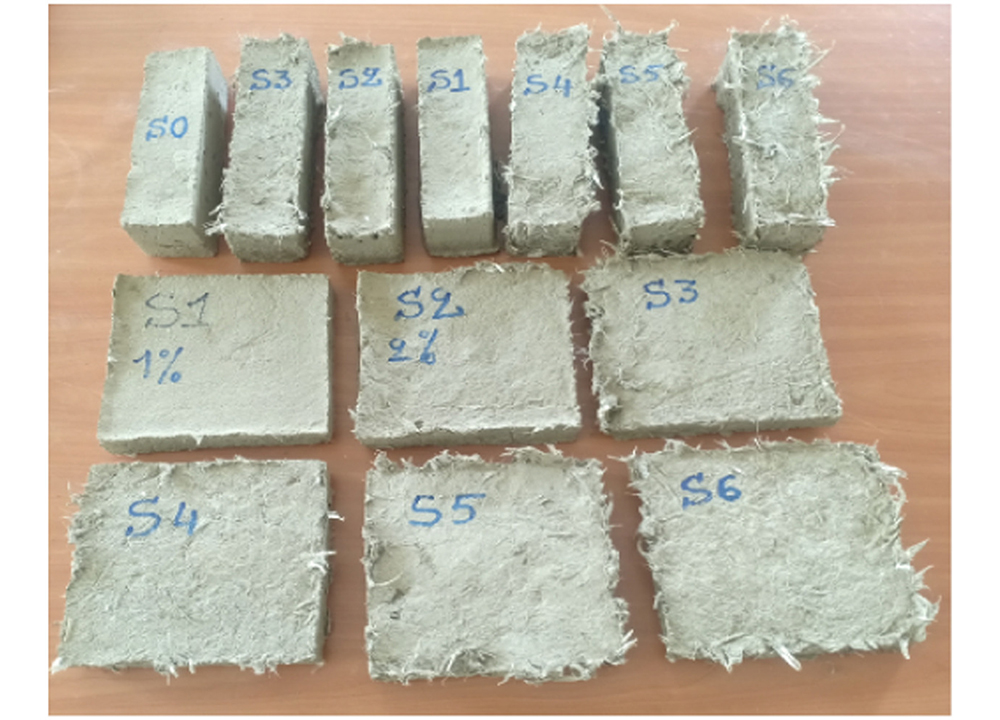
[Image above] Samples of earth bricks reinforced with treated chicken feathers. Credit: El yahyaoui and Manssouri(opens in new tab), Cleaner and Circular Bioeconomy (CC BY 4.0)
Among construction materials, brick stands out as an enduring testament to practical and aesthetic design(opens in new tab). It has served as the “urban fabric” of civilizations for millennia, as we explored in a special three-part CTT series(opens in new tab) last fall.
The very first bricks were simply mud slabs dried by the sun. But the discovery that firing bricks in a kiln greatly improved their durability revolutionized brick production(opens in new tab), allowing societies to construct monumental structures that withstood flooding, fires, and stormy winds for generations.
However, firing bricks takes a lot of energy, and in today’s world of increasing energy prices(opens in new tab) and carbon emissions awareness(opens in new tab), this tried-and-true method for improving a brick’s durability may no longer be the best choice in all circumstances. Now, researchers are looking seriously at other methods for producing unfired construction materials with acceptable strength profiles, including the incorporation of agricultural fibers.
History of fiber reinforcement: Drawing strength from agricultural fibers
Agricultural fibers refer to plant- or animal-based organic filaments harvested from farming operations. Straw and animal hair (typically from horses, pigs, goats, or cattle) have been used in unfired bricks(opens in new tab) since antiquity to provide stability. The addition of straw keeps the clay from cracking in the heat, while mixing animal hair into the lime plaster that coats the bricks helps improve sound and temperature insulation.
Recently, interest has grown in exploring other types of agricultural fibers as brick additives, as will be discussed in the sections below. Using these agricultural materials as stabilizers not only keeps them out of the landfill, but it also offers an eco-friendly alternative to the binder Portland cement (the material responsible for 8% of global CO2 emissions(opens in new tab) every year).
Notably, as research on agricultural fibers and other stabilizers and binders(opens in new tab) in unfired bricks continues, scientists must remember that incorporating coarse additives such as glass and ceramic waste into the brick can potentially introduce pathways for moisture intrusion, which can decrease the strength of the finished product over time. Therefore, special attention should be paid to the additive segment size and binding agents(opens in new tab) to ensure proper cohesion.
Novel plant fiber discoveries
There are many plant fibers that scientists are evaluating for their performance in sun-dried bricks. Some of these include cactus, smmar, and kenaf fibers.
In a study(opens in new tab) by researchers in Saudi Arabia and Algeria, they added cactus fibers and biochar to earth bricks to increase their strength and improve their thermal insulation ability. The cactus fibers, specifically the Barbary fig (Opuntia ficus-indica) are treated with baking soda to help them stick to the mud better. The biochar is itself an engineered material produced by pyrolysis. Structures built with bricks made in this way keep the interior more than 40% cooler(opens in new tab) than structures built of bricks without these additives.
Smmar is the local Moroccan name for the spiny rush (Juncus acutus) plant. In an open-access paper(opens in new tab), researchers from Moulay Ismail University in Morocco developed earth bricks reinforced with varying proportions (0–10 wt.%) of locally sourced smmar fibers and biochar. Although adding the fibers increased porosity and capillary water absorption (and slightly reduced the compressive strength), the researchers found that a 3% fiber blend provides the ideal balance between improved thermal insulation, structural integrity, and moisture resistance while remaining fully compliant with international construction standards.
Another study(opens in new tab) by researchers in Burkina Faso and France investigated the effectiveness of adding kenaf (Hibiscus cannabinus) fibers for reinforcing pressed earth blocks. The kenaf fibers have high tensile strength and resistance to elastic deformation. Incorporating these short, natural fibers into the clay improved the material’s structural ductility and bending performance by effectively controlling crack propagation.
Novel animal fiber discoveries
Research is increasing on the use of sheep wool in unfired bricks(opens in new tab) because of its moisture control properties and its ability to reinforce and bind the matrix together. However, just adding animal fiber alone can leave the material vulnerable to cracking. Scientists have looked at adding alginate(opens in new tab), a polymer derived from seaweed, or keratin(opens in new tab) to the sheep wool or other animal fibers to create unfired bricks with durability and compressive strength to rival fired bricks.
Another possible additive to unfired bricks is chicken feathers, a material that would otherwise go to waste. In another open-access paper(opens in new tab) by the Moulay Ismail University researchers, they developed sustainable earthen bricks reinforced with chicken feather fibers that were treated with formaldehyde and silane to enhance their compatibility with the clay matrix. The treated composites had lower porosity and bulk density, increased compressive strength, and reduced thermal conductivity compared to untreated bricks.
The future of sustainable building materials
The construction industry is responsible for more than a third of global carbon dioxide emissions(opens in new tab), and those emissions continue to grow(opens in new tab). Between 2011 and 2013, China used more concrete than(opens in new tab) the United States used in the entire 20th century. (A fact I picked up while watching “The History of Concrete(opens in new tab),” which is more about independent film making and New York City’s crumbling infrastructure than history, but it is still quite good.)
As we look to the future, we must find ways to cut back on carbon-intensive building materials without sacrificing structural integrity or quality of life. It is no wonder, then, that unfired bricks are making a comeback. Using agricultural fibers to stabilize these materials provides a solution to multiple sustainability concerns facing us today.