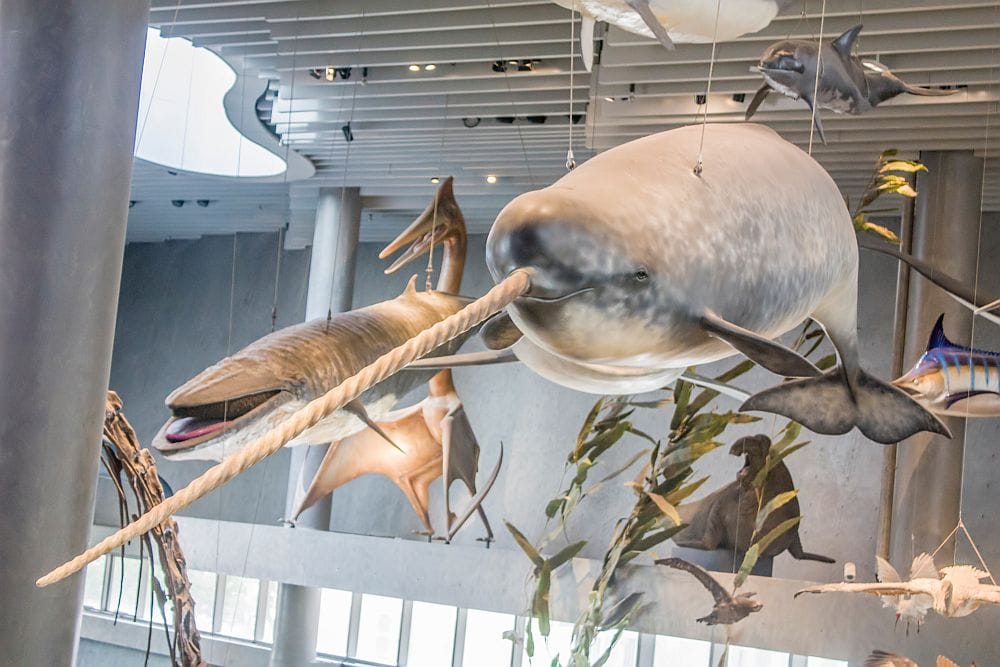
[Image above] Model of a narwhal in the Shanghai Natural History Museum. The whale’s long, spiral tusk is unlike any other tusked mammal. Credit: Danny Ye(opens in new tab) / Shutterstock
Despite their moniker “Unicorn of the Sea,” narwhals are very real animals. These unique toothed whales live in the Arctic, and during the Viking colonization of Greenland(opens in new tab) in the 10th century, narwhal tusks were frequently sold as unicorn horns because of their supposed physical similarity.
Although narwhal tusks do not have the magical healing properties of their fantasy brethren, their tusks are fantastical in other ways. To understand what sets narwhals apart from other tusked mammals such as elephants and walruses, we first need to take a close look at the concept of chirality.
The narwhal tusk’s left-handed chirality
Chirality is the geometric property of an object that cannot be superimposed on its mirror image. In practice, this concept is spoken of as an object’s “handedness” because of the prime chirality example: Although your left and right hands are almost identical mirror images of each other, they do not match when laid on top of each other.
Chirality is a familiar concept in molecular chemistry. The building blocks of life(opens in new tab) are strongly chiral: Most sugars are right-handed, and most amino acids are left-handed. Until recently, the reason for the preference(opens in new tab) of certain organic molecules for left- or right-handedness was unknown. But what was known is that this molecular preference can influence crystal growth habits(opens in new tab) and fiber orientation(opens in new tab) on the macroscale, as well the behavior of surfaces(opens in new tab) and mechanical anisotropy(opens in new tab).
So, what does chirality have to do with narwhal tusks? First, let us clarify that tusks are a specialized type of tooth that lack the thick protective enamel coating found on standard mammalian teeth. The lack of rigid surface enamel allows the tusk to grow throughout its lifetime.
As almost all other mammalian tusks grow, they develop curved shapes that lack macroscale chirality. Narwhals are the only mammals to grow perfectly straight tusks, and what is more, all narwhal tusks have an immediately obvious leftward surface spiral. This leftward preference is interesting because protein fibers typically favor a right-handed helix formation(opens in new tab). Understanding how this biological ceramic-matrix composite manages handedness at the molecular scale is key to understanding its macroscale appearance as well as how it resists catastrophic shear and bending failures.
How the narwhal tusk grows straight
Narwhals only have two teeth, both in their upper jaw. Although these teeth typically remain hidden inside the jawbone of female narwhals, the left tooth usually erupts through the lip of male narwhals and grows into the iconic long, spiral tusk. (On rare occasions(opens in new tab), the right tooth will erupt through the lip as well, giving the narwhal two tusks.) Unlike any other standard mammalian tooth or tusk, the narwhal’s tusk has its nerve endings on the surface(opens in new tab), making it unique in the animal kingdom(opens in new tab).
Until recently, scientists did not know how narwhals could grow their tusks so straight. A recent open-access paper(opens in new tab) out of Aarhus University in Denmark has shed some light on the narwhal tusk’s fascinating growth process.
Beneath the surface, the tusk’s hierarchical structure may be the key to how it achieves its length, straightness, and flexibility. Narwhal tusks are made of three layers: the center pulp, the hard dentine core, and the relatively softer outer cementum. Chemically, these structures are made of collagen microfibrils mineralized with hydroxyapatite nanoparticles. Each year, specialized cells within the pulp produce and deposit a new layer of dentine, pushing the tusk to become longer and thicker.
For the Aarhus team, the first clue to the narwhal tusk’s straightness came when they sliced the tusks in half longitudinally. Each half curved after cutting, which they attributed to the release of torsional force. They realized there must be internal stress generated by the tusk nanostructure.
Mechanical testing on transverse and longitudinal tusk sections revealed differences in bending strength and fracture behavior. But 2D imaging was not enough to identify the 3D helical structures in the tusk’s interior.
The Aarhus team used small-angle X-ray scattering tensor tomography(opens in new tab) to examine the 3D internal structure. This characterization technique revealed the tusk to be a hierarchical bioceramic composite, where hydroxyapatite nanoparticles are spatially oriented by collagen templates to manage fracture toughness.
The mineralized collagen fibrils (MCF) in the narwhal’s dentine exhibit right-handed chirality, while the MCF in the cementum has the left-handed chirality visible on the surface of the tusk. This concentric, counter-coiled geometry produces a natural torque-balanced bioceramic composite, giving the narwhal tusk its straightness, strength, and flexibility. It also highlights the complexity of the dentine–cementum boundary(opens in new tab) in narwhal tusks.
What the unique structure of the narwhal tusk does for the animal
Unlike standard mammalian teeth, which have the dentin tubules sealed beneath a protective layer of dense enamel, the narwhal tusk lacks exterior enamel. The lack of this layer means the porous cementum channels are directly exposed to sea water, which lead into millions of open, fluid-filled dentine tubules(opens in new tab).
Because of the millions of nerve endings in the cementum, the narwhal tusk is extremely sensitive to ocean conditions. The tusk can detect water temperature, pressure, particle concentration, and salinity. It is basically a microfluidic sensory probe(opens in new tab) that detects weather conditions and the presence and movement of prey to help narwhals navigate and hunt.
The evolutionary reason for why narwhal tusks grew straight, in contrast to every other tusked mammal, is believed to be related to advantages in hydrodynamic efficiency(opens in new tab) and sexual selection(opens in new tab). The larger the tusk, the better it is at sensing small changes in the ocean and at attracting a mate.
The narwhal tusk’s high microporosity allows sensing, but porous ceramics are inherently vulnerable to stress concentration, microcracking, and environmental degradation. The narwhal compensates with a concentric double-helix bioceramic architecture, which mitigates these structural risks.
Inspiring new engineered materials
When I first learned about narwhals in one of my favorite childhood ABC books(opens in new tab), their similarity to unicorns struck me immediately. But although I am now long past mistaking narwhals for unicorns, the microstructural anatomy of their tusks makes these marine mammals magical to me in a different way.
Although these findings about narwhal tusks can help attract attention to marine science, understanding the double-helix geometry on a deeper level could help inspire solutions for common engineering problems as well. For example, the tusk’s architecture could provide clues to warping prevention and high-toughness composite rod design, both factors of interest(opens in new tab) to ceramic engineers.