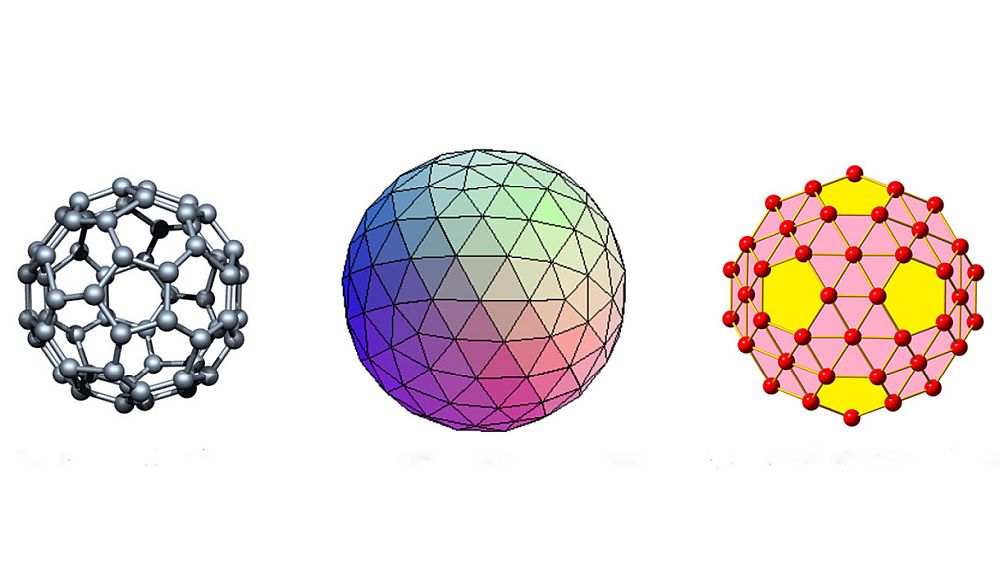
[Image above] The carbon buckminsterfullerene, or “buckyball,” made from 60 carbon atoms (left) was named after the geodesic sphere (middle) popularized by U.S. architect and futurist Buckminster Fuller. The 80-atom boron buckyball (right) is the latest addition to the nanotech world. Credit: Brown University(opens in new tab)
Graphene(opens in new tab), the two-dimensional sheet form of carbon, often serves as the public face of nanomaterial research. Its discovery in 2004 came at a key time for nanoscience(opens in new tab), which allowed it to quickly gain mass media attention and commercial funding. However, 20 years before graphene entered the scene, a different carbon nanostructure was generating waves of excitement in the materials field: fullerenes.
Fullerenes refer to the family of carbon molecules arranged in a closed cage or cylindrical shape. Buckminsterfullerene, or “buckyball,” was the first fullerene discovered in 1985. This soccer-ball-shaped fullerene consists of 60 carbon atoms, and it drastically accelerated interest(opens in new tab) in nanoscale medicine encapsulation and drug delivery. It also opened the door to the broader family of fullerenes(opens in new tab), such as carbon nanotubes, and these advancements rightly earned fullerenes the 1996 Nobel Prize in Chemistry(opens in new tab).
In recent years, researchers have used fullerenes as a framework for understanding the development of noncarbon nanostructures, such as those built from(opens in new tab) boron atoms. Unlike carbon, which bonds in a uniform sp2 hybridization, boron bonds in a mixed sp2-sp3 hybridization. This mixed hybridization means boron layers buckle rather than lying perfectly flat, which has made for unique challenges when synthesizing 2D sheets of boron(opens in new tab).
Because of this buckling, researchers were unsure whether boron could ever form a spherical buckyball shape like carbon. But a recent open-access paper(opens in new tab) led by Brown University researchers provides experimental confirmation that a boron buckyball is possible when using 80 boron atoms.
The researchers are led by Lai-Sheng Wang(opens in new tab), the Jesse H. and Louisa D. Sharp Metcalf Professor of Chemistry at Brown. Wang and his students have been investigating boron nanostructures for decades, and they showed in 2014(opens in new tab) that a 40-atom boron cluster could form a hollow cage similar to a carbon buckyball. However, this cage lacked the carbon version’s perfect spherical symmetry, so they started investigating boron cages consisting of more atoms to see if the additional atoms allowed for a spherical shape.
After using photoelectron spectroscopy to analyze various boron cluster sizes of more than 40 atoms, Wang says in a press release(opens in new tab) that he started to doubt whether his team would discover anything interesting. However, his graduate students Hyun Wook Choi and Deniz Kahraman recently noticed interesting signals in the spectral readouts for 80-atom clusters, and closer examination led them to conclude that only a spherical buckyball shape could produce the observed spectrum.
Wang notes that density functional theory calculations have previously suggested that the boron buckyball should not be stable. However, “I think the DFT calculations are wrong in this case … [because] DFT has some of the bond lengths wrong for the B80 buckyball, and that leads to incorrect predictions for its stability,” Wang says in the press release.
Future studies will aim to understand why DFT might have gone awry in the boron buckyball predictions. Wang’s team also hopes to work with colleagues in other labs to investigate the chemical reactivity of the B80 buckyball as well as determine if the buckyballs can stay intact in ambient conditions (the ones in this study were created in a vacuum).
The open-access paper, published in Chemical Science, is “Boron buckminsterfullerene(opens in new tab)” (DOI: 10.1039/d6sc02674e).