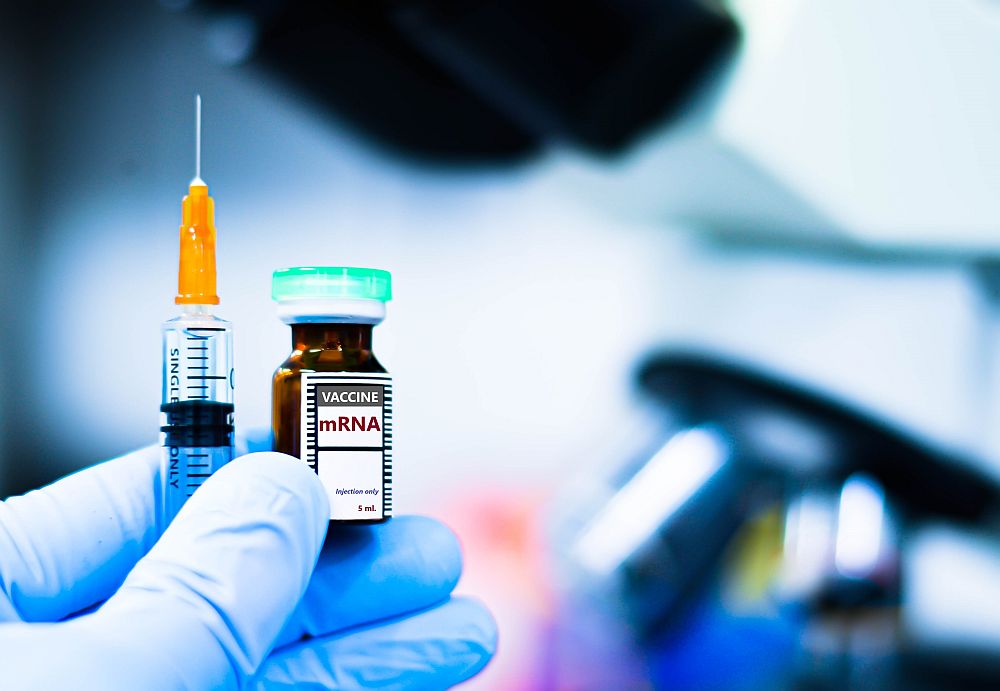
[Image above] The mRNA vaccines used during the COVID-19 pandemic were based on lipid nanoparticle technology. Since the pandemic, billions of public and private dollars have been poured into lipid nanoparticle research. Credit: Kitsawet Saethao(opens in new tab) / Shutterstock
The U.S. is known for taking its catchphrase “go big or go home(opens in new tab)” quite literally, with entire maps dedicated(opens in new tab) to tracking the large-scale attractions calling to tourists along roadsides across the country. But since the turn of the century, our efforts to “go big” on the latest research trends led to some of the smallest scientific innovations instead as nanotechnology developed into a commercially relevant market(opens in new tab).
In 2016, the National Nanotechnology Coordination Office(opens in new tab) organized and launched the first National Nanotechnology Day(opens in new tab) to raise public awareness about nanotechnology, its current uses, and its future potential. It takes place annually on October 9 as a playful nod to the nanometer scale (10-9 meters, or one-billionth of a meter).
This year marks the 10th anniversary of National Nanotechnology Day. Below we have compiled some of the greatest commercial developments in nanotechnology since the launch of this national themed day.
Healthcare: Scaling of lipid nanoparticles
Lipid nanoparticles are membrane-bound, fluid-filled sacs called vesicles that are used to protect and deliver fragile medicines, such as genetic code or vaccines, directly into human cells. Researchers first proposed using(opens in new tab) vesicles as drug carriers in the 1970s, and the first FDA-approved liposomal drug reached the market(opens in new tab) in 1995.
In the early 2010s, scientists developed ionizable cationic lipids(opens in new tab), which shift their electrical charge based on pH changes to protect delicate genetic cargo. The FDA approved the first targeted RNA therapy(opens in new tab) using lipid nanoparticles in 2018, and modern lipid nanoparticle formulations became vital components(opens in new tab) of widespread COVID-19 mRNA vaccines in 2020.
Since the pandemic, billions of public and private dollars(opens in new tab) have been poured into lipid nanoparticle research, cementing this technology’s role in global healthcare. In addition to serving as delivery systems for other infectious diseases(opens in new tab), lipid nanoparticles are increasingly being used to deliver advanced gene-silencing and CRISPR-based gene-editing therapies(opens in new tab) to targeted tissues as well.
Electronics: Reimagined transistor materials and architectures
To increase computing power, scientists have traditionally just packed more transistors(opens in new tab) onto a semiconductor chip. However, this approach to scaling has reached fundamental physical and thermal limits(opens in new tab), so scientists need new ways to increase computing power that do not rely on simply cramming more transistors onto the chip.
In 2016, researchers at Lawrence Berkeley National Laboratory shattered the long-held belief(opens in new tab) that 5 nanometers was the lowest physical limit for transistor gate lengths. While that may be true for silicon, they demonstrated a working transistor with a 1-nanometer gate by pairing a molybdenum disulfide semiconductor channel with a carbon nanotube gate.
This laboratory demonstration served as a scientific proof-of-concept for ultrashort channel control and inspired subsequent explorations into Gate-All-Around (GAA) architectures(opens in new tab). Traditional FinFET architectures control the current channel from only three sides, which leaves the system susceptible to gate-induced drain leakage and source-to-drain electron tunneling. In contrast, GAA architectures wrap the gate material completely, successfully blocking unwanted electron pathways and eliminating leakages through the substrate.
Major companies have now started producing semiconductor chips with GAA architecture. In 2022, Samsung Electronics began producing(opens in new tab) a 3-nanomater process node for high-performance, low-power computing applications. In 2025, Intel unveiled(opens in new tab) a new PC platform called Panther Lake based on a 2-nanometer process node.
Energy: Reliable solid-state batteries
Compared to traditional batteries that use liquid electrolytes, solid-state batteries use solid electrolytes to eliminate fire risks and enable much higher energy storage. However, solid-state batteries face several big challenges, namely high interfacial resistance between the electrolyte and electrodes as well as degradation caused by volume changes during charging.
To overcome these challenges, companies have been exploring the use of different nanostructuring techniques and nanocoating materials to stabilize the electrolyte–electrode interfaces in solid-state batteries since the late 2000s. Various review papers such as here(opens in new tab) and here(opens in new tab) summarize these innovations.
Although no solid-state batteries are yet on the market, several are planned to be released within the next year. For example,
- Greater Bay Technology(opens in new tab) (Guangzhou, China) rolled out its first A-sample all-solid-state battery cells in April 2026. The company is targeting gigawatt-hour scale mass production and vehicle integration by the end of the year.
- Chery Automobile(opens in new tab) (Wuhu, China) unveiled its Rhino S-series battery lineup featuring sulfide- and polymer-based solid-state cell variants in March 2026. The company is targeting consumer mass-market rollout by 2027.
- Toyota Motor Corporation(opens in new tab) (Toyota City, Japan) confirmed its timeline to introduce first-generation solid-state batteries for electric vehicles between 2027 and 2028. The company has stated that affordability, not range,(opens in new tab) will be its priority in upcoming EVs.
Interested in learning more about recent nanotechnology innovations? Check out all past CTTs on nanomaterials and nanoscience(opens in new tab).