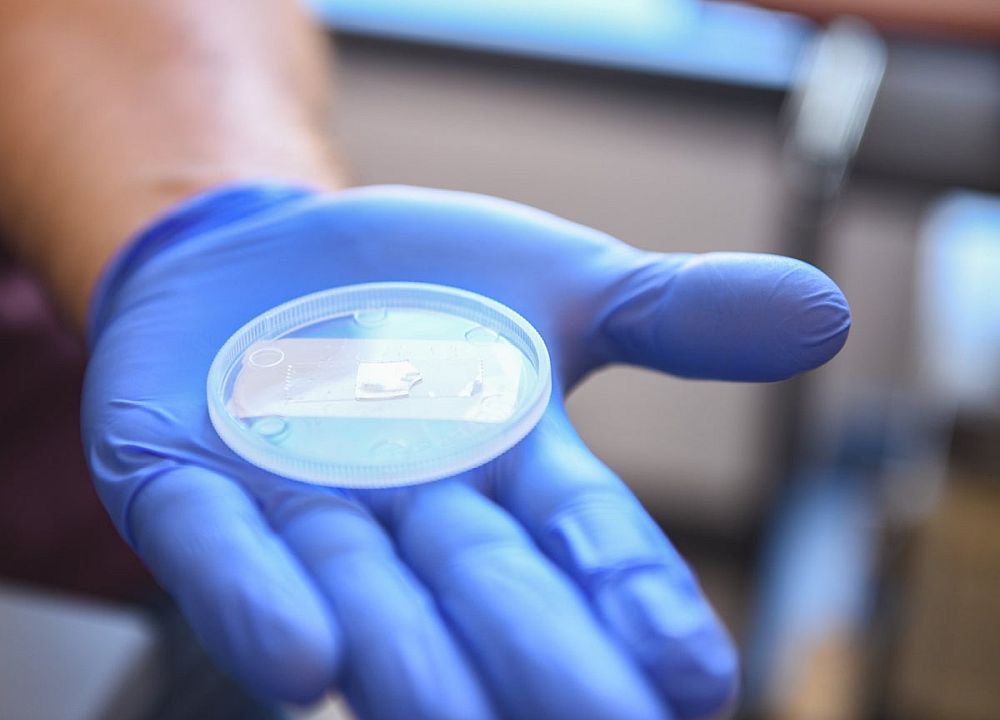
[Image above] Example of a nanostructured, superhydrophobic sapphire surface. Credit: The University of Texas at Austin(opens in new tab)
If the first mental picture that comes to mind when you hear sapphire is the Star of India(opens in new tab), I would understand. This spectacular milky grey-blue sapphire is currently the largest known gem-quality star sapphire, and it has inspired numerous caper storylines(opens in new tab) and references in popular culture (as well as being at the center of a real-life museum heist(opens in new tab)).
Ironically, what gives the Star of India and other gem-quality sapphires their iconic “perfect” coloring are atomic imperfections, specifically elemental impurities. The Star of India and its sister gem, the purplish red star ruby(opens in new tab), are both made of the mineral corundum, a crystalline form of aluminum oxide (Al2O3). Their differing colors are due to ruby containing trace amounts of chromium, while sapphire can contain trace amounts of iron, titanium, and/or beryllium.
In contrast to gem-quality sapphires, which are prized for their color, industrial-grade sapphires are typically colorless. That is because they are grown in the lab to avoid any elemental impurities or lattice defects that would affect the sapphire’s properties.
Industrial-grade sapphire is typically synthesized in the alpha phase (α-Al2O3), which consists of a hexagonal close-packed structure(opens in new tab). This atomic arrangement is what provides industrial-grade sapphire with its extreme hardness, chemical resistance, and optical clarity. (In contrast, the cubic spinel gamma phase(opens in new tab) is less hard but provides a higher specific surface area for catalysis applications.)
Although the properties associated with α-Al2O3 are beneficial in application, they also make it very difficult to functionalize industrial-grade sapphire using standard surface modification methods. Fortunately, three recent studies demonstrate how sapphire surfaces can be modified to affect the wetting behavior.
Why sapphire’s wetting behavior matters
Sapphire is an oxide, making it highly immune to atomic oxygen erosion(opens in new tab). This property, along with sapphire’s exceptional hardness (just behind diamond on the Mohs hardness scale(opens in new tab)) and optical transparency, make sapphire an attractive material for use in harsh environments, such as outer space and nuclear reactors.
Sapphire already serves as cover glass(opens in new tab), sensor windows(opens in new tab), and optical components(opens in new tab) in extreme applications. Its surface is traditionally hydrophilic (attracts water), but its performance could be improved if the sapphire was designed to be superhydrophobic (extremely water repellent) instead.
When heated to extreme temperatures, sapphire components can react with moisture(opens in new tab) in the ambient air, forming a microscopic surface layer that scatters light and reduces optical transmission. If sapphire was designed to be superhydrophobic, it could exhibit self-cleaning, anti-icing, and antifouling capabilities, all beneficial additions in harsh environments.
Materials can be made superhydrophobic through nanoscale structuring, which creates uneven areas on the surface that trap air. This trapped air reduces the surface contact area(opens in new tab) of water with the solid surface, thereby preventing the formation of the microscopic, light-scattering surface layer.
Structuring the sapphire surface directly is difficult, though, because of the material’s high hardness. So, most current methods to achieve superhydrophobic sapphire surfaces involve applying polymeric(opens in new tab) or fluorinated(opens in new tab) molecular modifiers, which face durability challenges in harsh environments.
The three micro- and nanostructuring methods described below demonstrate ways to make superhydrophobic structural modifications of sapphire more commercially successful.
Multifunctional tapered nanostructures
Researchers at The University of Texas at Austin (UTA) engineered high-aspect-ratio, tapered nanostructures(opens in new tab) directly onto sapphire surfaces, mimicking the antireflective profile of moth eyes. They achieved this feat by using interference lithography to pattern the nanostructures, which were then transferred to a sapphire substrate using reactive ion etching.
Adding nanostructures to the surface altered the local stress response and slightly decreased the scratch resistance compared to polished bulk sapphire. However, the modified surface remained much more durable(opens in new tab) than an external superhydrophobic polymer coating.
Additionally, the high-aspect-ratio cone shape of the nanostructures came with several benefits. For one, it allowed gravity alone to clear most of the surface dust, providing a water-free cleaning solution for space exploration vehicles. The tapered nanostructures also reduced glare and improved light transmission without sacrificing structural integrity because the broad base of the cones distributed the applied loads over a broader area, thereby maintaining mechanical durability comparable to tungsten.
Notably, the UTA team’s method allows for reversible surface chemistry, which means the sapphire can be tuned to be either superhydrophilic (anti-fog) or superhydrophobic (water-repellent) depending on the surface treatment. It can thus be used to improve the properties of aerospace optical windows, space mission equipment, glare-free camera lenses, and rugged consumer electronics.
The open-access paper, published in Materials Horizons, is “Scratch-resistant sapphire nanostructures with anti-glare, anti-fogging, and anti-dust properties(opens in new tab)” (DOI: 10.1039/d4mh01844c).
Ultraprecise laser microtexturing
The next study(opens in new tab), conducted at Keio University in Japan, used chemical-free precise laser tooling to overcome sapphire’s brittleness(opens in new tab) and form hierarchical (micro- to nanoscale) surface structures without inducing microcracks or phase transitions in the bulk sapphire.
The structures are formed through controlled growth of redeposited material. Direct laser writing is used to generate a micron-scale periodic grid, upon which nanoscale cauliflower-like clusters are self-assembled through laser-induced redeposition stacking.
The finished sapphire surface yields water contact angles of more than 150° with low sliding angles (less than 5°). This process preserves the underlying single-crystal structure and retains sapphire’s superb optical transmission in key spectral bands (ultraviolet to mid-infrared).
The researchers state that sapphire treated in this way could find applications in defense sensor windows, deep-sea optical viewports, and high-power laser exit optics exposed to marine or humid environments.
The paper, published in Ceramics International, is “Toward superhydrophobic, self-cleaning, and high-transmittance sapphire surfaces via femtosecond laser-induced redeposition modification(opens in new tab)” (DOI: 10.1016/j.ceramint.2026.05.095).
Acid-based selective etching
The final study(opens in new tab), also a product of UTA research, evaluated ultrafast-laser-induced surface modification as well, although it was paired with a hydrophobic silane coating to enhance hydrophobicity.
The researchers used ultrafast femtosecond laser pulses to induce localized phase or morphology shifts in the sapphire’s surface lattice, either to an amorphous state or a polycrystalline one. They then used a hydrofluoric chemical etch to selectively dissolve the laser-modified regions, leaving behind clean, hierarchical micro- or nanostructures ready for the silane coating.
The researchers used Raman spectroscopy to track vibrational mode shifts in the laser-affected regions. The data gathered from this method allowed them to predict the chemical etch selectivity based on lattice disorder before any wet chemical processing took place.
They determined that the laser-modified regions could be etched significantly faster in hydrofluoric acid than the surrounding pristine α-Al2O3. The resulting hierarchical surface achieved an apparent water contact angle of approximately 140°.
Interestingly, rather than exhibiting classic lotus-effect self-cleaning(opens in new tab) (where droplets roll off the surface), the structured sapphire displayed a rose-petal effect(opens in new tab) (droplets beaded up tightly but remained pinned to the surface). Coupled with a high broadband diffuse transmittance of up to 81.8%, the researchers state that this maskless technique opens new doors for chemical-resistant optical diffusers, specialized display covers, and microfluidic optical components.
The open-access paper, published in Nanotechnology, is “Fabrication of hierarchical sapphire nanostructures using ultrafast laser induced morphology change(opens in new tab)” (DOI: 10.1088/1361-6528/adab7c).
Ushering in the next generation of functional sapphire components
Taken together, these studies demonstrate that shifting from brute-force mechanical polishing(opens in new tab) to precision surface structuring can make sapphire surface functionalization a commercially viable endeavor.
This CTT post is part one of two that explores superhydrophobic materials for extreme environments(opens in new tab). Be on the lookout for the second part later this month, which will look at how ceramic engineers are solving an even greater challenge with superhydrophobicity: maintaining superhydrophobic behavior in high-temperature environments where standard silane coatings break down.