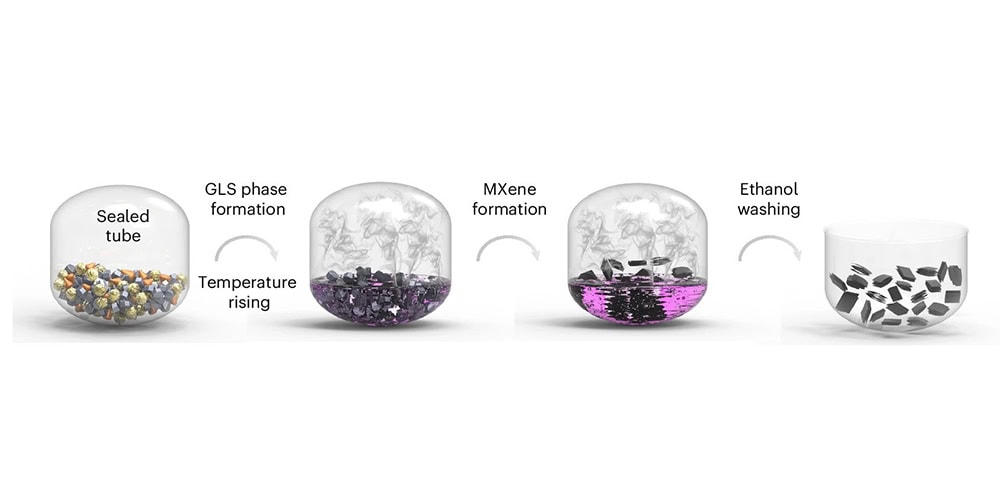
[Image above] Illustration of MXenes synthesized using the new gas–liquid–solid (GLS) etching process. Credit: Li et al.(opens in new tab), Nature Synthesis (CC BY 4.0)
Performing in unison is a hard-earned skill that takes years of practice. But once mastered, a synchronized team can achieve feats that may be difficult or impossible to accomplish with an uncoordinated group, as demonstrated unintentionally well(opens in new tab) by China’s debut all-female police squad during the 2026 UAE SWAT Challenge in Dubai.
Materials can also benefit from uniformity, as a consistent internal geometry can help distribute stress evenly and reduce localized weak points caused by large-scale, random imperfections. Developing techniques to manufacture a precisely controlled structure takes time, but just as a proper hair care routine(opens in new tab) can bring out natural waves and curls from frizzy “straight” hair, proper processing of materials can reveal properties that were previously hindered by atomic imperfections.
MXenes are an emerging family of 2D transition metal carbides and nitrides that is slowly revealing its potential as researchers move from fundamental studies(opens in new tab) to real-world applications(opens in new tab). But uniform production of MXenes still faces some challenges.
Traditionally, MXenes are synthesized by etching away the A layer in bulk MAX phases using strong acids. The use of these harsh etchants and subsequent aggressive washing steps result in mixed and randomly distributed atoms and functional groups on the outermost layer.
“This atomic disorder limits performance because it traps and scatters electrons, much like potholes slowing traffic on a highway,” says Dongqi Li, former Ph.D. student at the Technical University of Dresden, in a press release(opens in new tab).
Li is the lead author on an open-access paper(opens in new tab) published with colleagues from various institutes in Germany, Poland, and Czechia. In the paper, they describe a new gas–liquid–solid (GLS) etching process that enables the synthesis of MXenes with uniformly distributed halogen atoms and a greatly reduced level of impurities.
Instead of the traditional strong acids used for etching, the new GLS process uses gas-phase iodine vapor dissolved in a halide molten salt. A simple ethanol wash can completely remove the generated side products and unreacted reactants, thereby preventing the contamination and atomic disordering that comes from aggressive washing.
Using the GLS process, the researchers successfully synthesized MXenes from eight different MAX phases, demonstrating the technique’s broad applicability. They then used titanium carbide MXenes to show how uniform processing leads to improved electrical properties.
“The chlorine-terminated MXene variant showed a 160-fold increase in macroscopic conductivity and a 13-fold enhancement in terahertz conductivity compared with the same material made by traditional methods. In addition, a nearly fourfold increase in charge carrier mobility was observed, a key measure of how freely electrons move through a material,” Li says in the press release.
The researchers also investigated how using different halide molten salts for the etching process affected the final electrical properties. They found that chlorine-terminated MXenes showed strong absorption in the 14-18 GHz frequency range, while bromine- and iodine-terminated MXenes absorbed most strongly in the 12–17 GHz and 16–18 GHz frequency ranges, respectively.
“This result suggests a promising strategy for designing MXene-based absorbers tailored to specific frequency bands for various practical applications,” the researchers write. Ultimately, “our GLS method will accelerate the development of MXenes with customized properties for advanced (opto)electronics and beyond.”
The open-access paper, published in Nature Synthesis, is “Triphasic synthesis of MXenes with uniform and controlled halogen terminations(opens in new tab)” (DOI: 10.1038/s44160-025-00970-w).