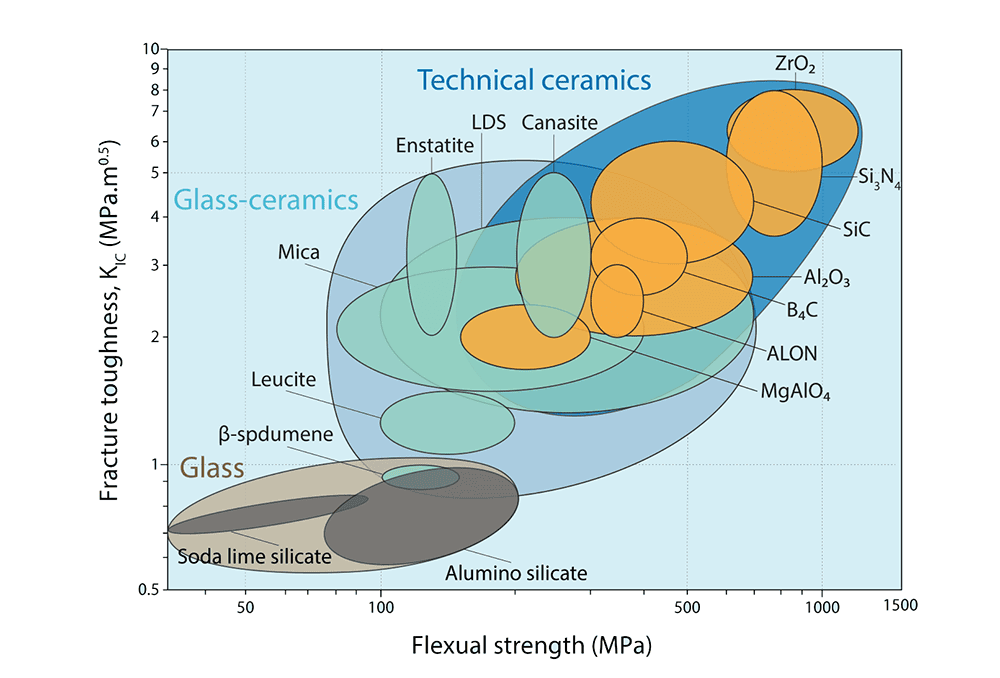
[Image above] Ashby plot showing fracture toughness versus flexural strength for glass, glass-ceramics, and technical ceramics. Credit: Fu and Gross, JACerS (CC BY 4.0)
In theory, virtually all elements can be turned into a glass if they are cooled fast enough to bypass crystallization. I had the pleasure of watching this theory play out in person during my undergraduate studies, when some of my labmates spent their entire summer attempting to create pure tellurium dioxide glasses using the roller quencher. (Their success toward that goal can be seen in the papers here and here.)
Sometimes, however, allowing a little bit of crystallization to creep into the glass is beneficial. Having fine-grained crystals distributed throughout the glassy phase can improve crack and thermal shock resistance compared to a pure glass. On the other hand, the majority glass phase makes the material easier to form than a traditional engineered ceramic.
The inventor of these multiphase materials, called glass-ceramics, is S. Donald Stookey. He attended the same undergraduate institution as me (Coe College) before going on to graduate studies at Lafayette College and Massachusetts Institute of Technology.
It was after Stookey joined the research staff at Corning Glass Works (now Corning Incorporated) that he accidentally created the first glass-ceramic, later branded Fotoceram, in the 1950s. In the 70 years since that discovery, glass-ceramics have grown into a nearly $2 billion industry, with applications ranging from heat‑resistant cookware and tough cover materials for consumer electronics to color-matching dental implants and next-generation batteries.
Despite their market growth, scientists still have a lot to learn about the design and manufacture of glass-ceramics. The benefits of the multiphase structure come at the expense of inherent trade-offs among optical transparency, mechanical performance, thermal properties, and processability. Balancing these trade-offs requires careful optimization for a given application.
Recently, sectors ranging from energy to aerospace are pushing for materials that can offer better performance across all parameters with fewer trade-offs. This demand is driven by the increasingly extreme operating environments of modern devices, from the radioactive core of nuclear reactors to the blistering-hot leading edges of hypersonic vehicles.
To design glass-ceramics that meet these demands, researchers must understand how crystallization behavior, phase assemblage, and microstructural design influence the optical and mechanical performance of glass‑ceramics. A new open-access paper published in Journal of the American Ceramic Society provides a succinct review of the most up-to-date knowledge on this topic.
Newly inducted ACerS Fellows Qiang Fu and Timothy Gross, both of Corning Inc., wrote the new paper.
“When we were invited to contribute to this special JACerS issue on advances in transparent glass- ceramics, the timing felt especially right,” Fu says in an email. “We are seeing exciting new momentum in glass-ceramics, particularly in optical and mechanical performance, and we wanted to capture these recent advances and the opportunities they create for future glass-ceramic design.”
Highlights from their 44-page review paper are given below.
Major glass‑ceramic families
After describing in-depth the three traditional approaches used for glass-ceramic production (internal crystallization, surface crystallization, and powder processing), Fu and Gross discuss the main families of glass-ceramics designed to date.
Currently, “the majority of technologically important glass‑ceramic materials have been derived from silicate‑based glass systems; consequently, silicate and aluminosilicate phases dominate the crystalline assemblage,” they write.
They provide information on 26 representative crystalline phases, which span a wide range of crystal chemistries, structure types, and crystallographic symmetries. These structural features strongly influence the mechanical and optical performance of the glass-ceramics, which the authors examine in detail in the paper’s following sections.
Notably, they include a section on transparent glass-ceramics, which “requires satisfying a stringent set of criteria to minimize light attenuation”:
- Crystal sizes must be much smaller than the wavelength of visible light, “particularly for phases exhibiting biaxial optical behavior.”
- Close refractive‑index matching must exist between the glassy matrix and crystalline phases.
- Crystalline phases with intrinsically low birefringence should be selected or designed.
“In practice, transparent glass‑ceramics are produced by strategically meeting at least two of these requirements through microstructural and compositional design,” they write.
Future directions for glass-ceramic design
Fu and Gross write that “A central theme of this review is the concept of architected glass-ceramics, in which crystallization is not merely used to precipitate crystals, but is deliberately directed to create microstructures and phase assemblages that achieve targeted combinations of properties.”
This design framework has already enabled important advances, including glass-ceramic systems that exhibit fracture toughness values comparable to those of advanced structural oxide ceramics such as Al2O3, despite their lower Young’s modulus. This example, along with the transparent ceramics mentioned above, “demonstrate that optical performance, strength, and toughness do not have to be mutually exclusive, provided that crystallization process and microstructures are carefully designed.”
Of course, realizing the full potential of this design framework will require overcoming a few notable challenges.
- Scale-up and high-throughput manufacturing. Thermal gradients and kinetic variations make it difficult to maintain uniform crystallization and microstructure in large components or continuous production lines. The authors recommend focusing future research on rapid and energy-efficient crystallization methods, shortened heat-treatment schedules, continuous processing approaches, and advanced process-control strategies.
- Hybrid organic–inorganic glass-ceramics. Because the high-temperature treatments required for glass-ceramic production are generally incompatible with polymers and biomolecules, “potential hybrid glass-ceramic systems will likely rely on post-crystallization integration strategies, such as polymer infiltration, surface functionalization, or biomolecule incorporation, to impart enhanced toughness, bioactivity, and multifunctionality,” the authors write.
- Pushing the property limits of glass-ceramics. Crack deflection, crack branching, microcracking, and transformation toughening have been “partially exploited” to improve glass-ceramic toughness. However, the authors argue that “Future work should focus on designing hierarchical microstructures that activate synergistic toughening mechanisms across multiple length scales.”
Fu and Gross also make the case for exploring new glass-ceramic chemistries, crystalline phases, and novel processing approaches to unlock architected structures across length scales. Artificial intelligence and other advanced computational tools “will play an increasingly important role in accelerating this progress,” they conclude.
The open-access paper, published in Journal of the American Ceramic Society, is “Architected glass-ceramics” (DOI: 10.1111/jace.71216).