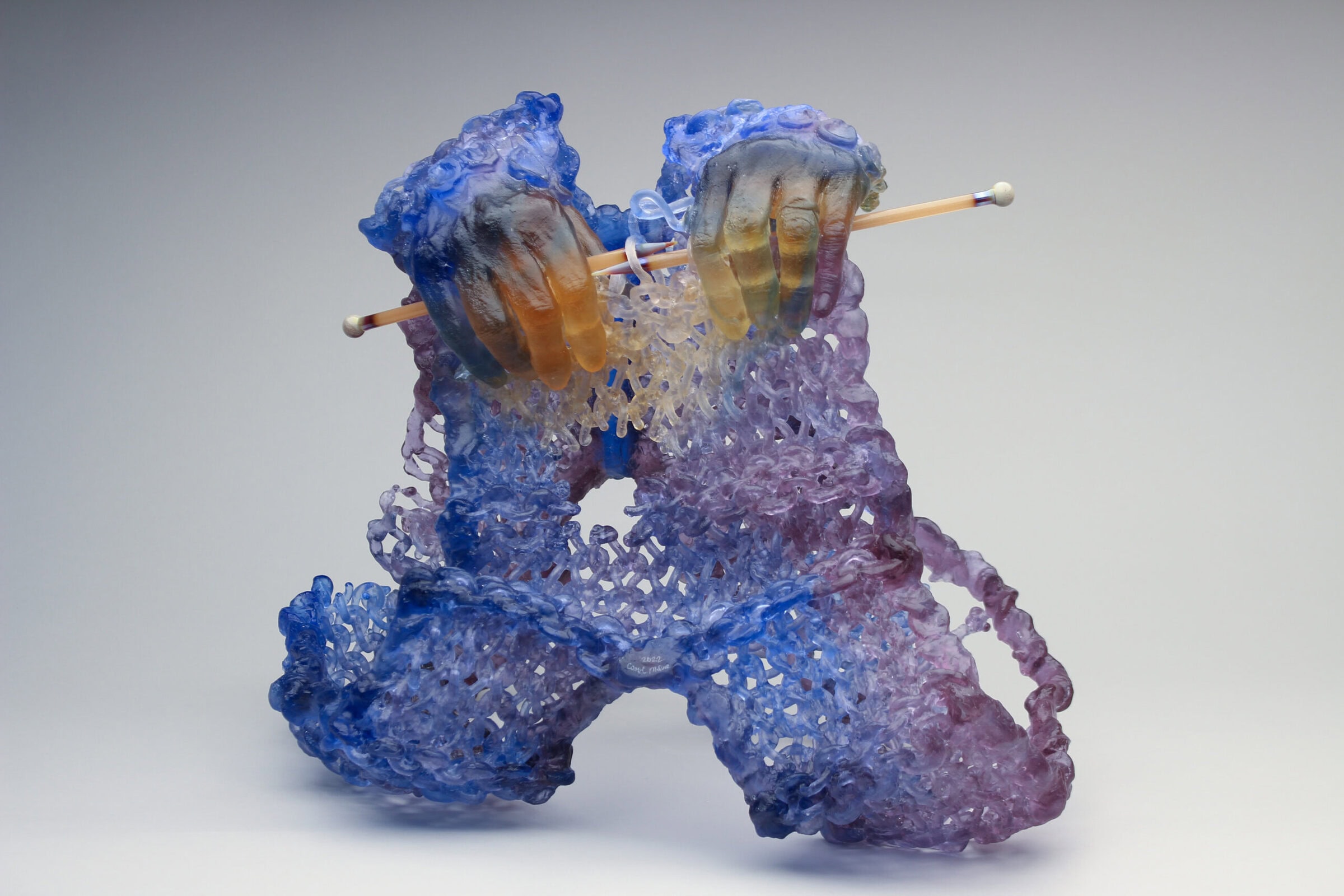
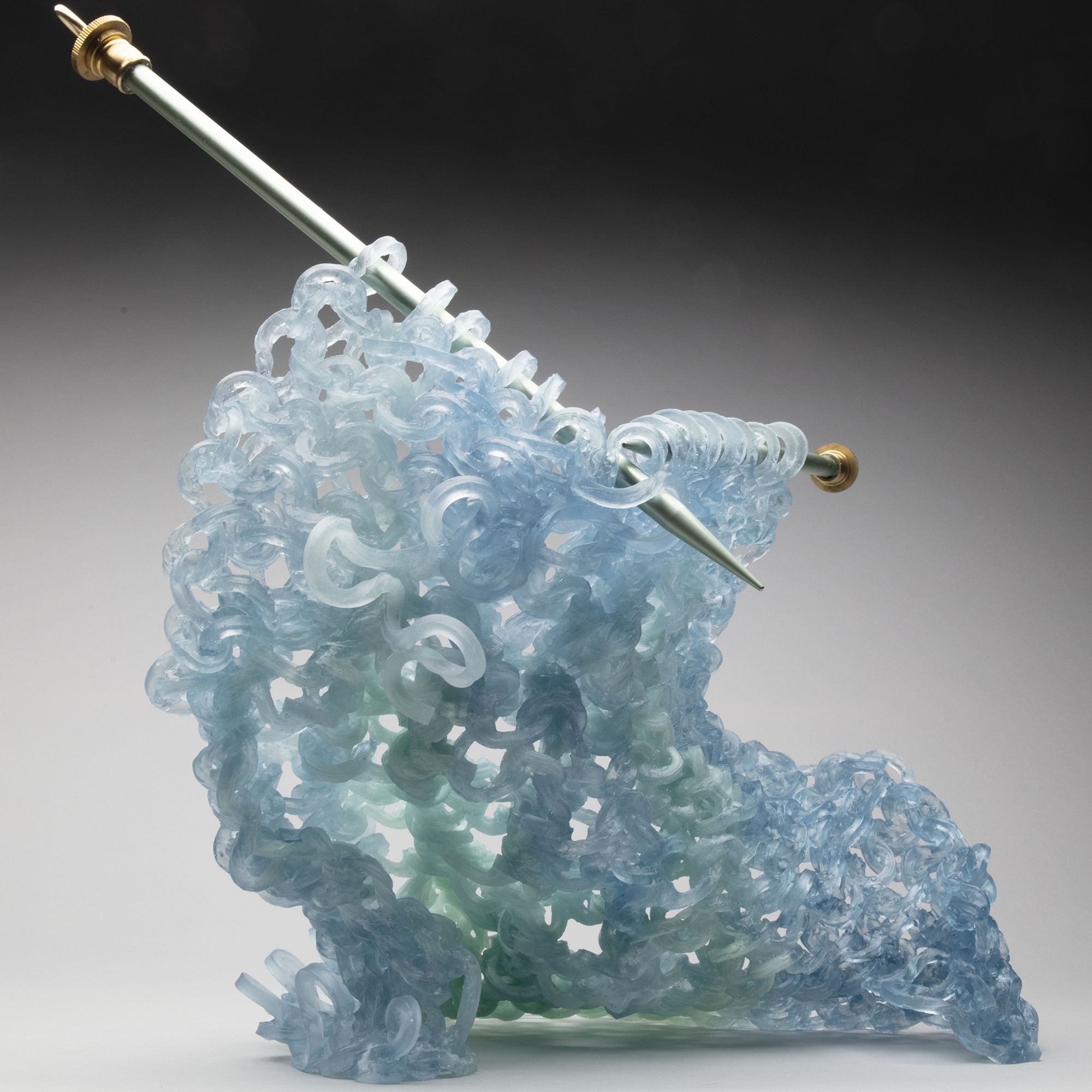
[Image above] The cast glass sculpture “Metamorphosis” by Carol Milne celebrates a trip to the Monarch butterfly sanctuary that she took with her mom. Size: 14 x 18 x 11.5 inches. Credit: Carol Milne
As the days grow darker and the temperatures colder, the time for cozy knitted sweaters has arrived to keep us warm during the winter holidays.
Knitting, derived from the Dutch verb knutten (to tie a knot), has been around for centuries. It is a technique for producing fabric without large equipment by using two or more needles to pull yarn into a series of interconnected loops. (Before knitting, a technique called nålebinding was used, which involved creating multiple loops with a single needle and thread, much like sewing.)
By the Middle Ages, knitting became a highly lucrative commercial enterprise in Europe, leading to the organization of male-only craft guilds. However, after mechanization, men left the craft and hand knitting became a domestic task mainly performed by women.
The popularity of the craft declined in the late 20th century. But recently, knitting has seen a resurgence with numerous blogs, podcasts, and ezines, spurred on by celebrities who have it as a hobby.
Yarn is the material traditionally used for knitting, as this technique was developed to create warm clothing. But for sculptor Carol Milne, her passion for knitting inspired her to create unique pieces of glass art that look like knitted fabric.
From fiber to glass
“I’ve knitted since I was 10,” Milne says in an email. She remembers being fascinated by a group of women in the knitting store, knitting in the round on multiple needles. Fortunately, she was able to learn the “fascinating” technique thanks to her grandmothers.
“Both my grandmothers were knitters. My paternal grandmother taught me, and then when I forgot how, my left-handed maternal grandmother and my paternal great-aunt re-taught me,” Milne says.
Milne’s mother did not knit, but she did love glass. Milne remembers that “Glass was my mom’s favorite thing to buy at garage sales, so we always had glass tchotchkes around.”
Her mother’s interest eventually influenced Milne’s own passion for glass art. However, “Growing up, I wasn’t aware of any facilities where I could learn to work with glass,” she says.
She finally learned the art of making stained glass after her undergraduate studies in landscape architecture at the University of Guelph. This knowledge played a role in her graduate studies in sculpture at the University of Iowa.
“It was my ‘gateway drug’ into glass art,” Milne explains. “Scrap stained glass pieces made their way into my cast iron sculpture in grad school, and when I moved to Seattle, I was able to take classes in glass casting at Pratt Fine Arts Center.”
Casting knitted glass
There are two different glass casting methods:
- Hot cast glass, where molten glass (melted at 2,200°F) is ladled out of a furnace and poured into a mold.
- Kiln cast glass, where glass is slowly heated in a kiln to 1,450–1,650°F, which becomes molten and then is drizzled into a mold.
Lost-wax glass casting (cire perdue or pâte de verre) is a sub-technique of kiln casting that evolved from the ancient lost-wax process for metalworking, which is about 6,500 years old. In this technique, an artist creates an original model out of wax and then encases it in a plaster-silica investment mold. The wax is melted or steamed out of the mold, and the resulting void is filled with glass from the kiln.
Milne uses lost-wax glass casting to create her knitted glass sculptures, although with some modifications.
Close-up picture showing one of Carol Milne’s knitted glass pieces. Credit: Carol Milne
- Holes between stiches. Cast metalwork and glass both tend to be formed without piercings, or with one single hole (beads created on a rod which is removed from the glass). Milne places holes between each of the knitted stiches, which serve as obstructions that the glass must go around. (Because this geometry slows the molten material’s speed of entry, metal would likely solidify before it could completely fill the mold.)
- Two-sided texture. Glass is usually cast solid with a texture on only one side because glass flows best into open channels within a mold. However, Milne included textures on both sides to make the glass look like knitted fiber.
“All the knowledge that led up to my process—knitting, bronze casting, wax working, mold-making, and sculpture—made it possible to bring the idea to fruition,” says Milne.
She explains that developing the technique took about a year to overcome the technical problems. But even though the process is generally established, “I still occasionally have failures,” she says. “Turns out glass does not want to do what I want it to do. So, I need to analyze and coax it into bending to my will.”
Despite the challenges, Milne says, “There are things I can do with cast glass knitting that I couldn’t do with fiber knitting.” For example, “Glass holds its shape. So, I can make forms and follies such as ‘knit knots,’ which are knots that hold their shape and stand on their own in a way that would not be possible in fiber.”
Milne uses a product called Gaffer Glass Casting Crystal for the knitted glass sculptures. This product, which was originally developed in New Zealand, is a 45% lead crystal. It comes in a wide range of colors that are compatible with each other.
Cast glass artist Ann Robinson also uses the Gaffer Glass Casting Crystal for her work. She is the reason that the glass was first developed, when she asked her colleagues John Croucher and John Leggott to create a glass that matched her casting needs. Another artist from New Zealand, Evelyn Dunstan, also uses a lost-wax kiln casting method to create works that explores ecological themes and connections through the shapes of flora and fauna.
Reflecting on Milne’s favorite series
Milne’s favorite series is her hands knitting themselves, which was initially inspired by M.C. Escher’s drawing of two hands drawing each other.
“The series began as a joke, poking fun at the absurdity of knitting oneself,” explains Milne. “But subsequent work in the series evolved from a place of self-nurturing.”
The second piece in this series, called “Handmade,” was created in a year during which Milne lost several key mentors in her life.
“I began (and continue) to see these pieces as a meditation on what it means to become your own mentor: to pull yourself up, or knit yourself together, and carry on. Often, it is your passion that carries you through,” she says.
Continues Milne, “This is my favorite series because the hands are cast from life, using my family and friends as models. The resulting pieces reflect something about the person or about my experiences or relationship with them. For instance, ‘Metamorphosis,’ with my mom’s hands, celebrates a trip to the Monarch butterfly sanctuary with her on her 80th birthday.”
Experiences around the world
Milne is well known around the world, with collections of her work exhibited in museums in Belgium, Germany, Türkiye, France, and Japan. But her favorite exhibition to date was the 2023 exhibit “Knotty and Nice” at Culture Object Gallery in New York City. Milne explains, “The work in the show evolved from discussions I had with the gallerist and owner, Damon Crain. It consisted of a strange cast of characters: playful, anthropomorphic, and potentially functional vessel forms.”
Milne has been to at least 30 countries, and although it is difficult to pick a favorite one, she says that a stand-out experience was Türkiye.
“I was invited to teach at the Glass Furnace, a place I knew little about,” says Milne. “I showed up at the airport not speaking the language and was picked up by a non-English speaking driver. The drive was over an hour with multiple mysterious stops. I could have panicked, but I summoned my courage. It required a vulnerability and trust that I rarely allow myself in my own, comfortable life.”
As far as what country may have impacted her work the most, Milne says, “Perhaps I was directly influenced by Antonio Gaudi’s work in Barcelona and the Alhambra, a palace in Spain. But for the most part, that influence is not directly obvious in my work. I strive to add to the ‘conversation that is art,’ not to copy what has come before.”
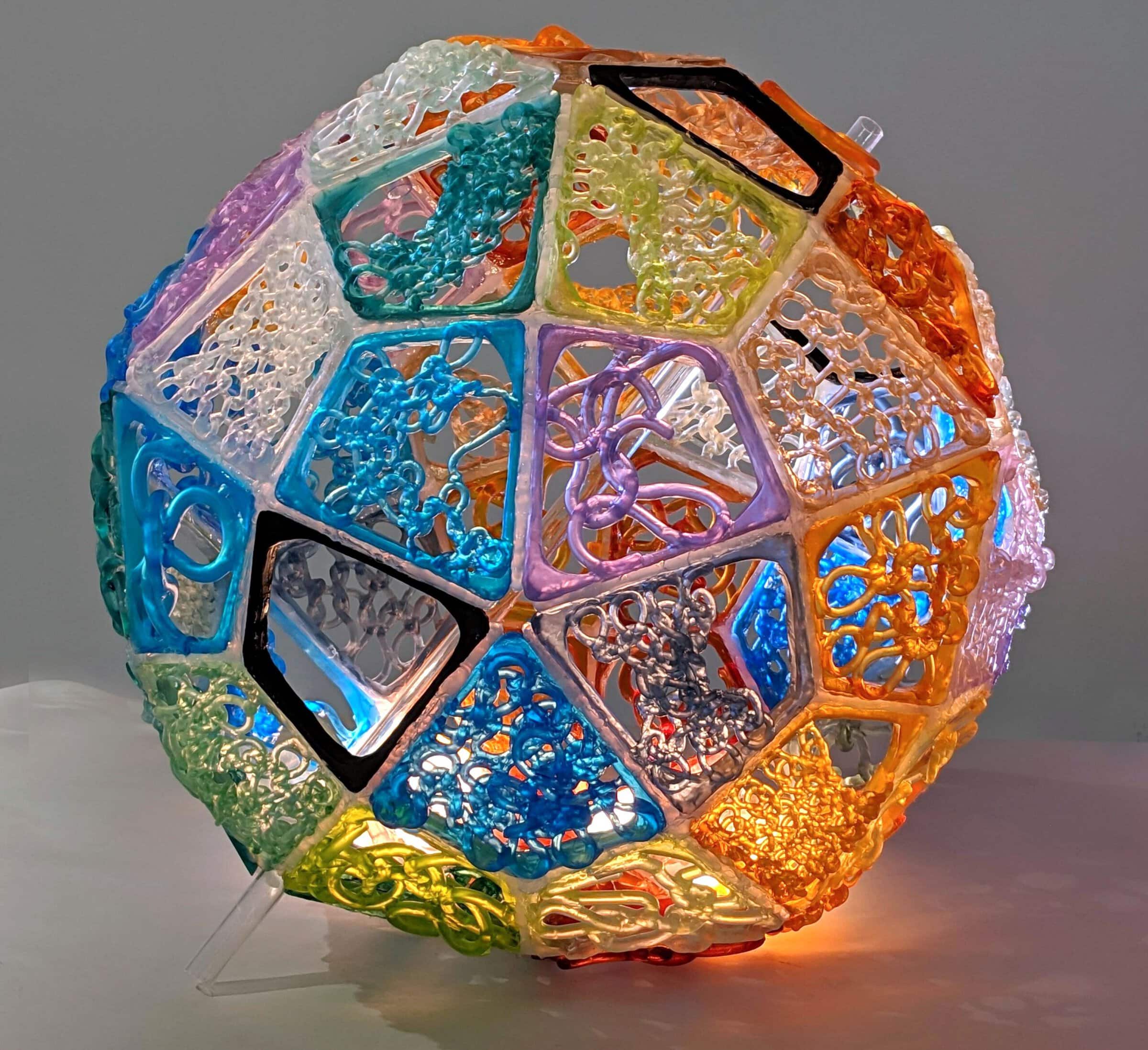
Carol Milne’s “Sphere of Delight” was created during a 2019 artist’s residency at Amazon headquarters in downtown Seattle, Wash. The design was inspired by the Amazon Spheres, three spherical conservatories comprising part of the Amazon headquarters campus. Credit: Carol Milne
Planning for the future
Milne has been featured in numerous online periodicals and website publications. She has authored at least 10 articles in a variety of publications, as well as conducted numerous lectures and workshops. Among her awards, one of the most recent was a 2026 SOLA award, which she received in September 2026 at the Tacoma Museum of Art in Washington state. Despite all her accomplishments, Milne continues to expand her horizons.
“2026 has been a year of learning new processes,” she says. One is encaustic painting, which combines pigments with wax to create paintings.
“I have been collaging photographs of my glasswork with wax pigments. It’s much faster than glass casting,” she explains. “I can also see what the finished product will look like as I am working on it. There is immediate control of color and design.”
She adds, “In the lost-wax casting process, I have limited control over how colors mix. Additionally, molds can fail, or flaws can be introduced in the mold making or kiln firing processes.”
Milne has been learning two other processes, including lampworking, a method for making scientific glassware that uses a torch to melt and form borosilicate glass. She is using this process to make knitting needles.
Milne is also learning how to blow glass (both borosilicate and traditional furnace-based glassblowing) into plaster molds. She says, “I’m not sure yet how I will use this process, but it seems a natural progression from my background in mold making.”
Stay tuned for more exciting works from Carol Milne!
Further information
Learn more about Milne’s most recent exhibits here and here.
Milne explains her knitted glass technique in this video.
In this video, Milne shares the inspiration behind her knitted glass sculptures.
Purchase this inexpensive e-book to learn more about the process of making knitted glass.
Take a deep dive into knitting history at this link or watch several videos here and here.
Visit Ravelry, a free website for knitters and crocheters that includes a yarn and pattern database.