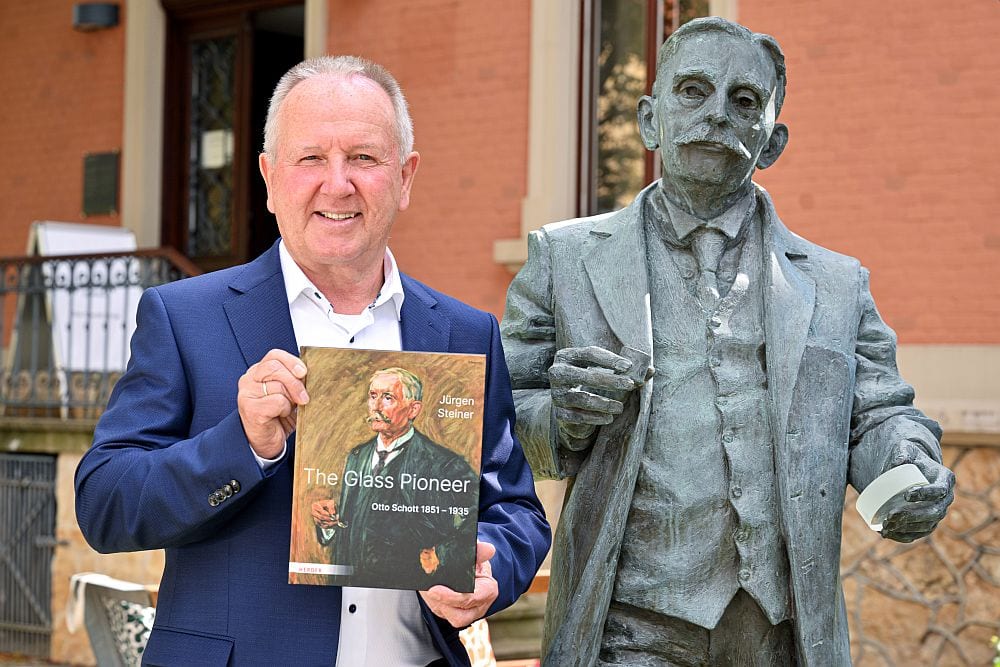
[Image above] Author Jürgen Steiner presents the Otto Schott biography at the SCHOTT Villa, the former home of the company’s founder. Credit: SCHOTT
From drop-resistant phone screens to high-speed telecommunication cables, specialty glass products enable many of the amenities and essential services underlying modern life. Yet it was only during the last century that specialty glass grew into a mighty industry thanks in many respects to German glass technologist Otto Schott, widely considered the founder of modern specialty glass.
To mark the 175th anniversary of Otto Schott’s birth on Dec. 17, 1851, the Schott company enlisted the help of Jürgen Steiner, a longtime SCHOTT company corporate communications professional, to write a comprehensive biography of Otto Schott’s life and work. I was grateful for the opportunity to read the book, called “The Glass Pioneer: Otto Schott 1851–1935,” and interview Steiner by email. My questions, and Steiner’s answers, are presented below.
Thank you to SCHOTT for providing a copy of the book and facilitating this interview.
Questions about Otto Schott
Q: Otto Schott completely shifted glassmaking from an empirical craft to a rigorous chemical science. What is the single most surprising discovery or technical breakthrough of his that gets overlooked in favor of borosilicate glass?
A: I wouldn’t single out a particularly surprising discovery, but rather the most significant discovery. In my view, this is Otto Schott’s fundamental scientific insight: that glass can be given new, previously unknown properties by altering the chemical composition of the glass melt. By systematically introducing new raw materials into the glass melt in a series of experiments, he was able to significantly improve optical glass and invent borosilicate glass. Thus, Otto Schott became the founder of the specialty glass industry.
Q: Schott’s contributions have sometimes been blended with broader Jena glass works history. Did you encounter any persistent historical myths about Schott during your research that you had to set straight?
A: Otto Schott’s personal achievements and the general history of the SCHOTT company during its first 50 years cannot be separated from one another. Both must be viewed as an indivisible whole. There were no historical myths that I needed to set straight. I only had to correct one anecdote that had been circulating for a long time. It concerns a glass cylinder that shattered during a baptism. This incident is said to have been the trigger that led Otto Schott to develop a heat-resistant borosilicate glass for the new gas lighting technology. My research revealed that it did not occur at the baptism of his son Erich (1891), as had long been reported incorrectly, but rather at the baptism of his daughter Daniela (1893).
Q: The relationship between Schott, Ernst Abbe, and Carl Zeiss was a legendary trifecta of science, optics, and precision manufacturing. How did their personal and professional dynamic shape the culture of modern industrial R&D?
A: I can only answer this question from the perspective of SCHOTT and ZEISS, which remain linked to this day under the umbrella of the Carl Zeiss Foundation. The collaboration between Otto Schott, Ernst Abbe, and Carl Zeiss was a stroke of luck. It has led to a corporate culture in which innovative strength and cutting-edge technology form the basis for the sustainable development and long-term economic success of both companies.
Questions on reporting the science
Q: Schott’s work involved complex phase diagrams, thermal expansion coefficients, and optical glass formulations. What was your thought process for balancing technical accuracy for materials scientists with a narrative arc that appeals to general readers?
A: My goal was very clear: I didn’t want to write an academic publication intended solely for experts, but rather a popular biography that would appeal to as broad a readership as possible—including interested laypeople and the general public. That’s why, when presenting technical details about glass, I focused on the essentials and tried to explain them in a way that laypeople could understand. Overall, however, it was important to me that all the facts presented in the biography be accurate and verifiable.
Q: How did you approach understanding the specific 19th-century glass compositions and melting techniques? Did you consult with current ceramic engineers or glass scientists during your drafting process?
A: During my time at SCHOTT, I naturally learned quite a bit about glass, but I am neither a scientist nor a glass expert. For the biography, I conducted research in original sources such as Otto Schott’s melting books in the SCHOTT Archive and in published primary sources. To verify the technical details regarding glass presented in the biography, I then consulted Ulrich Fotheringham, a renowned materials scientist from SCHOTT’s R&D division.
Q: You describe glass compositions as, for example, 16III, 59III, 202III, and 221III. What do these numbers mean? Is there a series I and II, as well?
A: The designations were coined by Otto Schott. When he began production in 1884 after founding the company, he created three melting books to scientifically document his glass melting processes. Melting book I covered standard optical silicate glasses, melting book II covered newly developed specialty optical glasses, and melting book III covered non-optical glasses. The glasses marked with the Roman numeral III are therefore non-optical glasses. The Arabic numerals 16, 59, etc., refer to the melt number within this series III. However, the optical glasses from melt series I and II were subsequently designated in product catalogs for customers using the nomenclature “O” or “S” (each followed by the melt number) for optical silicate glasses and special optical glasses, respectively.
Questions on the writing process
Q: Archival research on 19th-century industrial history can be notoriously spotty or locked away in specialized collections. How difficult was it to find what you needed in the SCHOTT archives or elsewhere?
A: For the Otto Schott biography, I was able to draw on a great deal of material that I had already compiled during my many years at SCHOTT. The challenge was to structure the whole thing according to a coherent conceptual framework, write it in a reader-friendly style, and present it in an attractive layout. Despite the solid foundation, time-consuming research was still necessary. I did not encounter any gaps or problems in the process.
Q: Was there a specific document, lab entry, or personal artifact in the SCHOTT archives that provided the “aha!” moment for this book?
A: There wasn’t a specific “aha!” moment for me, since I was already familiar with much of it. However, in my view, the most important document in Otto Schott’s life as a glass scientist is his first letter to Ernst Abbe, dated May 27, 1879, when he sent the physicist his first glass samples. Although the samples were not yet usable, this first letter served as the spark that ignited an extremely fruitful collaboration. It was the starting point for the founding of the SCHOTT company five years later and for Otto Schott’s scientific life’s work, which established him as the founder of modern glass science and glass technology.
Q: When writing a biography about the founder of the company you worked for, how did you balance celebrating SCHOTT’s corporate milestone with maintaining the objective rigor of a materials science historian?
A: My intention was not to glorify Otto Schott or to write a promotional publication for the SCHOTT company. That is precisely why I deliberately sought out a renowned publisher for the book. It was important to me to shed light on all facets of Otto Schott’s life’s work, because no such book had been written before. In doing so, I placed great emphasis on ensuring that the presentation was based on verifiable facts and was reliable
Question on Schott’s influence today
Q: Otto Schott helped establish the Carl Zeiss Foundation structure and a distinct corporate philosophy centered on research and social responsibility. From your vantage point, how intact is his original R&D mindset within modern specialty glass manufacturing today?
A: In my view, Otto Schott was the greatest basic and applied researcher that the history of glass has ever seen. He was the first to place glass manufacturing on a truly scientific foundation. Through his scientific and entrepreneurial life’s work, he became the pioneer of the specialty glass industry. And everything that came after him in the field of glass science builds upon his work.
Q: The Carl Zeiss Foundation had a strong influence on corporate philosophy and worker welfare in the early years at SCHOTT. How has that carried forward to today?
A: The visionary ideas of the Carl Zeiss Foundation led to a unique corporate model and an early form of social partnership between management and employees at ZEISS and SCHOTT. In terms of the scope of social rights for employees, ZEISS and SCHOTT were unique in their time. Over time, many of these rights have been incorporated into general social legislation in Germany or regulated in collective bargaining agreements. Responsibility, respect, and appreciation for employees remain central elements of SCHOTT’s corporate culture today.
Q: If Schott were alive today inspecting advanced glass-ceramics, semiconductor substrates, flexible displays, or other advanced materials, what aspect of 21st-century research do you think would fascinate him the most?
A: I think Otto Schott would be thrilled if he could see how successfully his successors are continuing his scientific work—how they are constantly developing new materials and solutions using new methods and technologies, and how these are being turned into products for specific, forward-looking applications. Otto Schott would certainly be fascinated to see how “his” material, just as in his day, continues to enable further progress in a wide variety of areas of life.
Q: As a long-time SCHOTT communications expert and historian, you’ve lived with Otto Schott’s corporate legacy for decades. What key lesson do you think today’s materials researchers and entrepreneurs should take from his methodical approach to science and commercialization?
A: Those who look to Otto Schott as a role model can learn from him how to develop new things and continually push existing boundaries through a pioneering spirit, passion, courage, creativity, and systematic work. They can also learn from him that innovation and technological excellence are always the key to a leading market position and economic success.
The book is available in both German and English from the publisher, Verlag Herder, and various online retailers. Also see if your local library may be able to purchase a copy!