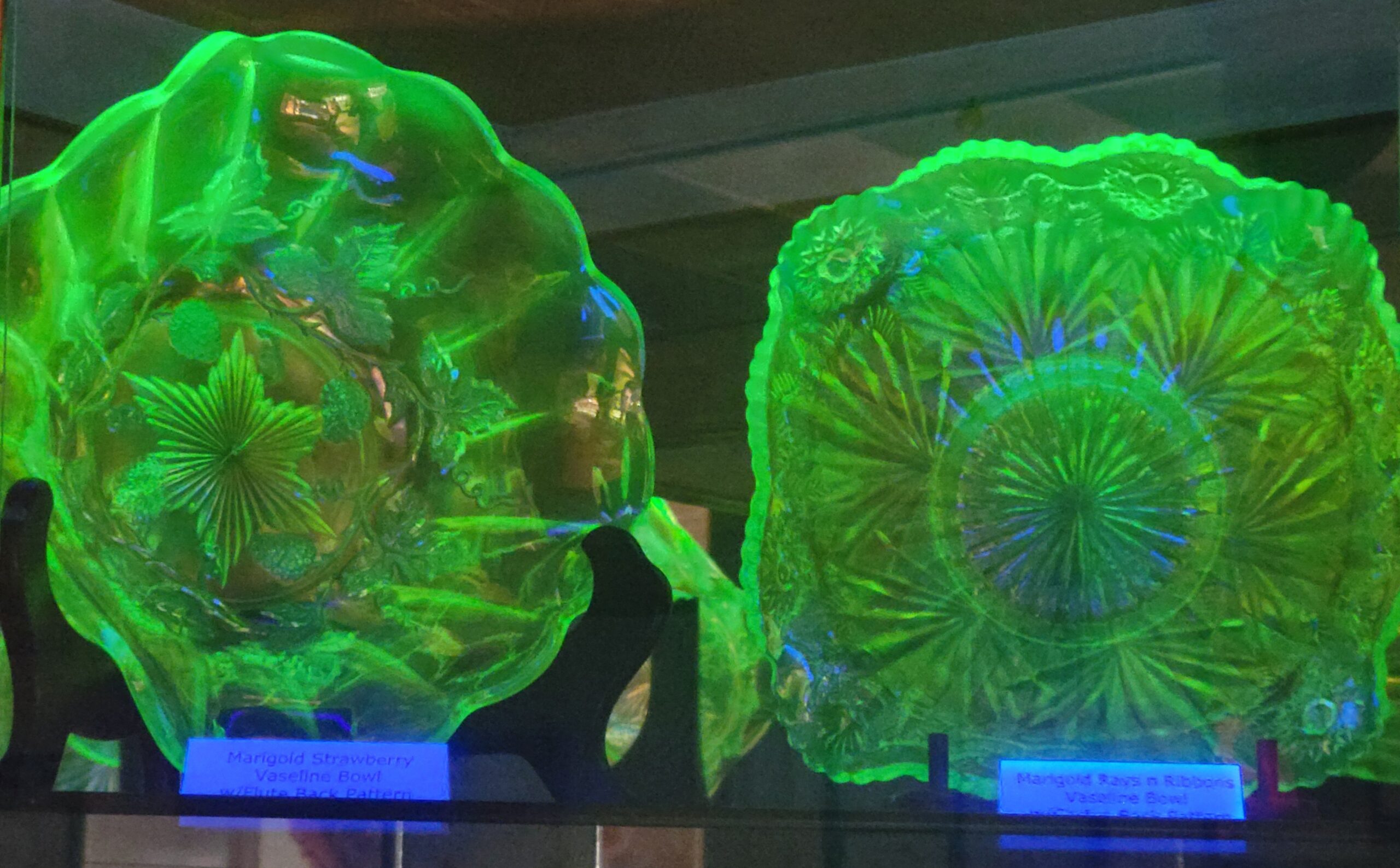
[Image above] Example of Radium glass, an iridescent glass created by Millersburg Glass Company. Credit: Laurel Sheppard
Learn more about the CTT special series on the Ohio Creativity Trail and find links to all the ceramic and glass sites highlighted in this post.
This month we visit two sites on the Ohio Creativity Trail that have their roots in glassmaking. One is a unique park, perhaps the most unique in Ohio, which has transformed the ruins of a glass factory into a recreation area complete with sculptures, walking paths, a labyrinth, and several lakes. The other is a museum that honors the brief history of a company known for its carnival glass.
Ariel-Foundation Park: Rebirth of an industrial site
On a warm Friday in April 2026, my friend and I drove to Mount Vernon, which is about 53 miles northeast of Columbus, to check out the Ariel-Foundation Park. Once a Pittsburgh Plate Glass (PPG) factory producing sheet glass for the automotive industry, the Foundation Park Conservancy has done a wonderful job preserving the ruins and transforming the land into a park for residents and visitors.
How did the PPG plant end up in the small town of Mount Vernon? Like other Ohio regions, Mount Vernon and the larger Knox County had an abundant supply of silica sand during the 20th century. Once the original steel casting plant built by Jacob Coxey on the now-park site failed in 1902, the facility was converted into a glass factory for the Mambourg Glass Company (founded by Leopold Mambourg and James A. Chamber). Chambers later took full ownership of the company and renamed it the Chambers Window Glass Company. Soon thereafter, PPG assumed ownership and turned the facility into the town’s first sheet glass plant (as well as one of the first in North America).
The Mount Vernon PPG plant played a significant role in developing the vertical draw technique, called the Pennvernon process. Molten glass in the form of a continuous ribbon is drawn upward vertically from a tank. Instead of using a slotted clay block directly on the molten glass, the Pennvernon process used a submerged refractory drawbar. This drawbar functioned as a radiation shield, allowing for more flexible temperature control and less crystallization in the glass. A major benefit of this process is that the waves, whorls, distortion, and uneven thickness commonly found in previous methods were drastically reduced, resulting in a much flatter, clearer, and more uniform sheet.
The PPG plant closed in 1976, but it was not until 2015 that the park officially opened. The first acreage purchase occurred in 2000, and nine years later, the Foundation Park Conservancy was established to develop a vision for the park. The acquisition of the former PPG site was completed in 2013, and over the next several years, development of the park continued.
When my friend and I arrived at the park, we were immediately impressed with the 280-foot tall Rastin Observation Tower, the highest structure in Knox County. Although I did not go all the way to the top (224 steps in total), there were still wonderful views from halfway. We then explored the labyrinth and the River of Glass.
We got our steps in for the day (and then some), walking the 250-acre grounds. There were several brick towers and buildings that had been saved from the wrecking ball or repurposed. Plus, several unique steel sculptures could be found along the way, including atop the Terraces. Our tour concluded with a visit to the woods and lakes area, a lovely place to enjoy nature that also includes several historic bridges.
As my friend and I discovered, Ariel-Foundation Park clearly lived up to its vision statement: “…a world class example of adaptive reuse that honors its industrial heritage and is the focal point for recreation, entertainment, and social interaction in Knox County.”
Take a tour of the park by watching the video below.

Credit: The American Ceramic Society, YouTube
Further information
This timeline provides more details about how the park came to being.
Watch a drone explore the park here.
Learn more about the role of Belgian immigrants in the Mount Vernon glass industry at this link.
Take a closer look at the history of automotive glass here and here.
Millersburg Glass Company: Founder with a famous name
Although Millersburg is less than an hour’s drive from Mount Vernon, my friend and I could not visit until Oct. 15, 2026. Because it was a two-hour drive from Columbus, we stopped at Velvet Ice Cream in Utica for lunch, where there is a historic water mill to check out on site.
Arriving in Millersburg, which is in Amish country (Holmes County), we first toured the Victoria House Museum, a 28-room Queen Anne-style historic mansion built in 1901, before heading next door to the Millersburg Glass Museum. (You can purchase a combination ticket for both museums.) The mansion had beautiful woodwork and furnishings, four gorgeous fireplaces, and even a haunted basement!
The Millersburg Glass Museum was recently renamed Sieverdes Millersburg Glass Museum, in honor of its founder and curator, Chris Sieverdes. Housed in the lower level of the Holmes County Cultural Center’s main building, it consists of one long room displaying both the crystal and colorful carnival glass made by the Millersburg Glass Company. The iridescence of the carnival glass results from the application of metal salts while the glass is still hot from the furnace.
The company was established in 1908 by a man well known in the glass industry at the time, John W. Fenton, brother of Frank L. Fenton. The Fenton brothers got their start in the glass industry by working at the Jefferson Glass Company in Steubenville for several years, followed by stints as glass decorators for several other companies. They then decided to start their own company, the Fenton Art Glass Company, in Williamstown, W.Va., which opened in 1907 and still operates today.
John Fenton chose Millersburg because of its high-quality raw materials. In 1909, production began and soon thousands of pieces were produced every day. In early 1910, the company introduced Radium glass, an iridescent glass that impressed both buyers and trade journals (despite its name, this glass did not actually contain the radioactive element radium).
Unfortunately, John Fenton was not a good businessman, and the company was already in financial trouble. After going bankrupt, the Millersburg Glass Company closed its doors two years later. The factory was then bought by the Jefferson Glass Company in 1913 to produce lenses and light fixtures, but it shut down permanently just three years later.
If it were not for Sieverdes, the Millersburg Glass Company and its wonderful glassware would be lost to history. At the museum, you can see many beautiful pieces, including a rare People’s Vase, created in 1910 for the royal family of the Netherlands to celebrate the birth of Princess Juliana. (In 2024, a cobalt blue People’s Vase with a ruffled top was sold at auction for $250,000.)
If you want to find your own piece of Millersburg glass to take home, check out the local antique stores like we did. I found a crystal piece in the Ohio Star pattern (the first Millersburg glass design in mass production) at one store. Or you can visit the Millersburg Glass and Collectibles shop if you want a pricier piece of carnival glass.
To see more of the museum’s collection, watch the video below.

Credit: The American Ceramic Society, YouTube
Further information
See several unique pieces explained by Sieverdes at this link.
Learn more about Millersburg Glass by watching these videos.
Read this top 10 list of Millersburg Glass by an expert here.
The Millersburg Glass Association, established in 2012, organizes an annual convention.
Everything you wanted to know about carnival glass can be found on this website.
Watch a video about Millersburg carnival glass at this link.