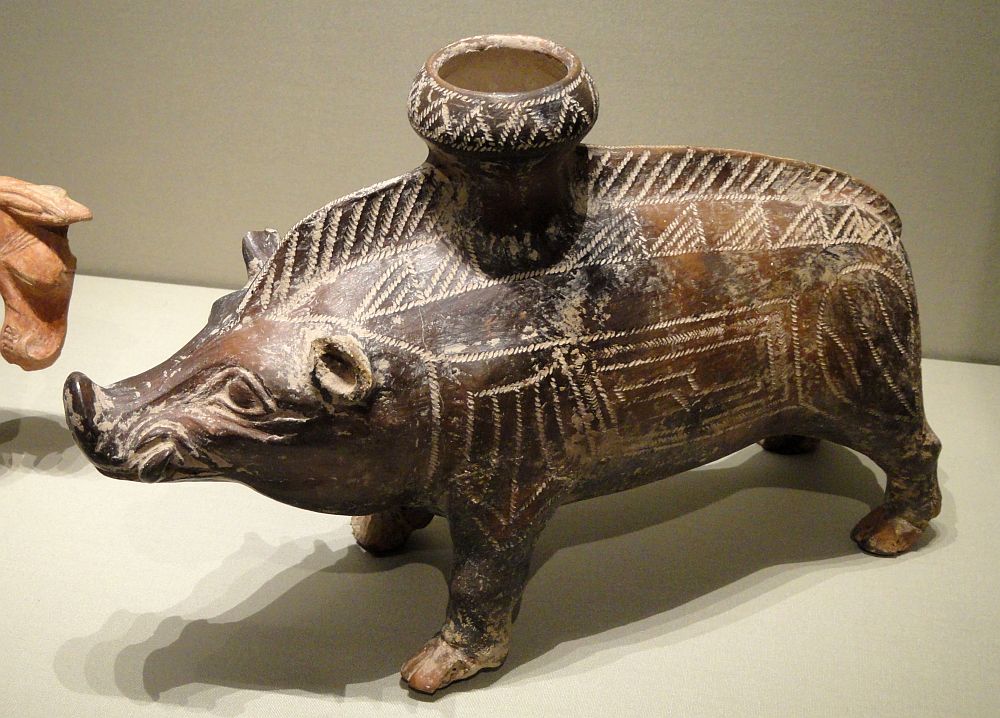
[Image above] The Etruscan Boar(opens in new tab) at the Cleveland Museum of Art is a high-profile example of a forged artifact that was publicly displayed as an ancient object. Credit: Daderot(opens in new tab), Wikimedia (public domain)
A region’s cultural heritage(opens in new tab) shapes the identity of its people and communities, drives tourism, and provides historical perspective. There are thus strong societal reasons to preserve or restore ancient artifacts, or in the case of artifacts created from morally contentious materials, such as ivory, to create respectful reproductions instead(opens in new tab).
However, interest in archeological objects has a dark side(opens in new tab), driven by high demand for antiquities and artworks combined with weak regulation on illicit trade. The potential profits can drive unscrupulous actors to not only coordinate the illegal sale of legitimate artifacts but also create fake artifacts (forgeries) that they pass off as real.
Reining in forgeries is extremely difficult due to the expense and limitations of current dating methods. Thermoluminescence(opens in new tab) measures the light emitted from heated crystalline minerals, but its accuracy can be disrupted by artificial irradiation or careful reheating techniques.
Furthermore, some clays naturally lack the specific mineral properties needed for thermoluminescence. That was the case for the counterfeit pre-Columbian art created by one of the most famous forgers, Brigido Lara(opens in new tab). Lara was originally arrested as a suspected looter before requesting clay and tools to demonstrate his expertise from prison. Today, he is considered one of the foremost experts in Totonac pottery(opens in new tab) and went on to work for the Anthropology Museum in Xalapa, Mexico.
Petrography(opens in new tab) is another dating technique that relies on identifying the mineral composition and origin of materials. But this technique can be foiled by using local historical clay sources, as the masterful porcelain artisans in Jingdezhen have routinely done for centuries when forging the pottery of previous dynasties(opens in new tab).
A new technique from the world of geophysics offers a potentially more rigorous way to detect fakes. The new technique is based on magnetism, and I was particularly intrigued by it because I did my capstone research project on the anisotropy of magnetic susceptibility(opens in new tab) in garnets.
Physical principles of magnetic recording in ceramics
It’s geology time again! Earth’s magnetic field(opens in new tab) has wandered and reversed many times throughout the planet’s history. These fluctuations are thought to be caused by rotation within Earth’s molten, metal core(opens in new tab).
When molten rock cools and solidifies, the magnetically susceptible(opens in new tab) mineral grains within it orient themselves according to the position of Earth’s magnetic field at the time of their formation. The resulting orientation is called remanent magnetism(opens in new tab). So, scientists can compare the orientation of the magnetic field within those grains to the current field orientation and arrive at a date range.
When clay is fired in the kiln, these magnetic minerals are realigned. As the object cools, the reoriented magnetic grains become locked in place, giving the object thermal remanent magnetization that corresponds to its firing date.
After firing, the finished object will go about its useful life, sometimes in places far from where it was originally produced. Over time, smaller magnetic particles within the object will shift their orientation to align with the ambient magnetic field in the new location (or, over very long periods, in the new time, as the Earth’s field shifts). These small shifts are called viscous remanent magnetization(opens in new tab) (VRM). VRM grows stronger the longer an object remains in its environment (sometimes for centuries or millennia).
Using viscous remanent magnetization for ceramic artifact dating
In the new study(opens in new tab), researchers from Scripps Institution of Oceanography at the University of California, San Diego, treated fired clay objects as magnetic timekeepers, using VRM and stepwise thermal demagnetization to determine an object’s age.
What is stepwise thermal demagnetization? As an analogy, you may know that heating a magnet(opens in new tab) will cause its electrons to increase their energy states, become less aligned, and weaken its total magnetism. Similarly, heating an object that possesses remanent magnetization can weaken its magnetic field. Stepwise thermal demagnetization thus involves incrementally heating a sample and monitoring how the magnetic field weakens. Because older objects have stronger VRM, their magnetism takes longer to release.
Before testing any samples with stepwise thermal demagnetization, the team modeled the process using the single domain comprehensive calculator(opens in new tab) to simulate magnetic relaxation times and magnetic particle behavior. The simulation provided precise micromagnetic predictions about VRM acquisition and removal by stepwise thermal demagnetization for single-domain particles.
The team then put authenticated ancient jars and new ceramic souvenirs as well as objects of unknown ages through controlled, incremental heating to find the point at which the object lost its VRM signal. They began the heating process at 50°C and increased the temperature in 10°C steps.
The ancient artifacts (more than 1,000 years old) had VRM signals that persisted until the object’s temperature passed 112°C. Newer objects lost their VRM at temperatures below this threshold. The researchers were able to validate their results across diverse clay compositions and firing styles.
The open-access paper, published in Proceedings of the National Academy of Sciences, is “Viscous remanent magnetization authentication method for archaeological artifacts(opens in new tab)” (DOI: 10.1073/pnas.2620397123).
Applications for VRM dating
By looking beyond traditional surface-level analysis and leveraging the magnetic record preserved in ceramic matrix microstructures, VRM offers an objective, nondestructive standard for artifact authentication. Although the process of thermal demagnetization and VRM measurement requires specialized equipment, it is a relatively simple way to verify the age of a ceramic object.
In the future, this technique may allow curators to verify objects of uncertain provenance currently held in storage without destructive oversampling. It also provides objective, physics-based evidence for law enforcement and anti-forgery prosecution. Finally, from a research perspective, it advances geoscientists’ understanding of geomagnetic field history and VRM relaxation physics.
Complementary computational methods
Combining VRM demagnetization for age and authenticity with point cloud data for typology and shape classification could provide even greater accuracy. For example, a recent study(opens in new tab) showed that deep learning can automatically categorize 3D point cloud scans of ceramic fragments (in this case, Japanese Sue ware) into structural types with high accuracy (~93%). Following this initial step, samples identified as historically significant or at high risk for being a forgery could undergo VRM thermal testing to verify their true age.
Seeing the fundamental principles I studied in college now applied to unmask modern fakes and protect cultural heritage is a compelling reminder that geoscience and material history are inextricably linked. The combination of computational modeling and 3D point cloud classification with thermal demagnetization gives curators and researchers the chance to build an ironclad defense against even the cleverest copycats.