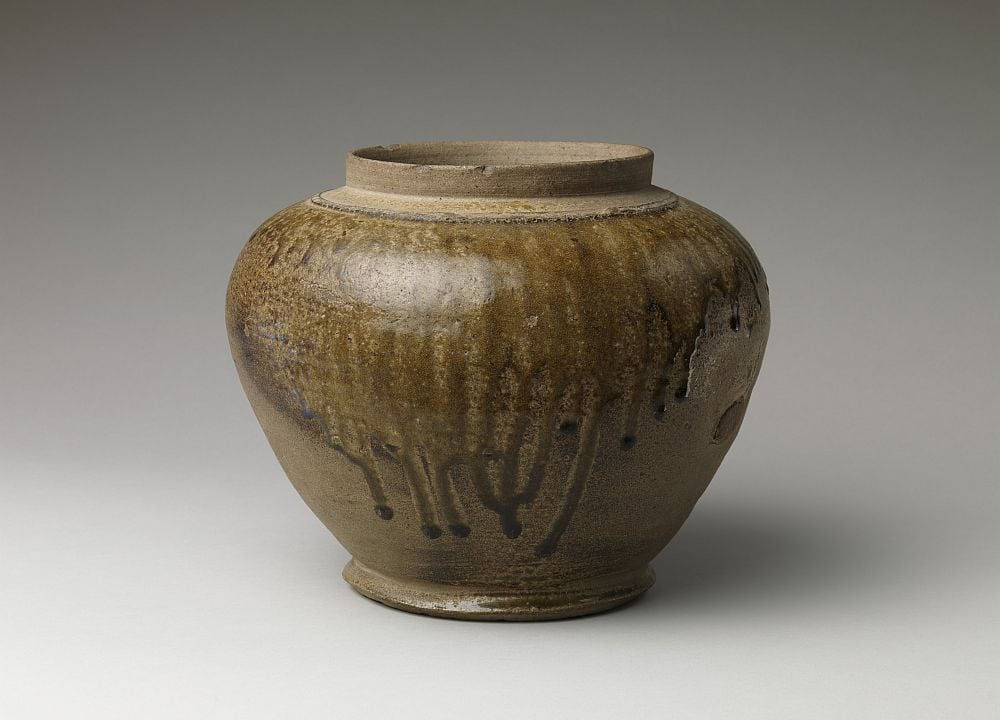
[Image above] Example of a Sue ware jar produced during the 8th century. The glossy surface suggests that the vessel was created at the Sanage Kiln, where potters positioned select wares in kiln “hot spots” to encourage natural ash glazing. Credit: The Metropolitan Museum of Art (public domain)
As this month’s Ceramic Tech Chat podcast episode showed, archaeologists are using increasingly futuristic techniques and technologies to uncover the secrets of long-ago cultures.
Point clouds are one example of how digital technologies are revolutionizing the evaluation of ancient artifacts. Point clouds refer to a 3D digital data structure composed of a massive set of discrete data points. The data points are collected with tools such as photogrammetry, and then these thousands of points are plotted in a 3D coordinate system to represent the external surface of the imaged object.
Several organizations, notably the South Carolina Department of Natural Resources, have used point clouds to create digital databases of ceramic pottery, making it easier for archaeologists to access and identify objects. In addition, digital repositories such as the Digital Archaeological Record ensure the long-term preservation of archaeological data.
While traditional point clouds require human experts to evaluate the data, point clouds can be combined with deep learning models to enable automatic morphological classification of ceramics. In a recent study, researchers led by University College London and Nagoya University of Japan took this approach using a cutting-edge deep learning model called Point Transformer.
Compared to previous 2D outline-based approaches, Point Transformer can classify objects directly from the 3D point cloud data. This ability allows it to more easily capture low-resolution data or local geometric details.
One limitation of Point Transformer is it does not preserve or adapt to changes in position and orientation in 3D space. Thus, preprocessing the input data is required by “aligning the vertical orientations (horizontal if needed) and normalizing the point cloud data to fit the unit sphere,” write the authors.
The recent study used Point Transformer to classify ancient Japanese pottery known as Sue ware, manufactured between the 5th to 10th century. This type of unglazed stoneware, with colors ranging from gray to brown–gray, is shaped using a potter’s wheel and then fired in a tunnel kiln at high temperatures. The final vessels are conventionally classified based on such characteristics as the shape of the body, knob, rim, and base.
Sue wares from the Sanage Kiln in Aichi prefecture were chosen for this study because this site was one of the major production centers of Sue ware. The 917 sample vessels were produced between the 8th to mid-9th century, and they were selected to represent five major types of Sue ware: dish cap, dish body with ring base, dish body, bowl, and plate. There were at least 50 samples per type of Sue ware (with 100 or more being preferable).
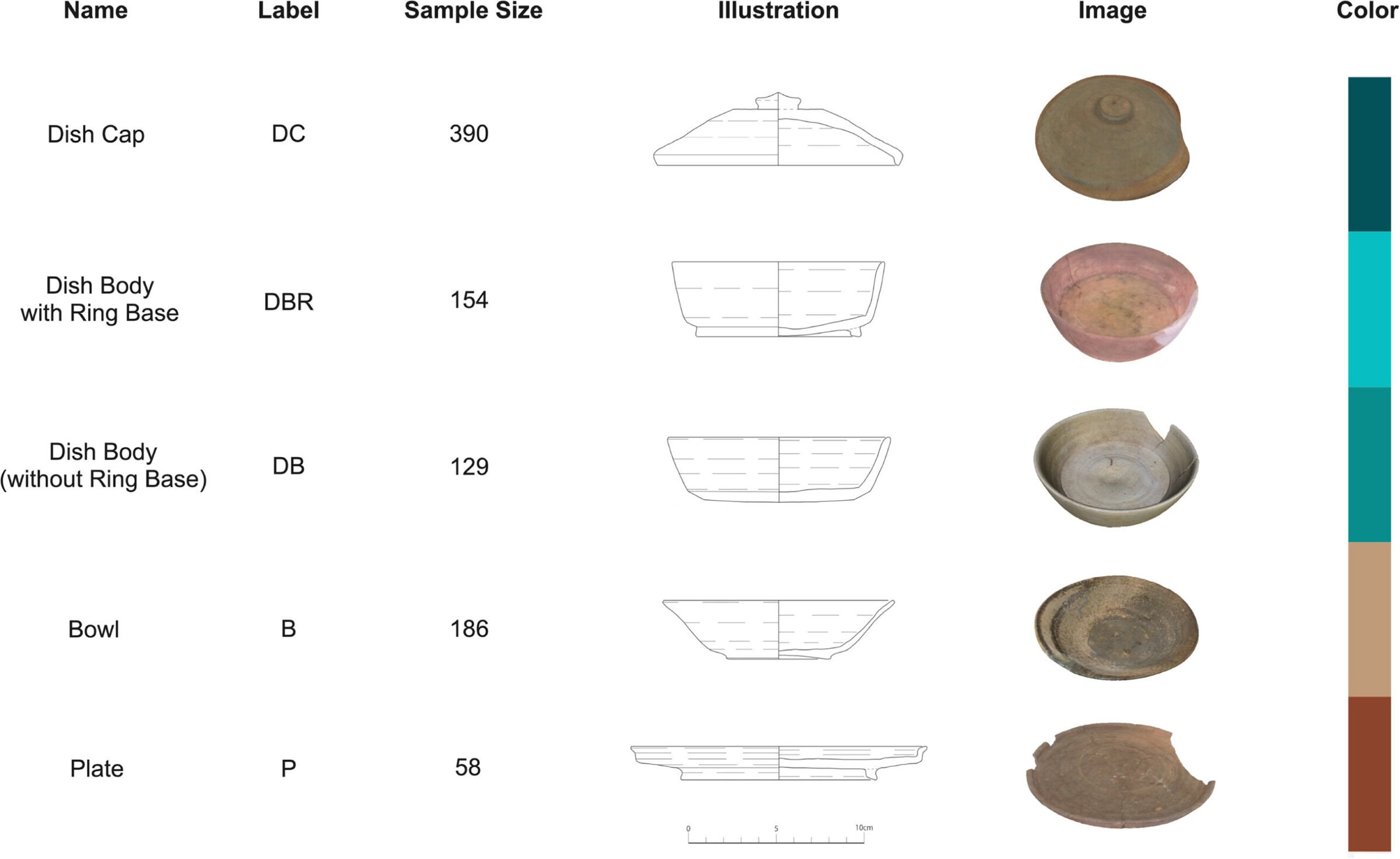
Examples of the five types of Sue ware used in this study. Credit: Tatsuda et al., Journal of Archaeological Science (CC BY 4.0)
After collecting the 3D object data for all the Sue ware samples using an optical scanner and photogrammetry (90 to 200 pictures of each piece), the object data was converted into point cloud data, consisting of 1,024 points for each sample. This size of input data is considered relatively small for a deep learning model. It thus benefits researchers on a limited budget because it eliminates the need for expensive graphic processing units, high-precision 3D sensors, or costly data storage as may be required for other models.
Across all five Sue ware types, the model achieved an average accuracy of 93.2%, performing almost perfectly with the most visually distinct categories (dish cap and dish body with ring base). The lowest scores came from the dish body and bowl types because they had similar features, resulting in misclassifications between the two. Eighteen bowls were misclassified as dish bodies, and 22 dish bodies were misclassified as bowls.
The study also took a closer look at six borderline cases of dish bodies and bowls. Point Transformer correctly classified all but one. The model assigned different patterns of importance to the competing classes, usually focusing on the rim and inner surface for dish bodies and the outer surface for bowls. An overall higher importance corresponded to the model’s final prediction.
“Our model lets us see which points were most important to the classification decision,” says senior author Hayata Inoue, assistant profession in Nagoya University’s Graduate School of Humanities, in a press release. “This transparency transforms the model from a black box into a tool that helps us understand how these decisions are made.”
To expand the application of the model described in the paper, the researchers recommend several next steps.
- Collecting additional 3D data for other ceramic types and conducting further experiments.
- Using methods that can image internal surfaces, such as X-ray computed tomography scans, for closed-shaped ceramics.
- Combining preprocessed fragment data with object part detection to obtain fragment classification based on morphological features.
- For limited availability of physical samples (and therefore datasets), other groups can combine their data with the authors’ dataset or use data augmentation techniques to expand the sample size.
The researchers have made the data and code freely available so that other groups can reproduce the results and adapt the model for their investigations. The researchers hope that this study “becomes a cornerstone for deep learning-based morphological classification of 3D data in archaeology, both in Japan and worldwide.”
The open-access paper, published in Journal of Archaeological Science, is “Deep learning-based morphological classification of ceramics: A case study of 3D point cloud analysis for Sue ware, Japan” (DOI: 10.1016/j.jas.2026.106472).