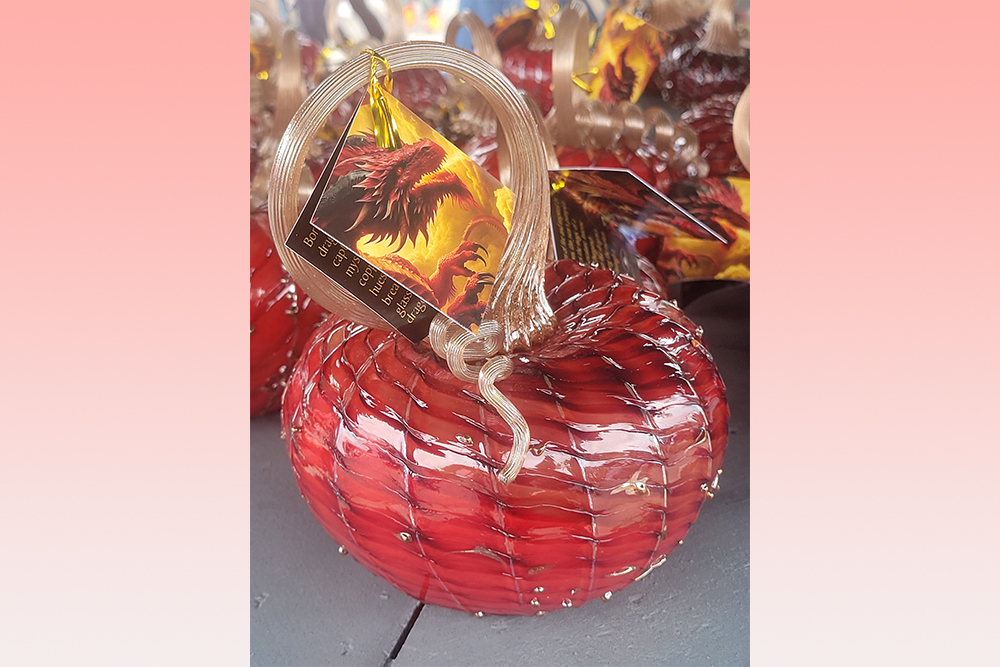
[Image above] The 2026 Official Pumpkin of the Year at Jack Pine Studio was themed after red dragons. Credit: Laurel Sheppard
Learn more about the CTT special series on the Ohio Creativity Trail and find links to all the ceramic and glass sites highlighted in this post(opens in new tab).
Glassblowing, or the process by which molten glass is gathered on the end of a blowpipe and formed by inflation and mechanical manipulation into a vessel, has been around for centuries.
When this glass forming technique was invented in the first century BCE(opens in new tab) in the Syro-Palestinian region, artisans focused on its functional benefits. Compared to slow, labor-intensive methods such as core-forming and mold-casting, glassblowing allowed fast forming of vessels in a wide range of shapes, making glassware affordable and widely available.
The use of glassblowing as an industrial trade was the status quo for centuries, but in the 1960s, the studio glass movement(opens in new tab) in the United States caused a shift in how this technique was used. Thanks to pioneers such as Harvey K. Littleton(opens in new tab), who collaborated with the Toledo Museum of Art to develop equipment and chemistries for small-scale glass production, glassblowing started to be defined by how it could support individual artistic pursuits.
Today, there are hundreds of glass art studios(opens in new tab) across the U.S. and around the world. And just one hour southeast of Columbus lies a studio with a rich history that got it placed on the Ohio Creativity Trail.
Jack Pine Studio: Home to a master glass artist
Jack Pine Studio(opens in new tab) is located near a small village called Laurelville(opens in new tab) in the heart of Hocking Hills (wishful thinking that they named the village after me!). Founder Jack Pine(opens in new tab) is the creative heart of the studio with more than 35 years of glassblowing experience.
Pine is a native of Tarlton(opens in new tab), a rural village near Circleville (home of the famous Circleville Pumpkin Show(opens in new tab)). He inherited his creative genes from his parents: his father was an inventor, and his mother was a talented painter and sculptor.
Pine attended the Columbus College of Art and Design with the help of a scholarship but took a break to serve in the U.S. Army after running out of funds. He later moved to Seattle, Wash., to improve his glassblowing skills as an apprentice at Mount St. Helens Glassworks(opens in new tab) (a studio that produced art glass infused with ash from the May 1980 eruption).
Sometime after the Seattle apprenticeship, Pine moved to Boulder, Colo. It was here where he made his first glass pumpkin at the request of a friend. Pine realized he could sell these pumpkins at the annual Circleville Pumpkin Show, and he sold his first batch there in 1994(opens in new tab) (the whole batch sold out immediately!).
“I knew I was in love with glassblowing from the start, as it involves everything I enjoy as an artist,” Pine says in an Ohio Cooperative Living article(opens in new tab). “It’s a mystical medium, and I was drawn to it immediately. You take a glob of hot, molten glass from the furnace and turn it into a gorgeous work of art—that initial experience was magical to me and continues to be.”
Pine eventually moved back to Ohio, where he initially established a shop(opens in new tab) in a warehouse in the Short North Arts District of Columbus. Feeling the need to return to his rural roots, Pine opened his current studio in December 2017(opens in new tab), which is about a mile and a half from Rock House(opens in new tab), a famous cave in Hocking Hills, and six miles from Laurelville.
Pine established his own glass pumpkin festival in 2020, when the COVID-19 pandemic shut down the Circleville Pumpkin Show. Pine’s festival continues today, and he is now widely regarded as the nation’s leading art glass pumpkin blower(opens in new tab). His expertise lies in a unique technique that fires enamels and precious metals at 2,000°F to iridize glass, giving the exterior of his creations lustrous, bright hues.
“There’s something about all this really beautiful crystal, molten glass … the colors seem to radiate outward,” Pine says in an Ohio Magazine article(opens in new tab). “The more you do, the more you want to do. I feel pretty lucky to have found a medium I love so much.”
Pumpkins galore at the annual Jack Pine festival
My friend and I drove down on Sept. 18, 2026, to attend the 7th Annual Jack Pine Glass Pumpkin Festival(opens in new tab) (we were fortunate to go on the day with no rain; the next two days were moved to the following weekend because of flooding(opens in new tab)). The festival provided us with the perfect opportunity to see some of Pine’s nationally recognized works of art, which can be found in hundreds of galleries across the country, including New York’s Corning Museum of Glass(opens in new tab) and the Franklin Park Conservatory(opens in new tab) in Columbus.
Upon arrival around 11:30 a.m., we parked in the designated muddy field (we were one of the few cars that could leave unassisted, thanks to all-wheel drive) and took a short walk over to the festival. On the grounds of the studio, the festival is divided into several outdoor areas: a vendor’s market, food trucks, and the pumpkin patch displaying the glass pumpkins for sale. There was also a live band playing bluegrass music and the world-famous squash carver Gus Smithhisler(opens in new tab) showing off his talents on a 600-pound pumpkin. No wonder the festival has been voted one of America’s Best Fall Festivals(opens in new tab)!
We decided to check out the vendor market first. Besides glass artists selling both pumpkins and garden art, there were other types of crafts to peruse, with two rows of booths representing artists from around the region. By the time we were finished, it was past lunchtime, so we found something to eat while listening to the band.
Next, we stopped to watch the glass-blowing demonstration, which was off the retail gallery (closed for the festival). They had two demonstrations going simultaneously by several of the studio’s glass blowers at either end of the workshop. The proprietor, Jack Pine, was nowhere to be found though another colleague said he was on the grounds. So, unfortunately, I did not get to interview him in person.
Finally, it was time to check out the glass pumpkin patch, which was a separate outdoor area with one entrance (you could only exit by the checkout booths). There were hundreds of pumpkins in various sizes and almost every color you could imagine, displayed on benches or multitiered tables. We went around twice to make sure we did not miss anything. I purchased a small pumpkin in my favorite color.
There was also a huge statue of a dragon located in the center, which was the inspiration for the 2026 pumpkin of the year(opens in new tab). Jack Pine discussed the motivation behind this design in this video(opens in new tab), which he says was the most difficult pumpkin they have ever tried and one for the record books. Featuring a deep crimson and dark ruby red achieved by layering colors, with ribbons of red resembling scales, these pumpkins also include gold venturine (sparkling copper/gold beads) incorporated into both the body and the sparkling stem.
On the way back to Columbus, we celebrated at the Hocking Hills Winery(opens in new tab) with some libations. Their wine is also served at 58 West(opens in new tab), a restaurant in nearby Logan.
Watch the following video for a tour of the festival.

Credit: The American Ceramic Society(opens in new tab), YouTube
Further information
In addition to the Glass Pumpkin Festival, Jack Pine Studio holds three other annual events: the Glass Garden Art Festival(opens in new tab) in May, the Summer Open House(opens in new tab) in July, and the Holiday Open House(opens in new tab) in December. (This year’s Holiday open house takes place December 4–6).
Watch this Tales of Southeastern Ohio(opens in new tab) video featuring Jack Pine giving a tour of his studio and gallery.
Check out the 2026 Mother’s Day Glass Pumpkin at this link(opens in new tab).
More glass art by the Jack Pine studio can be found at this link(opens in new tab).
Watch this video(opens in new tab) to learn how the world’s largest glass pumpkin was made.
Learn more about the history of glassblowing at this link(opens in new tab).
Glassblowing is also an important tool(opens in new tab) for scientific glassmakers. The American Scientific Glassblowers Annual Symposium(opens in new tab) will be held in June 2027.