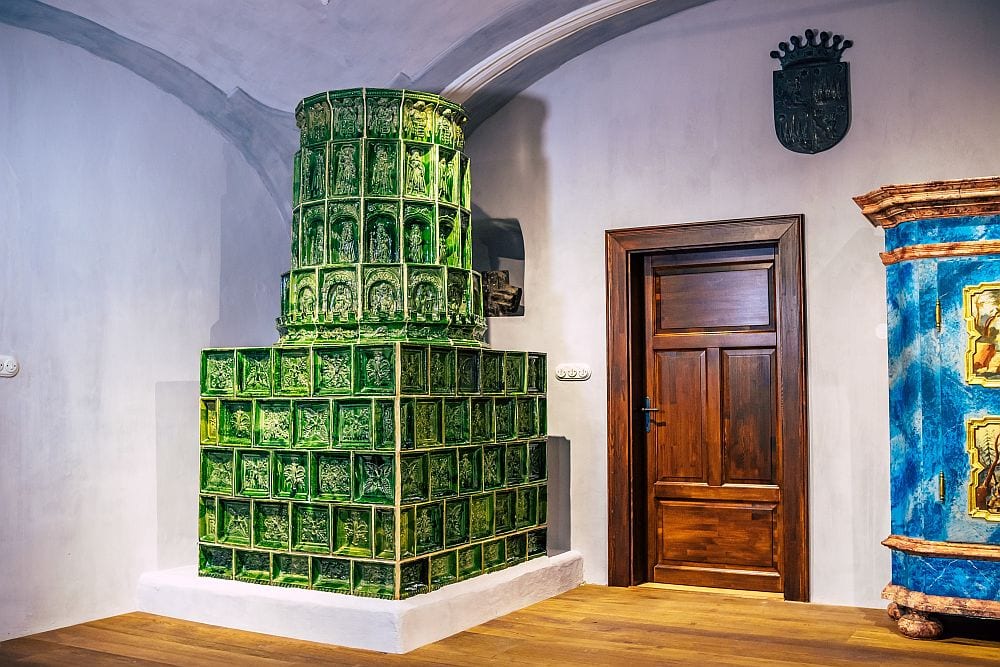
[Image above] Example of a ceramic stove in Gombasek, Slovakia. Credit: naszalyg93 / Shutterstock
It may not seem like winter is just around the corner with such unpredictable weather and unseasonably warm temperatures, but it always pays to be prepared. Now is a good time for homeowners to have their furnaces serviced and chimneys cleaned before the cold sets in for the long haul.
Although traditional open-hearth fireplaces offer some warmth to the home, most of the fire’s heat is lost immediately to the outdoors because it goes right up the chimney. Instead, European ceramic tiled stoves (kakelugn in Swedish or kachelöfen in German) offer a more efficient way to make use of the fire’s energy. With energy costs rising, these stoves are making a comeback in Europe and other countries including the United Kingdom, the United States, and Canada as well.
The ins and outs of ceramic stoves
In contrast to modern heating appliances, which typically are made of steel and quickly lose heat, ceramic stoves are made of different forms of clay that effectively trap heat.
- Interior: Bricks are used to construct a labyrinth of smoke channels and chambers within the stove. This clay core absorbs and stores the heat from the fire.
- Exterior: Glazed ceramic tiles act as both a decorative skin and additional layer of thermal mass to radiate warmth into the room.
After firing the stove for just a short time (one or two hours), the stove will continue radiating warmth for up to 12 hours on average. This radiant heat output is equivalent to an 80–90% fuel efficiency, in contrast to only 40–50% for metal stoves and a negligible 10–15% for an open-hearth fireplace. In practice, this fuel efficiency means a ceramic stove can heat a room of 60 m2 (646 ft2) using only about 1.65 cords of wood per year, which equals about one tree.
Furthermore, because ceramic stoves warm the space through radiant heat rather than convection (i.e., circulating air), they avoid the dust circulation problems experienced by modern convection systems. Additionally, they can burn wood at much higher temperatures than metal stoves, which allows all the combustible gases within the wood to be largely burned away, cutting down on the release of hydrocarbon pollutants. The stove’s surface also stays cooler than that of a metal stove, reducing the likelihood of severe contact burns dramatically.
Ceramic stove development: From the Middle Ages to today
Ceramic stoves (also known as tiled stoves) have been around for almost 1,000 years in Europe. However, major technological improvements took place in the 18th century, driven by wood scarcity that prompted governments to fund developments in several countries.
Ceramic stoves became popular in Sweden during this time, becoming the main focal point for the room as well as the primary heating source. With advances in glazing technology, tiles were often decorated to match the home’s interior. A century later, ceramic stoves became popular in other European countries.
With the development of new central heating systems fueled by coal and oil, ceramic stoves fell out of favor. Electric furnaces also hastened their demise, with many ceramic stoves being dismantled or destroyed. However, with the rising cost of energy and deployment of stricter environmental regulations in recent years, the technology is experiencing a rebirth.
Although modern ceramic stoves are still primarily fueled by wood, they can be adapted to run on gas or on both fuels. Benches and drying racks can be integrated into the design, as well as hot plates or a cooking oven. The stoves can also be connected to a boiler system for heating water. The warm water is used for showers or baths or can be distributed through the walls or the floor via hoses throughout the house to provide whole-house heating.
Besides the benefits of ceramic stoves, there are some challenges homeowners must consider before pursuing installation. For one, ceramic stoves are very heavy, with even a smaller model weighing at least 800 kilograms (1,700 lbs. or nearly one U.S. ton). Larger versions can weigh up to five metric tons (5.5 U.S. tons). Because of their weight, a slate or a stone platform must be installed and the floor must be flat. Ceramic stoves also require a flue if they cannot be connected to an existing chimney.
These considerations can add to the upfront cost of installing a ceramic stove. However, over time, the expense can be offset by the ceramic stove’s energy efficiency. The addition of a ceramic stove can also bring a unique charm to the room. As one interior designer Olivia Outred put it, a ceramic stove, “…reconnects with our more primordial instincts, inviting a closer connection. You can literally hug them.”
Further information
Ceramic stoves come in all shapes and sizes; view some antique versions at this link.
Learn more about how a ceramic stove works in both this article and this video.
Watch this video showing the operating principle of a modern Italian ceramic stove.
Learn how one manufacturer builds its ceramic stoves at this link.
Just in time for Halloween, learn about the tiled stoves in old Salem in this video.