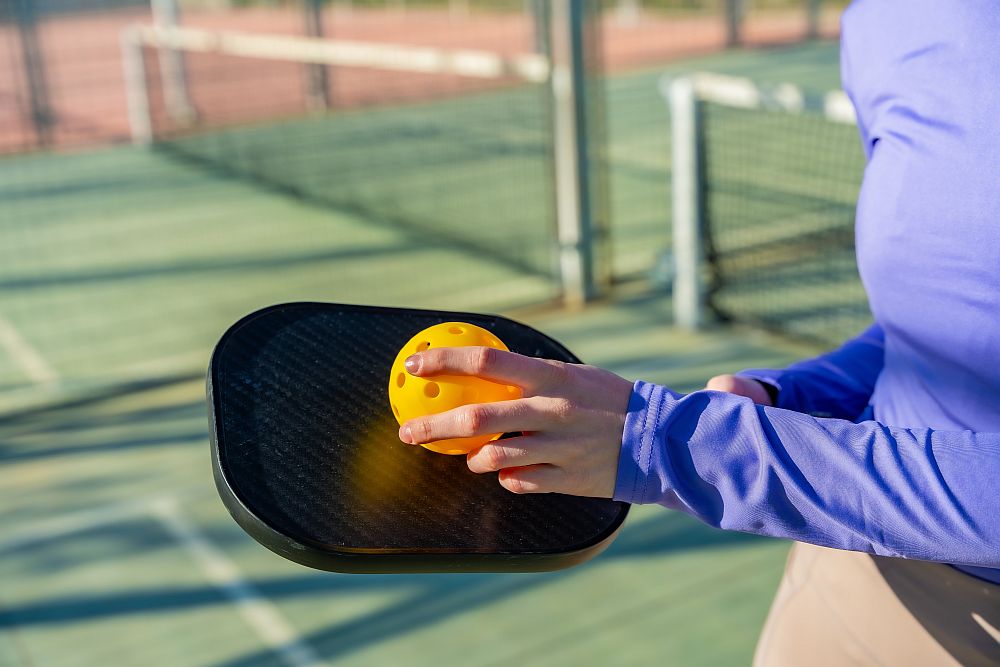
[Image above] As pickleball grows more widespread, keeping the noise level down is essential to maintaining peace in neighborhoods. Credit: Unai Huizi Photography / Shutterstock
Pickleball has become one of the fastest-growing sports in the United States in recent years, as shown by increased participation among younger generations, construction of designated pickleball facilities, and even signed athletes.
Pickleball was first invented on Bainbridge Island, Wash., in 1965 by a congressman and businessman looking to play a game their families could all join in on. When they could not find a full set of tennis rackets, the pair improvised by relying on ping-pong paddles, a plastic ball, and the rules of badminton.
By 1972, a corporation was formed for the new sport, and in 1976, the first known pickleball tournament took place in Tukwila, Wash. The sport witnessed many other milestones in the following decades, as briefly outlined in this previous CTT, and now this week the USA Pickleball National Championships is taking place Oct. 31–Nov. 8 in San Diego, Calif. (Established in 2009, it is the only pickleball tournament in which players must qualify to participate.)
For all its popularity, there is one oft-cited drawback to the sport: Pickleball tends to generate loud noise as the hard plastic balls smack against the rigid paddles. In residential areas, where new pickleball courts continue to crop up, this noise can be quite disruptive for neighbors.
Fortunately, there are material solutions that could address this nuisance, which will be revealed in today’s CTT.
Why does pickleball cause such a racket?
As a paddle-and-racket sport, pickleball is considered to eclipse tennis in the types of sound it emanates. The reason for this perception is not the raw volume of the hit, which can be about the same between the two sports, but rather the sound and impact frequency of the strike.
After the paddle strikes the hard plastic pickleball, the emitted sound sits between 1,200 and 1,250 Hz, in contrast to the less than 1,000 Hz frequencies emitted by a felt-covered rubber tennis ball. The pickleball’s sound frequency is the same range where human hearing is most sensitive, which leads us to perceive the sound as a high-pitched “pop” rather than the tennis ball’s softer “thud.”
In terms of loudness, measured in decibels, the sharp “pop” of the pickleball cuts more clearly through ambient background noise over longer distances compared to the soft “thud” of the tennis ball, which blends into the background noise much faster. For instance, the hit from a tennis ball about 100 feet away measures roughly 40 dBA while the same distance for pickleball measures between 70 and 80 dBA. (dBA uses a weighted system to mimic the sensitivity of the human ear while dB measures the raw, unweighted sound.)
In addition to frequency and loudness, pickleball matches typically involve frequent rapid-fire volleys, in contrast to fewer close-quarter encounters in tennis. This gameplay means hits in pickleball happen in a steady, high-frequency stream, which adds to the noise pollution.
For those living anywhere from 100 to 200 feet to a pickleball court, the sounds of the sport can easily cut through the typical din of a residential neighborhood. To reduce the loudness of the sport, there are two main solutions: quieter equipment or quieter courts.
Table information of different pickleball sound levels from PickleTile
| Measurement point | Approximate level | Notes |
|---|---|---|
| Impact at the paddle (source peak) | 99 to 106 dB | The crack of contact itself, measured at the source |
| About 15 feet from the court | 70 to 80 dBA | Close-range play, near courtside seating |
| About 100 feet (hard hit) | ~70 dBA | Tennis at a comparable distance is closer to 40 dBA |
| Match average over time | ~59 dBA | Includes soft shots and silences between rallies |
| Background, quiet neighborhood | 40 to 55 dBA | The level pickleball is compared against |
Cutting down the noise: Materials to decrease the decibels
In contrast to traditional wooden paddles, paddles featuring polymer honeycomb cores sandwiched between ceramic and glass composite materials are now the industry standard because they absorb the sound much better than their predecessors (hits from one polymer honeycomb paddle called the OWL measured at 600 Hz and under 80 dB). But the hard plastic nature of the balls is more difficult to mute, as changing their material can drastically change the game.
As far as the courts go, there are a handful of innovations that can help reduce the sounds of the game, including mesh windscreens, acoustic blankets or wraps, absorptive panels, or even structural glass.
In 2023, USA Pickleball introduced its Quiet Category, an equipment certification that aims to reduce the high-pitched noise of pickleball without affecting its play. The category promotes products that emit 50% less noise than a standard paddle (1,000 to 1,200 Hz). OWL paddles are approved for USA Pickleball-sanctioned events, including this week’s championship.
“With the sport’s growth, addressing noise concerns is essential to maintain a positive relationship between residential communities and facility operators. We are continuing to develop guidance and resources that offer short- and long-term solutions that continue to enhance the sport,” says Mike Nealy, USA Pickleball CEO, in a press release. “By working together with manufacturers and the entire industry, we can develop quieter options that benefit everyone.”
Understanding the ‘trampoline effect’ in sports sounds
A recent open-access study conducted by a father–son duo from West Lafayette Junior-Senior High School and Purdue University examined the “trampoline effect” from composite baseball bats and how the equipment materials can affect the sound of a hit.
The “trampoline effect” refers to how the barrel of a bat flexes inward (compresses) and then springs back outward (expels) during a collision with the ball. The authors were interested in how different bat materials would affect the scale of the trampoline effect and, subsequently, the “crack” sound when the bat hits a ball.
They used three bats in their experiment to test the pitch that emanates from the impact of the ball: a wooden bat, a composite bat, and a hollow metal bat. Each bat got five hits off a standard batting tee, and both the speed and sound were recorded. The peak loudness was recorded using an iPhone 15 Pro Max held close to the batter.
The authors reported 102–106 dB for hits from the metal bat and 91–95 dB for hits from the composite and wooden bats. They write that “The variation in decibels was influenced by ball speed, impact point, and bat design, affecting player perception.”
Although this study references single hits rather than prolonged hours of high-pitch play, the idea remains the same: the material of the equipment shapes the sound output, with composite and solid wood bats clocking in quieter than hollow metal bats.
Both baseball and pickleball players can use sound as feedback to gauge the intensity of their hit, so switching to quieter materials such as a composite bat or OWL paddle may feel unfamiliar at first, even if they have a more positive effect on bystanders.
Overall, the materials and the sounds they produce will continue to evolve as these sports seek to find a happy medium that satisfies both their players and the public.
The open-access paper, published in International Journal of Latest Technology in Engineering, Management & Applied Science, is “Superiority of composite baseball bats: Trampoline effect, acoustics, compliance and safety” (DOI: 10.51583/IJLTEMAS.2024.131219).