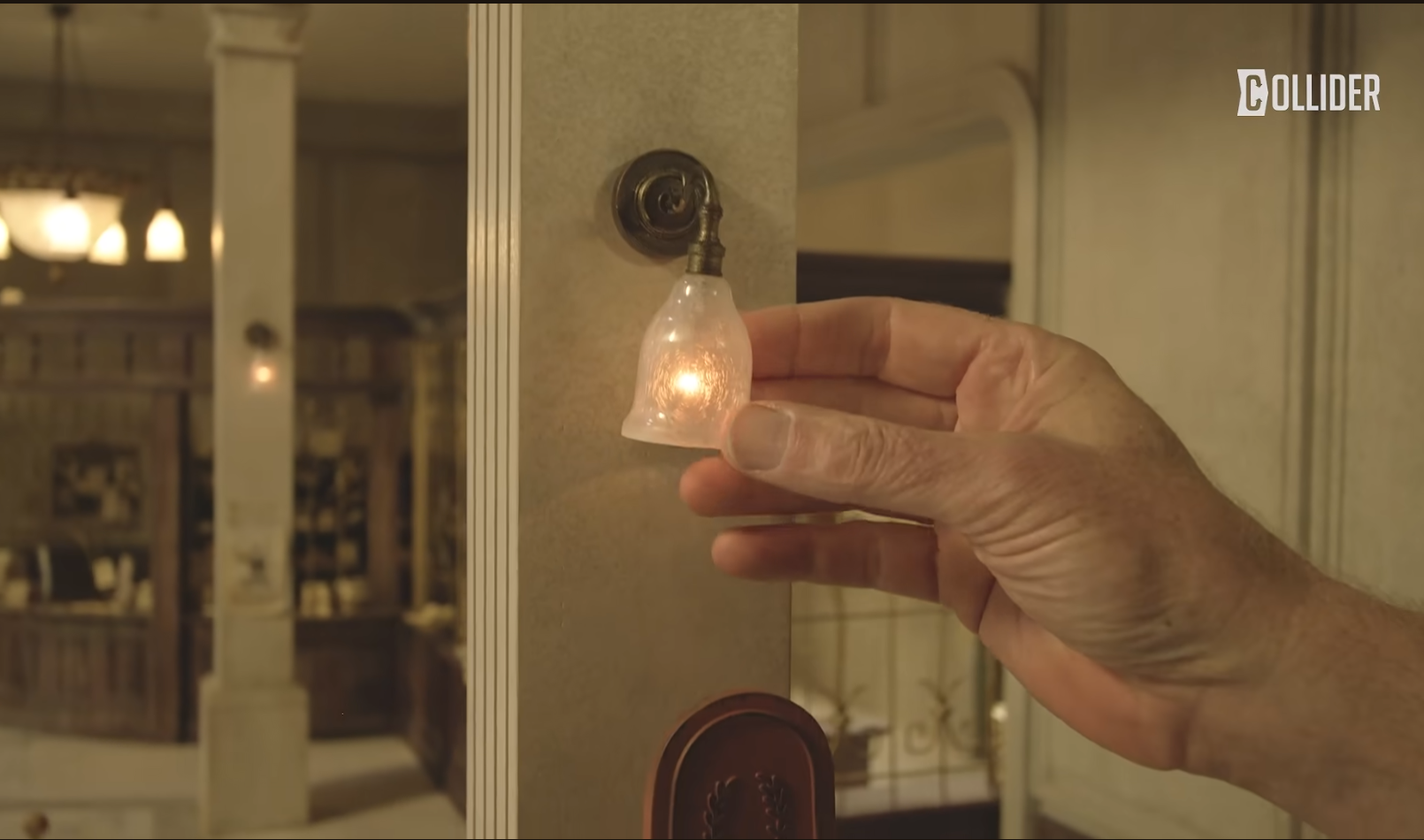
[Image above] Close-up of a 3D-printed faux glass light created for the movie “Wildwood.” Credit: Collider Behind the Scenes and Laika Studios(opens in new tab), YouTube
With the cost of movie tickets these days, I need a very good reason to make an evening trip to the cinema rather than waiting to stream it. But the release of “Wildwood(opens in new tab)” last week had me riveted in my seat until nearly midnight to see the first new movie by Laika Studios in seven years.
Laika Studios(opens in new tab) is an independent animation studio based just outside Portland, Ore. The studio has a rather complicated history(opens in new tab), originally established by famous clay animation producer Will Vinton in 1975 before a messy restructuring in the early 2000s, but it remains a leader in producing full-length stop-motion films.
Stop-motion animation(opens in new tab) is an animation technique based on the manipulation of physical objects rather than computer rendering. Photos are taken of the object after each little adjustment, and compiling all the photos gives the illusion of the object moving by itself. (In the case of “Wildwood,” the 2-hour and 12-minute movie consists of more than 190,000 individual frames.)
When Vinton first established the studio, the objects being manipulated consisted mainly of wire frames wrapped in modeling clay. Now, however, Laika animators typically use molded silicone to form the flexible outer skin of characters because it offers greater consistency over long production shoots.
Besides the characters themselves, the settings for Laika Studios films have grown increasingly more elaborate over the last two decades. While early films such as the famous dark fantasy “Coraline(opens in new tab)” (2009) relied heavily on intimate, localized environments, the “Wildwood” production design team built 136 unique practical sets spread across 52 different soundstages.
(The idea for “Wildwood,” which is based on a book(opens in new tab) of the same name, was 16 years in development as the studio waited for production techniques and technologies to progress(opens in new tab) that could realize their vision.)
To create such large, elaborate settings for the movie, the “Wildwood” team used a breathtaking spread of various handcrafted materials to imbue the movie’s world with authenticity. Included in this spread is a mix of 3D-printed faux glass and genuine hand-blown glass, which were used for lighting inside the massive, miniature three-story Pittock Mansion.
Pittock Mansion(opens in new tab) is an actual destination in Portland, built in 1914 as a private home for London-born Oregonian publisher Henry Pittock and his wife. The “Wildwood” team decided to use this landmark in the movie because it serves “as a central hub bridging the known and unknown worlds,” they explain on the Laika website(opens in new tab), as the movie takes place in a fictional Impassable Wilderness on the edge of the city.
In a video(opens in new tab) by Collider Behind the Scenes and Laika Studios, “Wildwood” production designer Nelson Lowry talks about how each piece of real and faux glass was produced in-house so that “the bulb inside is going to show through just to the right amount.” Just in the mansion’s foyer alone, he estimates there are about 70 light fixtures so the lighting is adequate to “make it feel like a large space.”
Interestingly, the glass windows in the real Pittock Mansion were made by the famous Povey Brothers Studio, known as the “Tiffany of the Northwest.” Learn more about this Portland-based studio, which was active from 1888 to 1928, in this article(opens in new tab).
Watch the full video below to learn more about the work that went into making the incredible “Wildwood” sets. And potentially see the sets for yourself on the big screen this weekend—I highly recommend the experience!