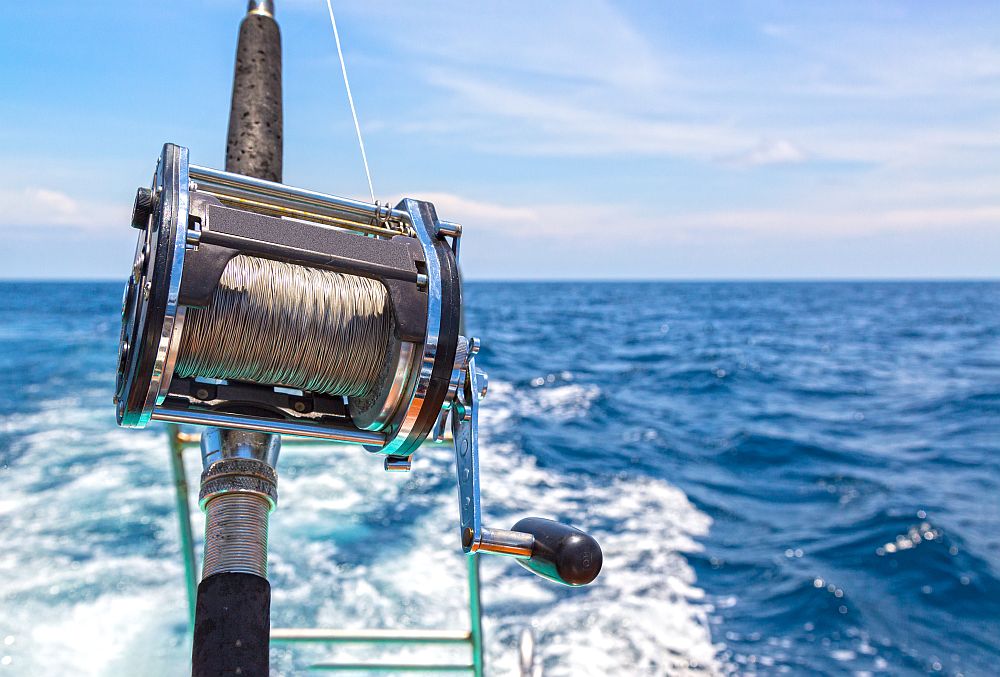
[Image above] Advancements in fishing rod design may unintentionally benefit other fields, such as the design of rescue robots for natural disaster response. Credit: Phuketian.S(opens in new tab) / Shutterstock
Each October, the marina at Cabo San Lucas, Mexico, transforms into the “Super Bowl of Fishing,” otherwise known as Bob Bisbee’s Black and Blue Marlin Tournament(opens in new tab). Throughout its 45-year history, this fishing tournament has made a name for itself as one of the richest sports competitions, with competitors regularly taking home more prize money than many professional athletes earn in a year(opens in new tab).
The 2026 tournament is being held this week, with the three official days of fishing happening Oct. 21–23. The marlins being reeled in must weigh at least 300 pounds to qualify, which means the rods used in the tournament must be able to support such a grand weight. Fortunately, ceramic and glass materials have made modern rods up to the challenge, and their design can unexpectedly benefit other industries as well—including natural disaster response.
Fishing rod basics
Although there are a variety of fishing rod designs based on fishing style(opens in new tab), fish type, or personal preference, all fishing rods are made up of a few basic parts(opens in new tab), from bottom to top: the butt, handle, blank (or shaft), and tip.
The blank is the core of the rod, and it must be flexible and durable to withstand the pull and movement of the fish. Blanks can be made of fiberglass, graphite, or composite materials depending on if the rod is fast-action, high-power, or made for movement sensitivity, respectively.
The tip is the thinnest part of the blank, and it is the farthest away from the angler holding the rod. Hard tips are less flexible but better suited for deep sea fishing while soft tips bend more to help catch lighter fish.
The butt is the thickest part of the blank, and the longer it is, the more leverage the angler receives. Finally, the handle provides comfort and durability in the hands of the angler.
The evolution of fishing rod materials
Throughout the last few decades, fishing rod design has evolved significantly to fit the changing needs of anglers. By the 1970s(opens in new tab), fiberglass had overtaken split-cane bamboo as the preferred material for rods due to their increased durability and lower manufacturing costs. However, the original fiberglass rods were solid, which made handling the heavy rod unwieldy.
Hollow fiberglass rods are much lighter, and when wooden butts are swapped out with synthetic rubber, these rods become even lighter still. Another key property of hollow fiberglass rods is how much they can bend, which can be useful when hooking heavy marlin(opens in new tab) in the Bisbee’s tournament but makes them less effective in fishing styles that rely on light taps or subtle nibbles(opens in new tab).
Ceramic line guides(opens in new tab) were also introduced in the 1970s. These looped guides, which are also known as the “eyes” of the rod, helped reduce friction and the potential for snaring along the line compared to steel guides.
The next wave in rod evolution came with graphite, which initially faced some skepticism(opens in new tab) in fishing communities due to the early versions being prone to shattering. Although modern versions are not free from brittle failure, their durability is greatly improved. Furthermore, their reduced flexibility compared to fiberglass rods gives them greater sensitivity to small tugs as well as a quicker recovery time. These characteristics(opens in new tab) are advantageous for bottom-contact and single-hook fishing styles.
Besides the fishing rod itself, the reels attached to the rod have also evolved with new technology, including hybrid and ceramic bearings(opens in new tab). Hybrid bearings contain both ceramic parts and steel, while fully ceramic bearings are made up of zirconium oxide or silicon nitride.
In fishing competitions such as Bisbee’s, fully ceramic bearings allow the angler to cast out farther distances, which can be extremely beneficial. Both hybrid and ceramic bearings can also enable smoother retrieval as the anglers reel in, and they both offer the advantages of corrosion resistance, longer lifespans, and reduced maintenance.
As casting technology in the fishing world evolves, it has also started to inspire other areas of research, such as robotics.
Fly-fishing mechanisms inspire rescue robots
In the wake of natural disasters such as earthquakes or wildfires, rescue robots can play a key role in disaster response(opens in new tab), from locating trapped people to detecting carbon dioxide in the air. By deploying rescue robots to the site first, they can help protect human first responders from hazardous conditions.
Researchers from Ritsumeikan University in Shiga, Japan, and the Institute of Science Tokyo used fly-fish casting as inspiration to design rescue robot arms. The goal is to create lighter robots that can reach objects in the far distance while maneuvering in a straight line, which is where the mechanics of fishing rods come into play.
Typical fishing rods, like the trolling rods used in the Bisbee’s tournament, rely on a lure or sinker to pull the line outward with inertia. In fly-fishing, however, the line relies on the elasticity of the rod and its own mass to cover the distance.
The researchers created a computer simulation of a model robot arm holding a flexible rod. The arm had three degrees of freedom—shoulder, elbow, and wrist—and each part of the arm joint had a motor. A single controller determined the force each motor should apply by calculating the force of all three motors together, with the goal that the rod would mimic the movement of fly fishing while keeping the tip in a straight line.
One problem the researchers ran into was twitchiness of the commands from the controller, so they compared four versions of it in MATLAB to solve the problem.
- Method A, the proportional-derivative control, focused on the arm simply swinging toward the reference point. It found that the arm moved forward smoothly, but the tip line was not straight.
- Method B focused on keeping the rod tip on the straight reference path (SRP) but not on the elasticity of the rod. It provided a straight-line path, but the rod twisted into an S-shape rather than the desired curved bow shape.
- Method C yielded promising results because it focused on both the SRP and the rod’s elasticity. The rod bent and straightened correctly, but the arm also moved backward, wasting energy to complete the movement.
- Combining all these elements in Method D demonstrated the correct curvature , with a nearly straight tip SRP and smoother force in the arm.
“In future work, we will analyze the stability of the control method proposed in this study, investigate model reduction considering input–output relationships, and verify the effectiveness of the proposed control method through physical experiments using the prototype manipulator,” the researchers write.
Although disaster response is probably the farthest thing from the minds of the Bisbee’s competitors in Cabo San Lucas this week, the advancements made in pursuit of hooking the biggest fish may unintentionally provide rich benefits to first responders around the world.
The open-access paper, published in Advanced Robotics, is “Control of elastic rod tip for fly-casting using single-mode model and integration of output-zeroing control with PD control(opens in new tab)” (DOI: 10.1080/01691864.2026.2706982).